


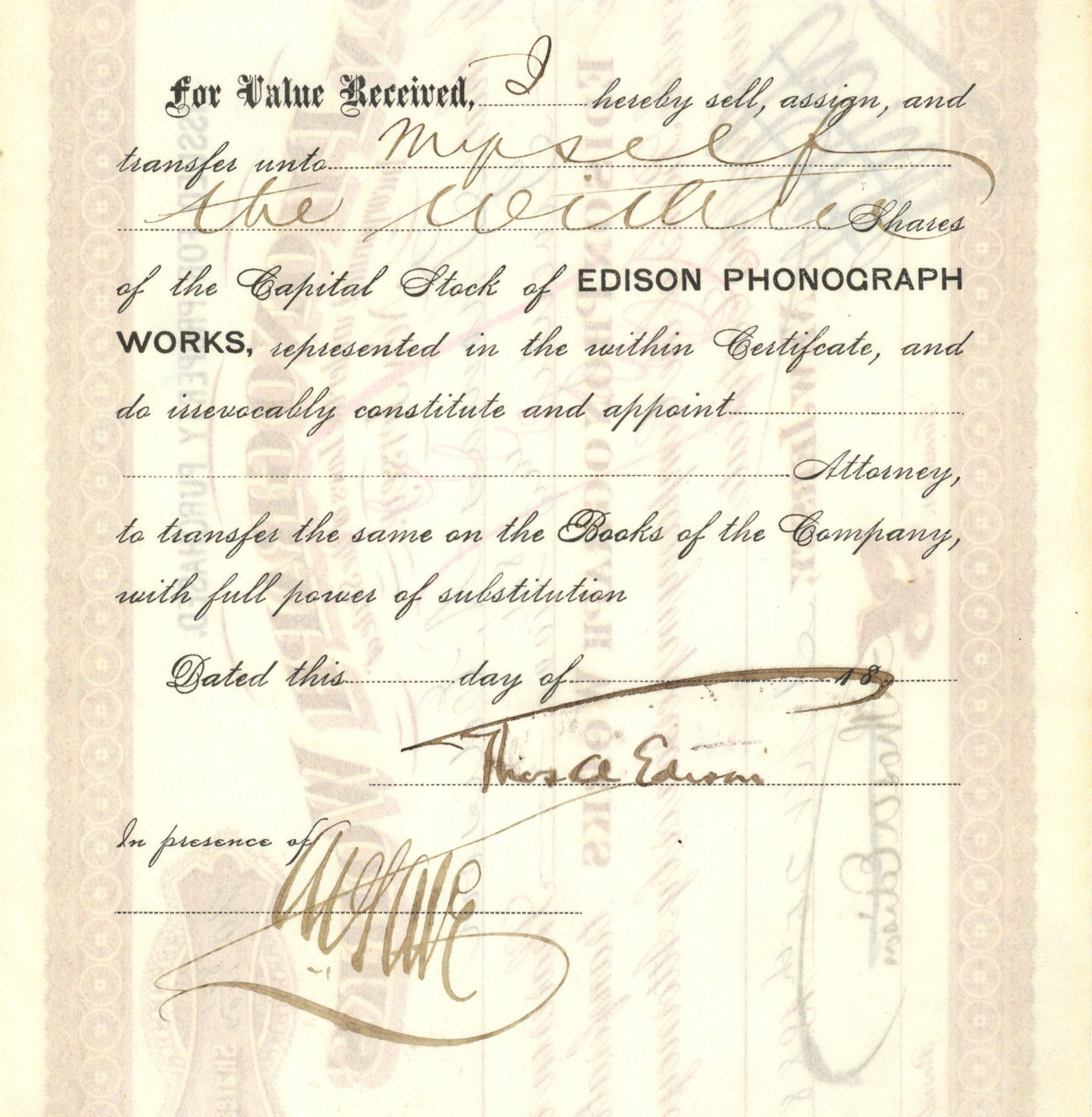
Double signed Thomas A. Edison on the Edison Phonograph Works - dated 1888 Autograph Stock Certificate - Signed Once at Front and Once at Back
Inv# AG1017 Stock

Thomas Alva Edison, renowned as the greatest inventor in history, achieved remarkable success despite his limited formal education. At the tender age of nine, he was home-schooled by his mother, who gifted him a chemistry book, sparking his passion for chemistry and experimentation. As a youth, he honed his skills by selling newspapers and snacks on the Grand Trunk Railway, often conducting chemical experiments during his train rides.
In 1868, Edison embarked on a career as a telegrapher in Boston, where he patented his first invention, an electrographic vote recorder, in 1869. His brilliance extended to developing an improved stock ticker, a telegraph device that reported gold prices to brokers’ offices.
In 1876, Edison relocated his laboratory to Menlo Park, New Jersey, where he continued his groundbreaking work. In 1879, he made the incandescent lamp commercially viable, though he didn’t invent it himself. Among his other notable inventions were the kinetoscope, ore-mill machinery, the storage battery, and the dictating machine. However, his greatest single achievement from a perspective of inventive imagination was the phonograph.
In 1888, Edison founded the Edison Phonograph Works. A remarkable example of his exceptional work is a New Jersey stock dated 1888 signed at the front with an ink cancellation line and beautifully signed at the back. This exceptional document is a rare and valuable piece of history. For more information, visit https://en.wikipedia.org/wiki/Thomas_Edison.
Edison Records, one of the pioneering record labels in the early recording industry, played a significant role in the development of sound recording and reproduction. In 1888, Edison manufactured the first phonograph cylinders, and later that year, he founded the Edison Phonograph Company. From 1896 onwards, Edison’s National Phonograph Company produced recorded wax cylinders, later replaced by Blue Amberol cylinders and vertical-cut Diamond Discs. The company underwent reorganization in 1911 and became Thomas A. Edison, Inc.
However, Edison’s company faced challenges in the 1920s, both technically and in terms of artist popularity. This led to a decline in its performance, and in 1929, production of recordings was halted.
Thomas A. Edison’s invention of the phonograph in 1877 marked a turning point in sound recording and playback. After patenting the invention and enjoying widespread publicity and acclaim, Edison and his laboratory shifted their focus to the commercial development of electric lighting. This marked a nearly a decade-long hiatus in the phonograph’s development.
Edison’s original phonograph, which recorded on sheets of tinfoil, was a crude curiosity that captivated the public. However, it lacked practical use and public interest soon waned. These early phonographs were primarily sold to entrepreneurs who traveled the country, giving “educational” lectures in rented halls or demonstrating the device to audiences for a fee.
A stock certificate is issued by businesses, usually companies. A stock is part of the permanent finance of a business. Normally, they are never repaid, and the investor can recover his/her money only by selling to another investor. Most stocks, or also called shares, earn dividends, at the business's discretion, depending on how well it has traded. A stockholder or shareholder is a part-owner of the business that issued the stock certificates.




Ebay ID: labarre_galleries