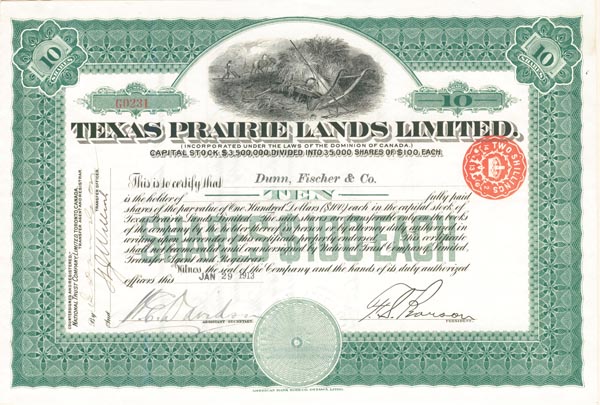
Texas Prairie Lands Limited - 1913 dated Texan and Canadian Land Stock Certificate - Canada
Inv# TX1012 StockStock printed by American Bank Note Co., Ottawa, Canada.
Texas Prairie Lands, Limited, a corporate entity established under the corporate laws of the Dominion of Canada, played a pivotal role in an ambitious early-20th-century agricultural expansion scheme. Initially chartered as the Texas Northern Land and Irrigation Company, it officially adopted the name Texas Prairie Lands, Limited on August 30, 1912, with the formal approval of the secretary of state of Ontario. The visionary engineer Dr. Fred Stark Pearson conceptualized and spearheaded this enterprise, aiming to capitalize on the burgeoning regional farming boom. With a substantial capitalization of $3.5 million, the corporation’s primary objective was to acquire, irrigate, develop, and subsequently resell vast tracts of agrarian property in the Texas Panhandle. By leveraging a Canadian legal structure, Pearson and his international associates effectively limited their personal liability while striving to generate substantial corporate profits through the wholesale transformation of Texas pastureland into highly lucrative, ready-to-operate farms.
The company’s operational focus was primarily on acquiring 60,000 acres of land near Plainview, Texas, strategically positioned to benefit from advanced irrigation techniques. To finance its ambitious land development goals, the enterprise issued a comprehensive bond series to the London-based banking and investment firm Dunn, Fisher and Company. This arrangement facilitated the direct infusion of British capital into the project through installment payments. Despite the impressive financial engineering and the establishment of demonstration farms to entice prospective settlers, the venture encountered a sudden and catastrophic downfall. Between 1913 and 1914, the company rapidly declined due to severe regional droughts, logistical challenges, and the abrupt disruption of international capital markets triggered by the outbreak of World War I. The financial collapse ultimately led to a corporate reorganization, leaving behind a legacy primarily preserved through surviving historic stock certificates bearing Pearson’s printed signatures.
A stock certificate is issued by businesses, usually companies. A stock is part of the permanent finance of a business. Normally, they are never repaid, and the investor can recover his/her money only by selling to another investor. Most stocks, or also called shares, earn dividends, at the business's discretion, depending on how well it has traded. A stockholder or shareholder is a part-owner of the business that issued the stock certificates.


Ebay ID: labarre_galleries