


State of Connecticut Line Note signed by William Whipple - Dated 1780 - American Revolutionary War
Inv# CT1058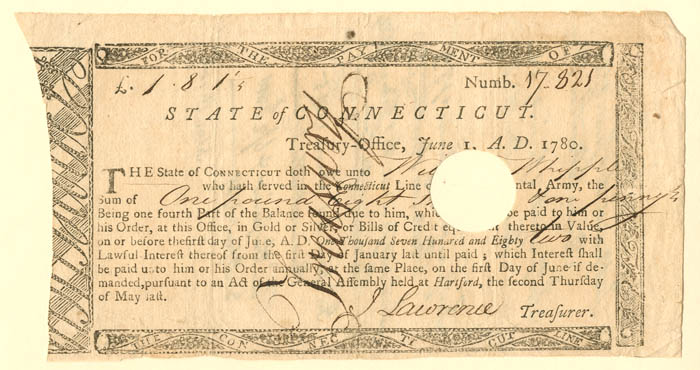
Connecticut Line Note signed by William Whipple (not the NH signer). Maybe a relative?
William Whipple Jr., born in Kittery, Maine, in 1730, was an American merchant, military leader, and Founding Father. He represented New Hampshire in the Continental Congress and signed the Declaration of Independence.
Whipple’s early years were spent as a ship’s captain, amassing a fortune through the triangular trade. He later settled in Portsmouth to establish a mercantile business with his brother. As the Revolutionary War approached, Whipple dedicated himself to the patriot cause, serving on the Committee of Safety and helping New Hampshire establish the first independent state government in 1776.
Beyond his political contributions in Philadelphia, Whipple served as a Brigadier General in the state militia. He led troops to a decisive victory at the Battle of Saratoga and later participated in the 1778 Rhode Island campaign, where he was wounded in the leg.
Whipple’s legacy is also defined by his evolving views on liberty and his relationship with Prince Whipple, an enslaved man who served as his military aide. Legend holds that when William asked Prince to fight for freedom, Prince challenged him, noting that he had no liberty of his own to defend. Whipple reportedly promised him manumission, which was finalized in February 1784.
After the war, Whipple continued his public service as a state legislator and an Associate Justice of the New Hampshire Superior Court. Despite a worsening heart condition, he remained dedicated to his duties, often fainting from his horse while traveling his court circuit. He passed away in November 1785 at the age of 55. Whipple is buried in the North Cemetery in Portsmouth, where a plaque on “Signers’ Walk” commemorates his historical role.
The Connecticut Line was a formation within the Continental Army. The term “Connecticut Line” referred to the quota of numbered infantry regiments assigned to Connecticut by the Continental Congress at various times. The size of this allocation was determined by Connecticut’s population compared to other states. These regiments, along with similarly apportioned contingents from the other twelve states, formed the Continental Line. This concept was particularly crucial in promoting commissioned officers. Officers below the rank of brigadier general were usually ineligible for promotion except in their own state.
During the war, 27 infantry regiments were assigned to the Connecticut Line. This included the eight provincial regiments from 1775, Wooster’s Provisional Regiment (formed by consolidating the remnants of the original 1st, 4th, and 5th Regiments), the five numbered Continental regiments from 1776, the eight Connecticut regiments from 1777, S.B. Webb’s Additional Continental Regiment (which later became the 9th Connecticut Regiment), and four new regiments created by consolidation in 1781.




Ebay ID: labarre_galleries