


New York Railways - 1912 dated Railroad Gold Bond (Uncanceled)
Inv# RB5220 Bond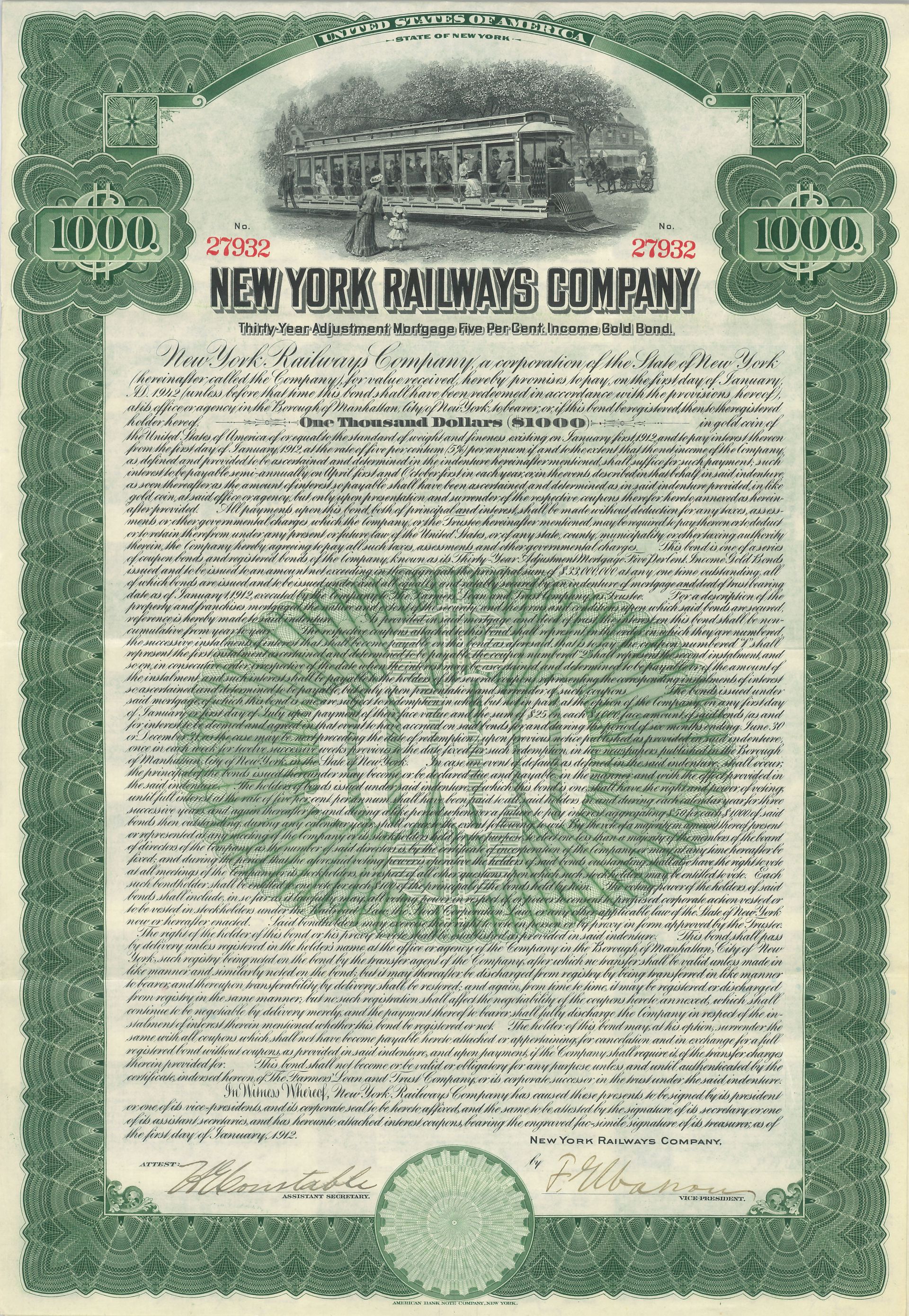
$1,000 5% Gold Bond. Uncanceled. Attractive vignette by American Bank Note Co. Numerous coupons. Excellent Condition. Rare!
The New York Railways Company operated street railways in Manhattan, New York City, from 1911 to 1925. In 1919, the company went into receivership, and control was transferred to the New York Railways Corporation in 1925. Afterward, all of its remaining lines were replaced with bus routes.
The first streetcars in Manhattan were horse cars operated by the New York and Harlem Railroad, which began service on Bowery on November 26, 1832. By the end of 1865, Manhattan had eleven north-south lines on most major avenues and several crosstown lines, operated by twelve companies. This number increased to approximately twenty companies by 1886, with only two leases in effect at that time: the One Hundred and Twenty-fifth Street Railroad to the Third Avenue Railroad (1870) and the Bleecker Street and Fulton Ferry Railroad to the Twenty-third Street Railway (1876).
In February 1886, a group of Philadelphia businessmen, including Peter A. B. Widener, Thomas Dolan, and William L. Elkins, incorporated the Metropolitan Traction Company in New Jersey. This holding company immediately began acquiring Manhattan street railways. They started by purchasing the Broadway and Seventh Avenue Railroad, the Houston, West Street, and Pavonia Ferry Railroad, and the Chambers Street and Grand Street Ferry Railroad in June 1886, forming a system of three north-south and two crosstown lines. In January 1889, the South Ferry Railroad was added to this system, followed by the Twenty-third Street Railway in March 1890, the Broadway Railway in October 1890, and the Metropolitan Cross-Town Railway in March 1891.
A bond is a document of title for a loan. Bonds are issued, not only by businesses, but also by national, state or city governments, or other public bodies, or sometimes by individuals. Bonds are a loan to the company or other body. They are normally repayable within a stated period of time. Bonds earn interest at a fixed rate, which must usually be paid by the undertaking regardless of its financial results. A bondholder is a creditor of the undertaking.




Ebay ID: labarre_galleries