


 Mexican Gulf Hotel Co. - circa 1880's Mississippi Unissued Stock Certificate - Pass Christian, Mississippi
Inv# HT1028
Stock
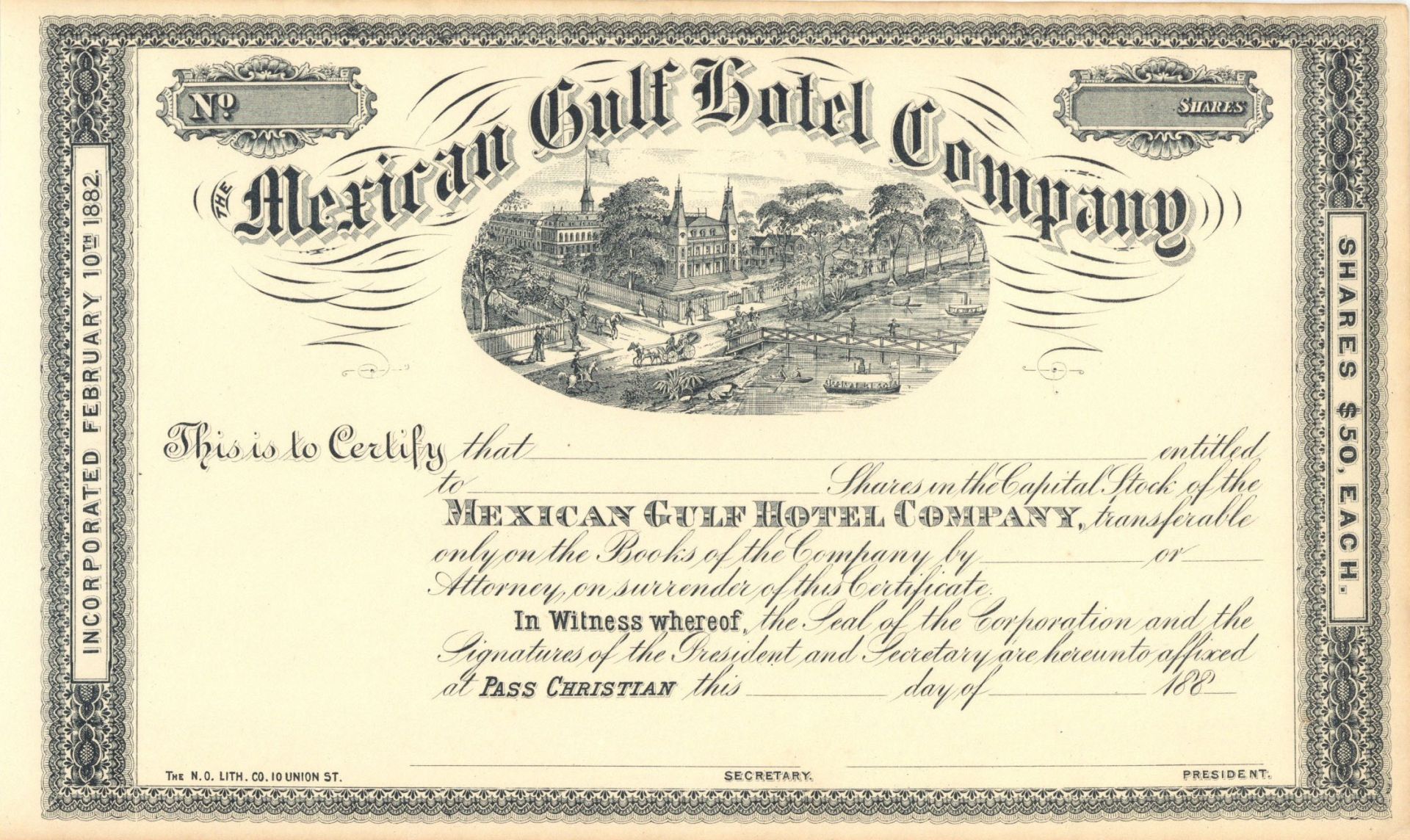
Unissued Stock printed by N.O. Lith. Co. Incorporated February 10, 1882.
The Mexican Gulf Hotel Company played a pivotal role in transforming the Mississippi Gulf Coast into a premier resort destination during the late 19th and early 20th centuries. Formed by visionary investors, the company capitalized on the region’s natural beauty and the expanding railway networks connecting the Deep South to major northern cities. Their flagship project, the Mexican Gulf Hotel in Pass Christian, Mississippi, opened its doors in 1883. This grand Victorian-style structure boasted sprawling galleries, over 100 guest rooms, and state-of-the-art amenities for its time, quickly becoming a symbol of Southern hospitality and a favored destination for the American elite, including wealthy families from New Orleans and Chicago.
Throughout its operation, the company adapted to the evolving hospitality industry, transitioning from the era of “Grand Hotels” to the more modernized tourism of the early 1900s. The hotel served as a seasonal escape and a cultural hub for social events, regattas, and high-society weddings. However, the company faced significant challenges, including the recurring threat of hurricanes and the economic hardships of the Great Depression. In 1917, the original grand structure was tragically destroyed by fire, a common fate for wooden seaside resorts of that era. While the specific company eventually faded from the industry’s forefront, its legacy endures as a foundational chapter in the history of Gulf Coast tourism, marking the moment the region transformed from a collection of fishing villages into a sophisticated “Riviera of the South.”
Pass Christian, Mississippi, was established in 1699 by French-Canadian explorers under Pierre Le Moyne d’Iberville. Its name is derived from Nicholas Christian L’Adnier, the first person to navigate the deep-water pass between the mainland and Cat Island. After the Louisiana Purchase, the town transformed rapidly from a quiet coastal outpost into a premier destination for the Southern elite. By the mid-19th century, it earned the nickname “Newport of the South,” attracting wealthy plantation owners from New Orleans and the Delta seeking respite from the summer heat and yellow fever outbreaks. This era witnessed the construction of the town’s iconic scenic drive, lined with majestic live oaks and grand antebellum mansions overlooking the Mississippi Sound.
Pass Christian’s history is also marked by its resilience in the face of nature’s fury. Throughout the 20th and 21st centuries, the town was devastated by two of the most powerful storms in American history: Hurricane Camille in 1969 and Hurricane Katrina in 2005. Katrina, in particular, wreaked havoc, destroying approximately 80% of the town’s structures, including many of its historic landmarks. Despite these catastrophic setbacks, the community has demonstrated remarkable resilience, consistently rebuilding and maintaining its reputation as a hub for the seafood industry and oyster harvesting. Today, Pass Christian stands as a harmonious blend of historic charm and modern recovery, preserving its unique identity as a refined yet rugged coastal enclave.
A stock certificate is issued by businesses, usually companies. A stock is part of the permanent finance of a business. Normally, they are never repaid, and the investor can recover his/her money only by selling to another investor. Most stocks, or also called shares, earn dividends, at the business's discretion, depending on how well it has traded. A stockholder or shareholder is a part-owner of the business that issued the stock certificates.




Ebay ID: labarre_galleries