

Farmers Union Exchange - 1920 dated Des Moines, Iowa Stock Certificate
Inv# AR1123 Stock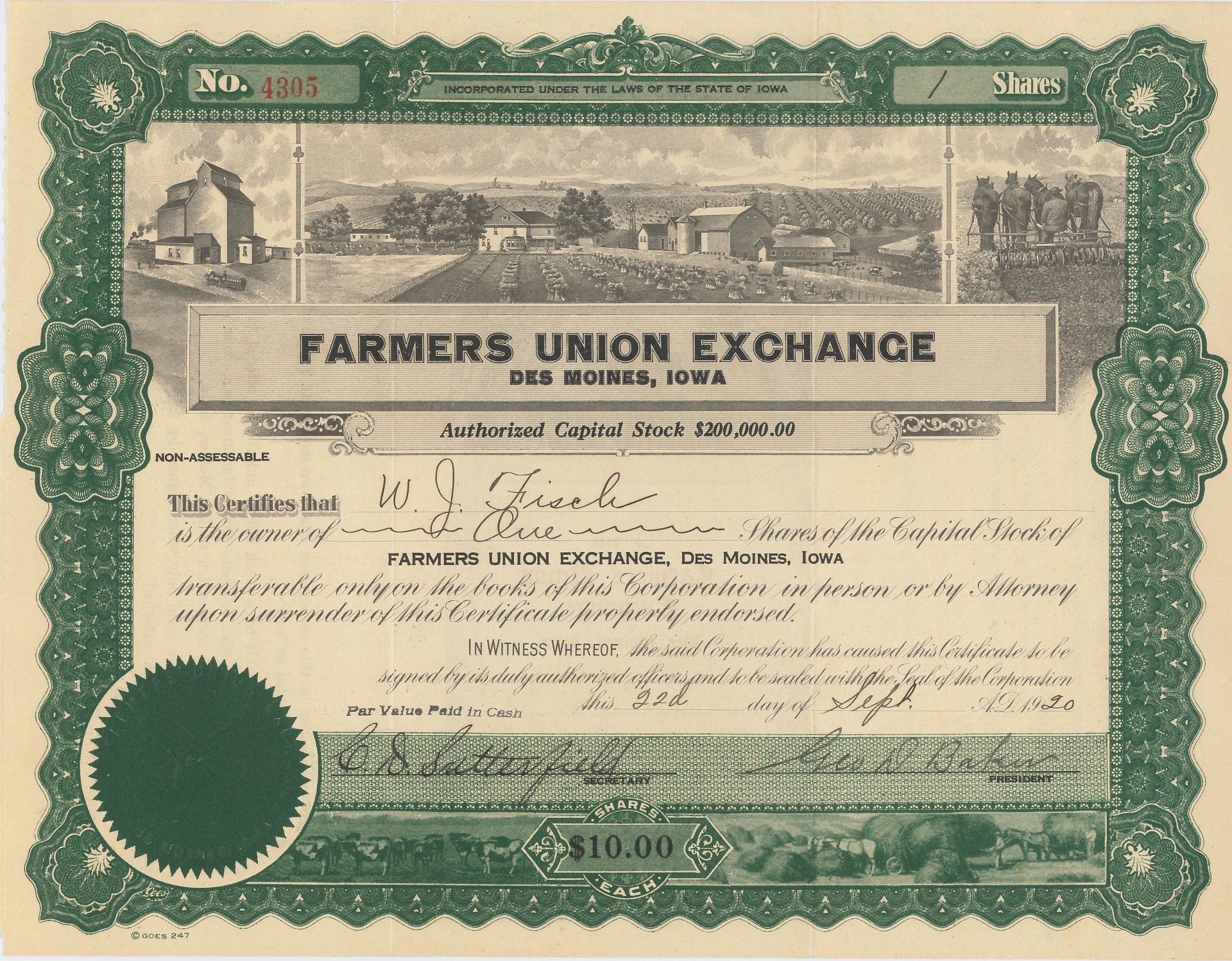
Stock printed by Goes. Des Moines, Iowa.
The Farmers Union Exchange of Des Moines, often linked to the early development of the Iowa Farmers Union, traces its origins to the broader cooperative movement that swept through the state in the early 20th century. Established after the first local Farmers Union in Iowa was chartered in 1915, these exchanges were designed to create a competitive marketplace for family farmers by bypassing traditional middlemen. By 1917, the state organization was officially granted a charter to use the name “Iowa Farmers Union,” paving the way for a network of cooperatives and exchanges that facilitated the collective purchasing of supplies and the marketing of livestock, grain, and produce. This era was characterized by rapid expansion as hundreds of local and county unions formed across the state to safeguard independent farmers from the economic pressures of the time.
During the 1920s and 1930s, the Farmers Union Exchange and its affiliated branches emerged as crucial hubs for agrarian activism and economic survival in Des Moines and throughout Iowa. Leaders like Milo Reno leveraged the union’s organizational infrastructure to launch radical protest movements, such as the Farmers’ Holiday Association in 1932, which encouraged farmers to withhold their products from the market to protest depressed prices. Despite internal divisions—where conservatives focused on cooperative marketing and radicals demanded legislative “cost of production” guarantees—the exchange model remained a cornerstone of the community. While some early entities faced legal challenges or evolved into larger regional cooperatives like the Farmers Union Central Exchange (later Cenex), the legacy of the Des Moines-based movement endures through the modern Iowa Farmers Union, which continues to advocate for sustainable production and grassroots member policy.
A stock certificate is issued by businesses, usually companies. A stock is part of the permanent finance of a business. Normally, they are never repaid, and the investor can recover his/her money only by selling to another investor. Most stocks, or also called shares, earn dividends, at the business's discretion, depending on how well it has traded. A stockholder or shareholder is a part-owner of the business that issued the stock certificates.




Ebay ID: labarre_galleries