


Document signed by Nicholas Biddle - 1837 dated Autograph - Famous Biddle Family
Inv# AU1664 Autograph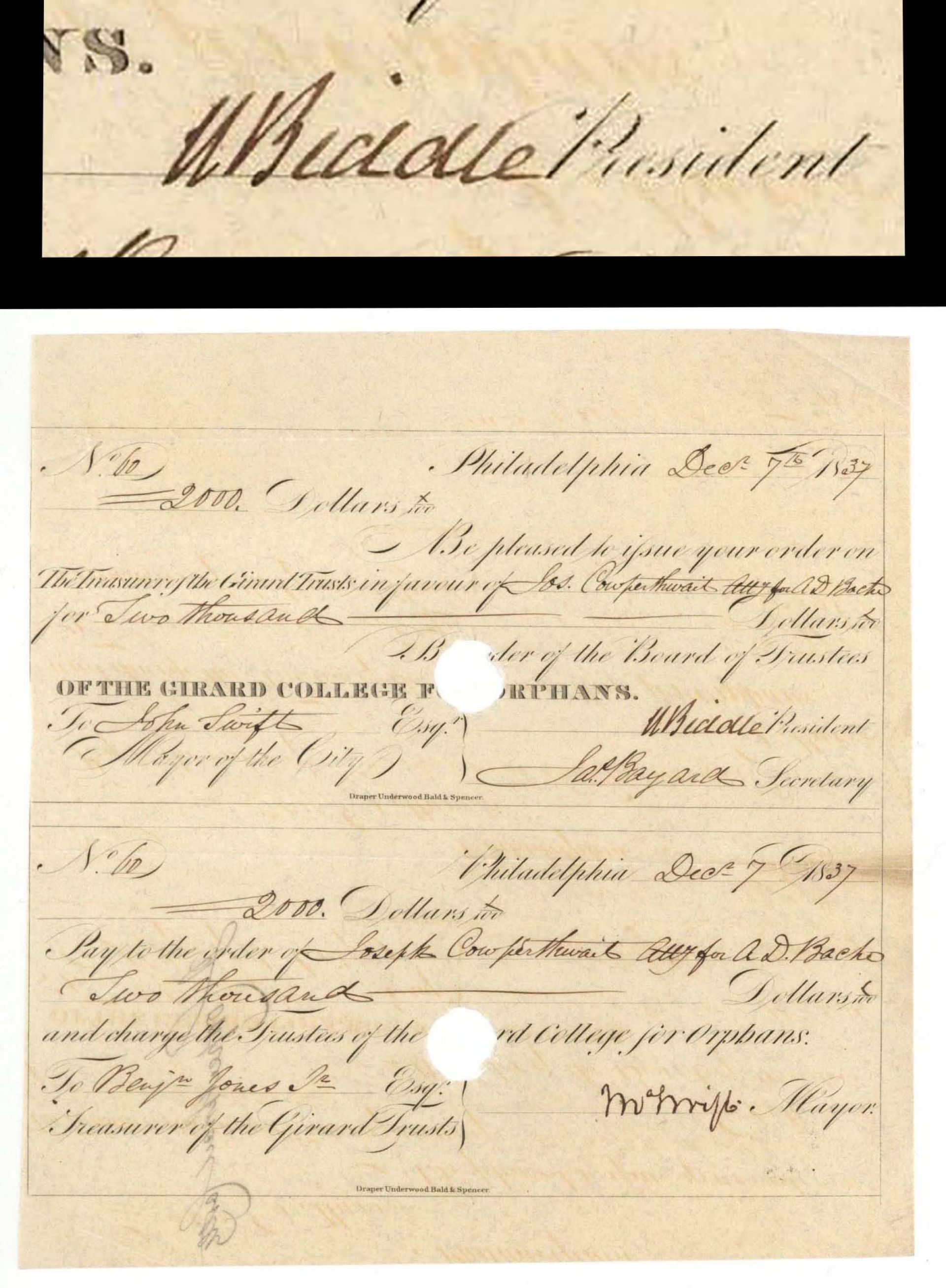
Pay receipt for the Girard College signed by Nicholas Biddle. Rare!
Girard College, established in Philadelphia in 1831 through the will of Stephen Girard, a French immigrant and then America’s wealthiest man, was founded with a substantial $2 million endowment. Girard’s bequest aimed to construct and operate a residential school dedicated to educating “poor, white, male, orphans.” At the time, Pennsylvania law legally defined an orphan as a fatherless child, so the school primarily served vulnerable young boys whose mothers lacked the resources to support them. Designed by architect Thomas U. Walter and featuring the iconic Greek Revival monument, Founder’s Hall, the school officially opened its doors on January 1, 1848. Girard envisioned the institution to bypass a traditional classical curriculum in favor of practical, real-world skills, preparing students for trades, commerce, and mechanical occupations.
For over a century, the boarding school strictly enforced its whites-only mandate behind its renowned ten-foot stone walls. However, as the surrounding neighborhood of North Philadelphia transformed into a predominantly African American community, this strict exclusion became a focal point for national civil rights battles. In 1965, the local NAACP, led by president Cecil B. Moore, launched a historic and relentless seven-month protest campaign outside the school gates. This significant public pressure campaign, coupled with a series of aggressive legal challenges, ultimately resulted in a landmark 1968 U.S. Supreme Court ruling that permanently desegregated the school. Following this victory, the first African American male students were admitted in 1968, and the institution later expanded to welcome female students in 1983. Today, the modern institution continues to honor Girard’s legacy by utilizing his endowment to provide full, five-day academic boarding scholarships to low-income students from single-parent households.
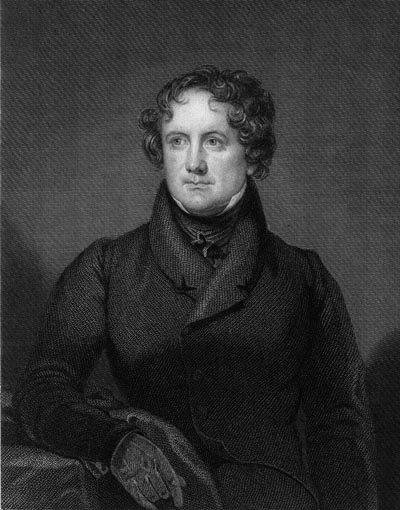
Nicholas Biddle (1786-1844), an American financier, was born and passed away in Philadelphia, Pennsylvania. The Biddle family’s ancestors immigrated to Pennsylvania alongside William Penn and played a significant role in the pre-Revolutionary colonial struggles. During the American Revolution, Charles, Nicholas’s father, demonstrated unwavering dedication to the cause, while his uncle, Nicholas Biddle, emerged as an early naval hero. Another uncle, Edward Biddle, served as a member of the Congress of 1774. Biddle received a well-rounded education and graduated from Princeton University in 1801 as valedictorian.
Before completing his law studies, Biddle was offered an official position. He served as the secretary to John Armstrong, the United States minister to France, and traveled abroad in 1804. During his time in Paris, he witnessed Napoleon’s coronation and later participated in an audit related to the Louisiana Purchase, gaining valuable experience in financial matters.
Biddle’s extensive travels took him across Europe, and he eventually returned to England to serve as the secretary for James Monroe, who was then the United States minister to the Court of St. James. In Cambridge, Biddle engaged in a conversation with Cambridge professors, comparing the modern Greek dialect with that of Homer. This incident caught Monroe’s attention. In 1807, Biddle returned home to practice law and write. He contributed papers on various subjects, particularly the fine arts, to different publications. He became the associate editor of a magazine called Port-Folio, which ran from 1806 to 1823. When the editor, Joseph Dennie, passed away in 1812, Biddle took over the magazine.
Biddle also prepared Lewis and Clark’s report of their exploring expedition to the mouth of the Columbia River for publication. He encouraged Thomas Jefferson to write an introductory memoir of Captain Meriwether Lewis. Although Biddle’s name did not appear in the memoir, he was elected to the state legislature (1810-1811) and was compelled to turn over the entire work to Paul Allen, who supervised its publication. With the consent of all parties involved, Allen was recognized as the editor. However, Robert T. Conrad has suggested that Biddle actually wrote the two volumes from Lewis and Clark’s notes.
In the legislature, Biddle quickly gained prominence. He introduced a bill that favored popular education, which was a quarter of a century ahead of its time. Although the bill was initially defeated, it was eventually revived in different forms and, in 1836, the Pennsylvania common-school system was established as an indirect result of Biddle’s efforts.




Ebay ID: labarre_galleries