


Central Ohio Railroad Co. - 1852 dated $1,000 Railway Bond
Inv# RB7347 Bond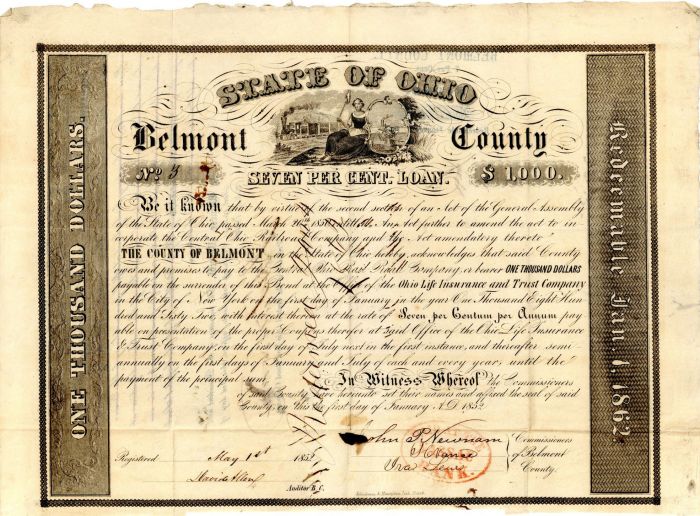
$1,000 7% Bond for the State of Ohio, Belmont County.
The Central Ohio Railroad, the third railroad to enter Columbus, Ohio, and the first to connect Columbus to the east coast, eventually became a part of the Baltimore and Ohio Railroad.
Initially, it was realized that a railroad from Bellaire on the west side of the Ohio River, across from Wheeling, would be a valuable franchise for transporting goods to and from the east coast. Chartered in February 1847 by interests in Zanesville, the construction of the CO proved challenging.
Eastern Ohio presented several obstacles for railroad development. The Muskingum River at Zanesville posed a significant challenge, requiring extensive excavation. Additionally, a 700-foot tunnel through the hard sandstone of the Blackhand Gorge along the Licking River between Zanesville and Newark posed a significant engineering feat. Furthermore, substantial quantities of fill and trestle work were necessary along the Big Walnut Creek. Additionally, a tunnel in Cambridge encountered rockfalls, while a cut near Barnesville resulted in landslides.
On January 19, 1852, trains commenced running between Zanesville and Newark. A year later, trains extended their service to Newark, and finally, in November 1854, the entire line between Bellaire and Columbus was operational. By 1852, the Baltimore and Ohio Railroad had been completed from Baltimore through Pittsburgh to Wheeling, providing rail-to-rail service, except for the Ohio River Crossing, from Columbus to Baltimore and onward to New York City. The railroad entered Columbus from the east, passing near what is now Port Columbus Airport. It crossed Alum Creek and Nelson Road south of Fifth Avenue and then swung around southwestward to enter Union Station.
A bond is a document of title for a loan. Bonds are issued, not only by businesses, but also by national, state or city governments, or other public bodies, or sometimes by individuals. Bonds are a loan to the company or other body. They are normally repayable within a stated period of time. Bonds earn interest at a fixed rate, which must usually be paid by the undertaking regardless of its financial results. A bondholder is a creditor of the undertaking.




Ebay ID: labarre_galleries