

Bank of the United States - Philadelphia - Stock Certificate (Uncanceled)
Inv# BS1005 Stock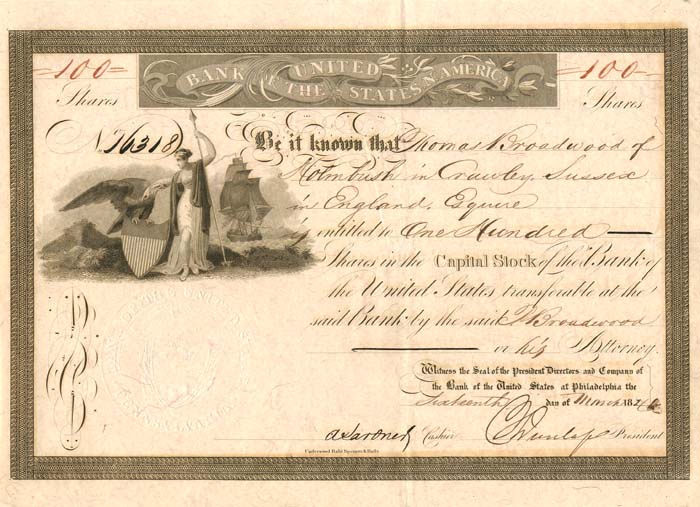
Uncanceled Stock. So historic!!! Particularly Choice Condition. Rare and Important.
The First Bank of the United States, established in 1791, was conceived by Secretary of the Treasury Alexander Hamilton. It served as the nation’s primary fiscal agent during Philadelphia’s time as the capital. Initially headquartered in Carpenters’ Hall, the bank aimed to consolidate Revolutionary War debt and establish a uniform national currency. In 1797, it relocated to its permanent home on South Third Street, a neoclassical landmark adorned with the first American eagle on its pediment. Despite its economic stabilization efforts, the bank faced intense political opposition from those wary of centralized federal power. Consequently, Congress narrowly defeated its charter renewal in 1811. After its closure, the building was acquired by financier Stephen Girard, who operated his private bank there for several decades.
Following the financial turmoil of the War of 1812, President James Madison signed the charter for the Second Bank of the United States in 1816. Also headquartered in Philadelphia, this second bank was housed in a magnificent Greek Revival temple on Chestnut Street, designed by architect William Strickland to resemble the Parthenon. Under the leadership of Nicholas Biddle, the bank emerged as a formidable regulator of the American economy. However, it ultimately succumbed to the “Bank War” orchestrated by President Andrew Jackson. Jackson perceived the institution as a corrupt monopoly benefiting the elite. Consequently, he vetoed its recharter and withdrew federal funds, effectively ending its national role by 1836. Today, both historic buildings are preserved within Independence National Historical Park, where the Second Bank serves as a gallery showcasing the portraits of the Founding Fathers.
A stock certificate is issued by businesses, usually companies. A stock is part of the permanent finance of a business. Normally, they are never repaid, and the investor can recover his/her money only by selling to another investor. Most stocks, or also called shares, earn dividends, at the business's discretion, depending on how well it has traded. A stockholder or shareholder is a part-owner of the business that issued the stock certificates.




Ebay ID: labarre_galleries