

American Bank Note Co. - ABNCO - Fantastic Condition - 1873 dated Stock Certificate
Inv# GS5661 Stock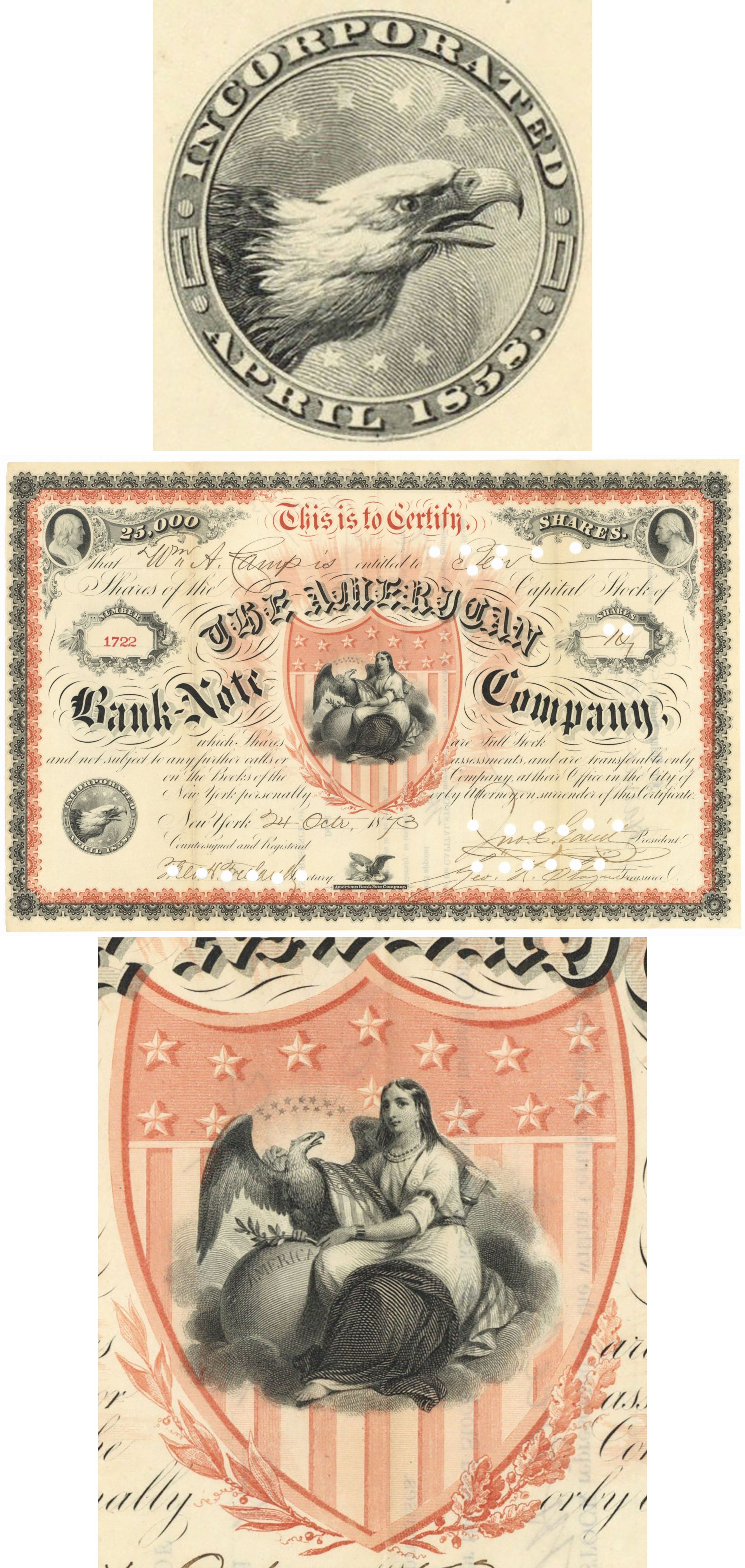
This stock certificate signifies the most prominent Bank Note company in history. This fantastic stock certificate is signed by John E. Gavit, George H. Stayner and Thoms H. Freeland.
John Edmonds Gavit (1817–1874) was a prominent American engraver and printer, renowned for his pivotal role in the security printing industry. Born in New York City, Gavit initially honed his skills in bank note transfer and engraving with various firms before establishing his own company, Gavit & Co., in Albany, New York, around 1840. His firm specialized in producing high-quality engraved checks, drafts, and business stationery. Gavit’s exceptional technical prowess extended to his contributions to E.B. O’Callaghan’s “The Documentary History of the State of New York” in the mid-19th century, where he provided several detailed maps and views. His reputation for precision and security led him to become a key figure in the consolidation of the rapidly growing bank note industry.
Gavit’s most significant achievement was his primary role in the formation of the American Bank Note Company (ABNCo) in 1858. This pivotal merger united seven of the largest engraving firms in the United States, establishing a single entity capable of producing secure, standardized currency and securities. This move was instrumental in addressing the pressing issue of counterfeit prevention. Despite being the smallest of the merging firms, holding only 2% of the initial stock, John Gavit was appointed as the company’s first president, serving until his passing in 1874. Under his leadership, ABNCo supplied banknotes and revenue stamps to the United States government and numerous foreign nations. Beyond his commercial success, Gavit demonstrated his scientific interests by serving as the secretary for the American Association for the Advancement of Science. He was also instrumental in founding the Dudley Observatory in Albany. Additionally, his name is synonymous with philatelists due to his production of the “Albany postmaster’s stamp” essay.
George H. Stayner was a Director of the American Bank Note Company from 1868 to 1888 and the Treasurer from 1873 to 1886.
Thomas H. Freeland was a Director of the American Bank Note Company from 1870 to 1911, Secretary from 1870 to 1900, Vice-President from 1901 to 1903, the President from 1903 to 1906 and Chairman of the Board from 1906 to 1911.
The American Banknote Company is a name synonymous with security, fine engraving, and the very fabric of financial trust in the United States and around the world. Its history is as intricate and enduring as the currency it once printed. With roots dating back to 1795, the company (now known as ABCorp) has weathered the major shifts of American capitalism, from the chaotic era of state-chartered banks and private currency to the modern age of digital transactions. This long and complex journey is more than just a corporate history; it’s a chronicle of technological evolution, artistic mastery, and the relentless pursuit of security in a constantly changing world. The story of the American Banknote Company is an essay on American enterprise, reflecting the nation’s growth, economic struggles, and its continuous evolution towards a more secure and centralized financial system.
The American Banknote Company was born in the turbulent early years of the American Republic. Before a uniform national currency was established, a vast and confusing system of private and state-issued banknotes circulated, often with little regulation. This fertile ground for counterfeiting meant that highly skilled and secure printing techniques were developed. In 1795, the engraving firm Murray, Draper, Fairman & Company was founded, providing high-security engraving and printing services to the newly established First Bank of the United States. This firm, a crucial predecessor to the American Banknote Company, set the precedent for combining masterful artistry with robust security measures, a principle that would define the company for centuries.
The mid-19th century was a turning point for the industry, with fierce competition and a pressing need for consolidation. In 1858, seven of the nation’s top engraving firms—including Murray, Draper, Fairman & Company’s ancestors—joined forces to form the American Bank Note Company. This strategic alliance was born out of necessity, combining resources and talent to fight the rampant counterfeiting that plagued the country’s patchwork banking system. But the merger wasn’t without its challenges. Some former partners, worried about becoming a monopoly, split off to form a rival, the National Bank Note Company. This era of consolidation and intense rivalry paved the way for the company’s dominance in the security printing market.
The company’s artistic and technical skills were its greatest strengths. Steel plate engraving, a method that creates finely detailed and raised impressions, was the heart of its security printing. The skilled engravers worked tirelessly, etching tiny portraits, intricate scenes, and microscopic letters onto steel plates, making counterfeiting incredibly difficult and expensive. This was a craft of immense precision, with artists spending days, weeks, or even months on a single plate. Beyond engraving, the American Banknote Company came up with many innovative security features. They experimented with special inks, unique paper blends (including a mix of 75% cotton and 25% linen), and complex printing methods to layer colors and create designs that were almost impossible to copy. The company’s focus on artistic detail and technical perfection made its products a benchmark for security documents around the world.
In 1861, the Civil War broke out, and the American Banknote Company became super important. The government needed money to fight the war, so they hired the company to print money. This was a big deal because it moved the power of printing money from banks to the government. The company made all sorts of notes, like ones, tens, twenties, fifties, and hundreds. They helped keep the economy of the Union going. After the war, in 1877, the Bureau of Engraving and Printing took over printing money, so the American Banknote Company lost its monopoly. But they didn’t give up! They started focusing on other things they did well and even started selling their products to other countries.
Diversification was the key to their survival. They kept printing money and stamps for lots of countries, and they also started making other important documents like stock and bond certificates. These certificates became super popular on Wall Street and are still sought after by collectors today. In 1891, they even started printing traveler’s checks for the American Express Company. These were like the first modern payment cards and helped keep people’s money safe. Throughout history, the American Banknote Company has always been ready to adapt to new things and meet the needs of the market. They’re a true survivor!
The 20th century was a rollercoaster ride for the company. By the 1980s, they were facing tough competition and the rise of digital technology. So, they got acquired and restructured. Under new leadership, they expanded their operations and ventured into new areas of security, like holography. This tech, created by a subsidiary, was a game-changer for secure credit cards, passports, and other ID documents in the digital age. It was a big step from the old art of steel engraving to the science of digital security.
But the relentless march of digitalization and the decline of physical documents took a toll. As electronic trading became the norm, the demand for beautifully engraved stock and bond certificates took a nosedive. Despite their rich history and their foray into new security tech, the company faced mounting financial pressures. In 1999, after centuries of business, the American Banknote Company declared Chapter 11 bankruptcy. It was a tough reminder of how challenging it is to adapt to a rapidly changing market.
But hey, they didn’t go completely extinct. They were reorganized and are still around today as ABCorp, a modern security company that offers a wide range of products and services, from secure cards and ID documents to vital records and authentication systems. While their physical presence has moved from their historic New York City buildings to more modern, discreet facilities in places like Trevose, Pennsylvania, and Tennessee, their legacy lives on.
The American Banknote Company’s physical creations have become a part of American history. Their old buildings in New York City are now landmarks, showing off the industrial power and skilled craftsmanship of a past era. Collectors love their stock certificates and old banknotes, which give them a real connection to the country’s financial past. The company’s story shows that even in our digital age, the physical things that used to make up our economy still have a strong and romantic appeal.
In summary, the American Banknote Company’s story is one of change. It started as a group of small engravers who competed, then became a big player in security printing through merging, being really good at art, and using new technology. It was important in keeping the country’s currency stable during a time of great trouble and kept changing to stay relevant in a changing economy. While the digital revolution changed its main business, the company’s legacy is kept in its remaining artifacts and landmark buildings, which remind us of an era when security was made not by code, but by the skill of master craftsmen. The American Banknote Company’s journey shows how human ingenuity, technological progress, and our basic need for trust in financial transactions are always connected.
A stock certificate is issued by businesses, usually companies. A stock is part of the permanent finance of a business. Normally, they are never repaid, and the investor can recover his/her money only by selling to another investor. Most stocks, or also called shares, earn dividends, at the business's discretion, depending on how well it has traded. A stockholder or shareholder is a part-owner of the business that issued the stock certificates.




Ebay ID: labarre_galleries