


Tri-Bullion Smelting and Development Co. - 1906-1913 dated Arizona Mining Stock Certificate
Inv# MS1159 Stock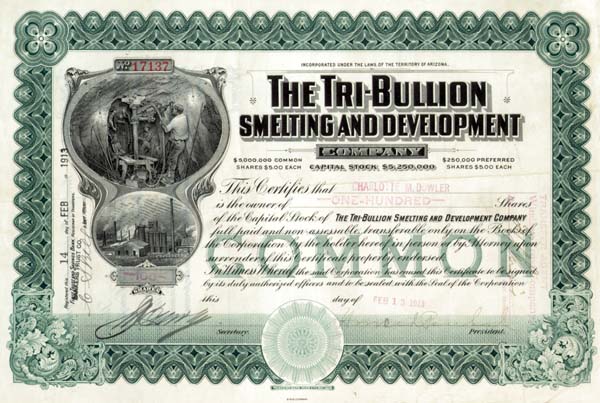
Stock printed by Western Bank Note Co. Chicago (Steelograph.) Attractive!
The Tri-Bullion Smelting and Development Co., a prominent New York-based mining firm, operated in the early 20th century in the Magdalena mining district near Kelly, New Mexico. The company owned several key properties, including the Kelly, Nitt, and Starlight mines, which were rich in lead, zinc, and smaller amounts of silver and copper ores. To process the ore on-site, Tri-Bullion constructed a local smelter and a separator plant, a practice that significantly increased profitability by eliminating the need for costly transportation to external facilities. Notably, the iconic headframe that still stands over the Kelly mine’s Traylor shaft was erected by the company in 1906.
The company’s primary period of operation spanned from approximately 1904 to 1917. However, a pivotal moment in its history occurred in 1913 when the Empire Zinc Company acquired the lucrative Kelly mine property. Consequently, Tri-Bullion leased its Nitt mine holdings to the Ozark Smelting & Mining Co.. During a post-war slump in the early 1920s, the original Tri-Bullion smelter was eventually dismantled. Despite the cessation of its major operations, records indicate that board of directors’ meetings continued as late as 1949, and some small-scale operations by lessees persisted for decades. Today, the tall brick tower, a testament to the Tri-Bullion smelter, stands as a prominent landmark in the ghost town of Kelly, New Mexico.
In 1910, the company owned the Starlight group, which included the Stanley Butte district in Graham County, Arizona, the Pipestone district in Jefferson County, Montana, and the Kelly mine in Socorro County, New Mexico. The Kelly mine was the primary property and had a mill with several outbuildings. In 1910, the smelter at the Kelly mine produced 25-35% zinc, 12-15% lead, 10 ounces of silver, and $3.50 worth of gold. After 1910, the property was leased. The company’s net income in 1910 was over $100,000. (Copper Handbook, 1910, p.1695). In 1925, the company still owned its Arizona and New Mexico properties, but these were leased with net royalties of only $6600. (Mines Handbook, 1925, p.1581-82)
A stock certificate is issued by businesses, usually companies. A stock is part of the permanent finance of a business. Normally, they are never repaid, and the investor can recover his/her money only by selling to another investor. Most stocks, or also called shares, earn dividends, at the business's discretion, depending on how well it has traded. A stockholder or shareholder is a part-owner of the business that issued the stock certificates.




Ebay ID: labarre_galleries