


Washington Central Railway Co. Signed by James N. Hill and George H. Earl - 1908 dated Autographed Stock Certificate
Inv# AG1933B Autograph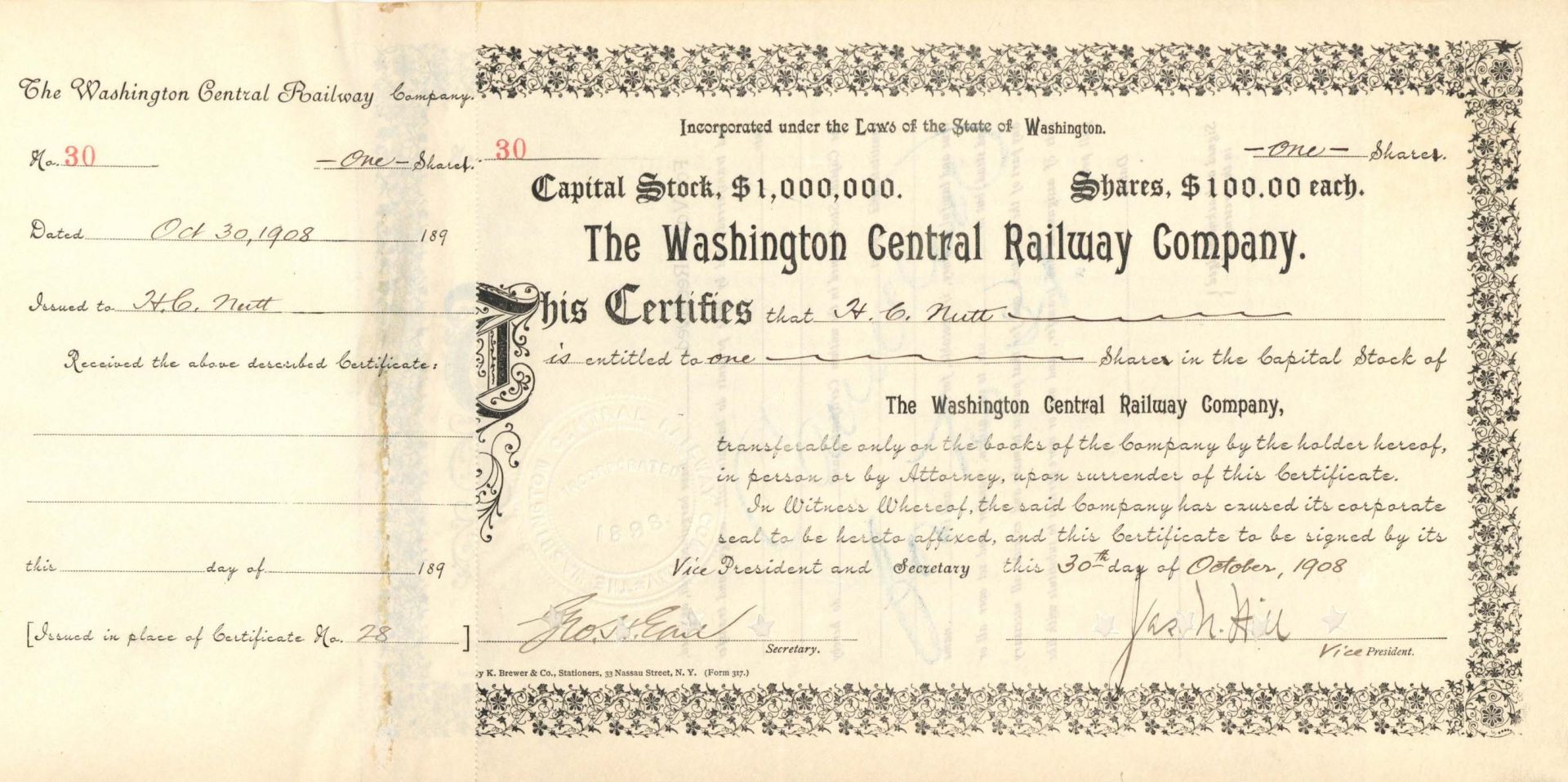
Stock signed by James N. Hill as vice president and Geo. H. Earl as secretary. Revenue stamp on back.
This company, established in 1898, was formed to acquire the assets of the bankrupt Central Washington Railroad. The railroad operated between Cheney and Coulee City, Washington, and was under the control of the Northern Pacific Railway Company.
The Washington Central Railway Company, also known as the Central Washington Railroad, was a subsidiary established by the Northern Pacific Railway to operate and expand a crucial branch line through the fertile agricultural regions of eastern Washington. By 1898, the line had become a vital artery for transporting wheat and other agricultural products from the “Big Bend” country to major markets. It connected towns like Davenport and Almira to the broader transcontinental network. This year marked a significant milestone for the company as the Northern Pacific formally integrated its branch line operations following its own corporate reorganization out of receivership in the mid-1890s.
During this period, the Washington Central played a pivotal role in the intense competition between the Northern Pacific and James J. Hill’s Great Northern Railway for dominance in the Pacific Northwest. The railway’s infrastructure facilitated rapid settlement and economic growth in Spokane and Lincoln counties, providing the first direct rail communication for many isolated communities. While the Washington Central Railway Company eventually merged its operations into the Northern Pacific system in the early 20th century, its 1898 status represented the peak of regional branch-line expansion that shaped the development of the Washington state interior.
James Norman Hill (1843-1910) was the eldest son of James J. Hill, and like his father, was a railroad man. He was born in St. Paul, Minnesota. He was the third child of ten. Hill graduated from Yale in 1893, and began his business career as a clerk in a railroad office. He held various subordinate positions, but in 1905 was made vice president of the Northern Pacific Railroad Company. He was also the vice president of the Minnesota & International Railroad, a director of the Burlington and Erie Railroads, of the Northern Securities Company, Pacific Coast Company, a Vice President of the Northern Express Company, and a Trustee of the New York Trust Company and the Washington and Columbia Trust Company. James N. Hill also moved to Texas and is noted to have earned millions investing in the Texas Oil Company.
George H Earl was a secretary of many Northern Pacific railroads including Duluth, Crookston and Northern Railroad, Duluth and Manitoba Railroad, Fargo and Southwestern Railroad, Helena and Jefferson County Railroad, Helena and Red Mountain Railroad, James River Valley Railroad, Jamestown and Northern Railroad, Little Falls and Dakota Railroad, Northern Pacific, Fergus and Black Hills Railroad, Northern Pacfic, La Moure and Missouri River Railroad, Rocky Mountain Railroad of Montana, Sanborn, Cooperstown and Turtle Mountain Railroad, and the Spokane and Palouse Railway.
George H. Earl, a prominent administrative figure for the Northern Pacific Railway during its pivotal expansion period in the late 19th and early 20th centuries, was often referred to by his full name, George Howard Earl. Dedicating several decades of his service to the company, primarily from its New York executive offices, Earl held various key positions. He served as Assistant Secretary and eventually became Secretary, overseeing crucial corporate records and legal documentation for the extensive transcontinental line.
Beyond his primary role as Secretary, Earl’s expertise in corporate administration led to his appointment as an officer and director for various Northern Pacific subsidiaries, including the Northwestern Improvement Company. His career encompassed several leadership transitions within the railroad, and he remained an integral part of the company’s New York headquarters until his passing in 1923. Unlike his contemporaries who focused on engineering or field operations, Earl’s contributions were instrumental in establishing the Northern Pacific’s legal and organizational stability during its transformation into a significant American industrial power.




Ebay ID: labarre_galleries