


Goldfield-Lincoln Mining Co. - 1908 dated Colorado and Nevada Mining Stock Certificate
Inv# MS2678 Stock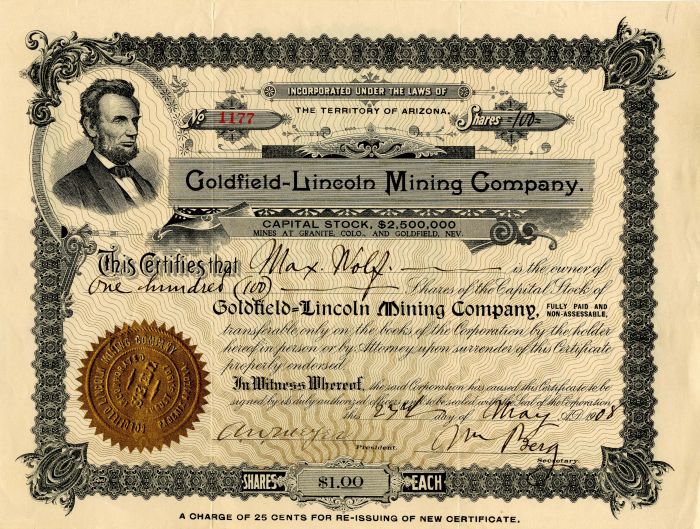
Stock printed by Goes.
Incorporated in late 1906 and reaching its peak in 1907, the Goldfield Consolidated Mines Company was a colossal, $50-million consolidation of mining properties in Goldfield, Nevada. This consolidation was controlled by George Wingfield and Senator George Nixon. By 1907, it had become the 17th largest corporation in the United States, exerting significant control over local production. The company constructed a 100-stamp mill and operated during the town’s zenith as Nevada’s largest city.
The company revolutionized local operations by replacing independent leasers with systematic, direct management. However, this approach led to intense conflicts with the Western Federation of Miners. Despite these challenges, the company continued to produce over
The company, which had been generating millions in dividends from its high-grade, shallow ore deposits, began to deplete rapidly. After a 1907 labor crisis that necessitated the deployment of federal troops, the company operated through the early 1910s before production declined. Eventually, the company ceased operations in 1919.
Established in 1867 along the Arkansas River, Granite, Colorado, emerged as a thriving mining camp during the 1860s placer gold rush. It swiftly transformed into a vital supply hub, boasting a population that once reached nearly 1,500 to 2,000. Key mining areas, such as Cache Creek and Kelley’s Bar, yielded approximately 49,000 troy ounces of gold. Subsequently, the surrounding hills became dotted with hard-rock mines.
As the easily accessible gold deposits dwindled by the 1880s, the town underwent a significant transformation. It evolved into a crucial transportation link for freight between Denver and Aspen, and it even served as the initial county seat of Lake County. Despite the decline of major mining operations, the town continued to face challenges, including railroad accidents and fires, until the 1950s. After that, it gradually faded into a quiet hamlet, frequently visited by tourists and gold prospectors.
Goldfield, Nevada, experienced a meteoric rise to prominence as one of the American West’s premier boomtowns. This transformation was triggered by the discovery of high-grade gold deposits by Harry Stimler and Billy Marsh in December 1902. Initially named “Grandpa,” the district swiftly attracted thousands of prospectors, transforming from a humble tent camp into a bustling city with over 20,000 residents by 1906. By 1904, the mines had amassed immense wealth, contributing a staggering 30% to Nevada’s total gold production. The boom was further solidified by the establishment of the Goldfield Consolidated Mines Company, under the leadership of George Wingfield. This company emerged as a major national corporation, generating over $32 million in dividends within just 11 years.
The peak years between 1904 and 1910 witnessed unprecedented construction activity and substantial output. However, the city’s fortune was short-lived as production declined by 1910, leading to the cessation of most mining operations by 1918. A devastating fire in 1923 further devastated much of the downtown area, accelerating its decline into a ghost town. Despite this, iconic structures like the Goldfield Hotel have endured, serving as enduring reminders of Nevada’s rich mining history and the remnants of its golden era.
A stock certificate is issued by businesses, usually companies. A stock is part of the permanent finance of a business. Normally, they are never repaid, and the investor can recover his/her money only by selling to another investor. Most stocks, or also called shares, earn dividends, at the business's discretion, depending on how well it has traded. A stockholder or shareholder is a part-owner of the business that issued the stock certificates.




Ebay ID: labarre_galleries