

1795 dated North American Land Stock signed by Robert Morris - Financier and Pennsylvania Signer of the Declaration of Independence - Exact Piece Shown
Inv# AG1402 Autograph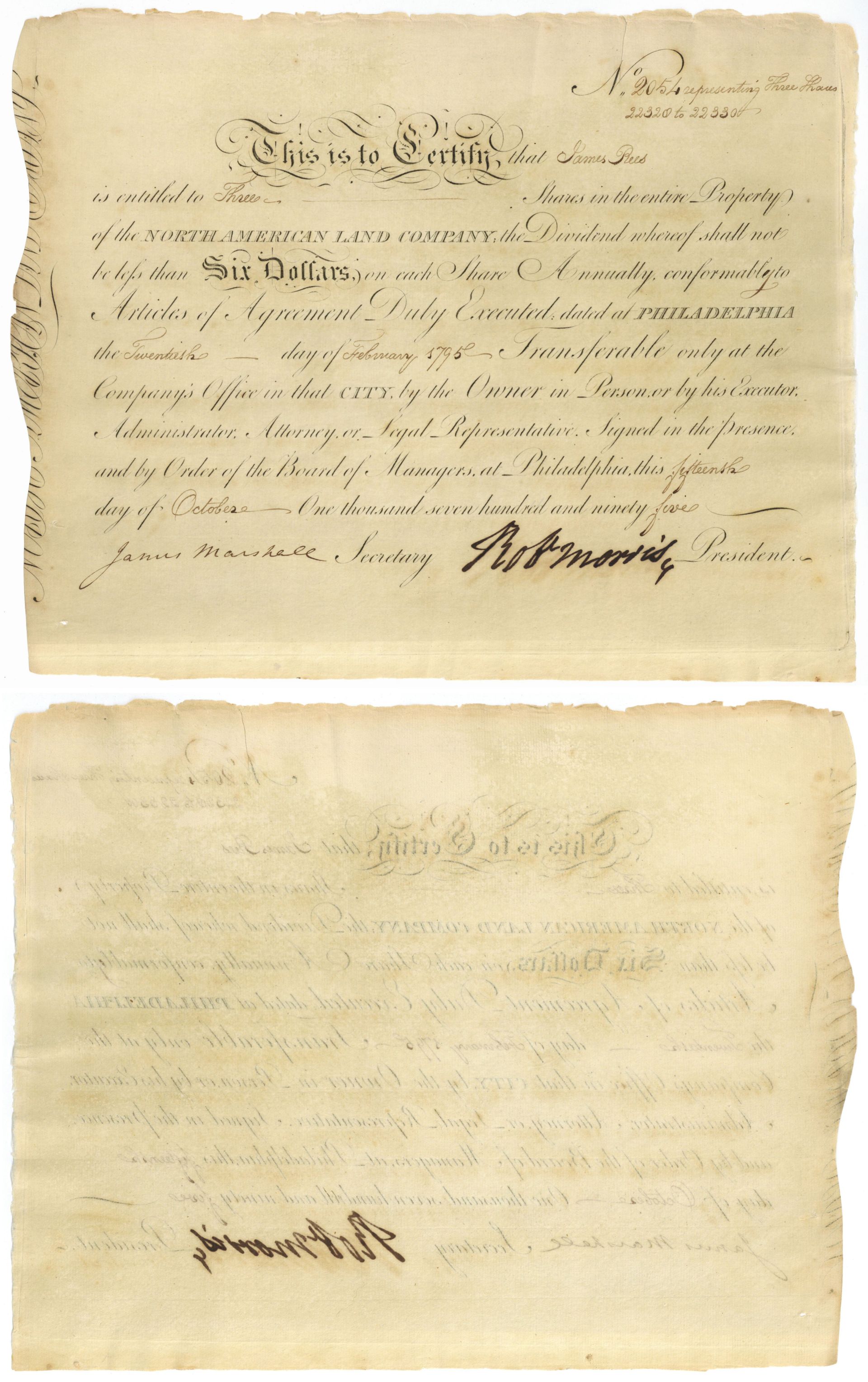
Early Stock Robert Morris signs as President. Also signed by James Marshall as Secretary. Exact Piece Shown.
Founded on February 20, 1795, by Robert Morris, James Greenleaf, and John Nicholson, the North American Land Company emerged as one of the most significant land trusts in early American history. At its zenith, the company held approximately 6 million acres of land spanning the District of Columbia, Georgia, Kentucky, North Carolina, Pennsylvania, South Carolina, and Virginia. The venture issued 30,000 shares of stock, each valued at $100, with Morris, the renowned “Financier of the Revolution,” assuming the role of the company’s president. Despite its substantial scale, the company faced immediate financial instability, questionable land titles, and the poor quality of its holdings, including the two million acres of uninhabited “Pine Barrens” in Georgia that proved nearly impossible to sell to settlers.
To salvage the failing enterprise, Robert Morris heavily relied on his son-in-law, James Marshall, who served as the company’s secretary and was the younger brother of the future Chief Justice John Marshall. Morris dispatched Marshall to Europe with the mission of selling shares of company stock to foreign investors. However, the mission failed due to European financial instability and skepticism regarding the true value of the American lands. By 1798, the speculative bubble burst, leading to the company’s collapse and the imprisonment of its founders in Philadelphia’s Prune Street debtors’ prison. Morris remained imprisoned for three and a half years before eventually gaining release through the Bankruptcy Act of 1800. Despite his eventual release, Morris died in relative obscurity and debt in 1806.

Robert Morris, Jr. (January 20, 1734 – May 8, 1806) was an English-born merchant who is acknowledged as a Founding Father of the United States. He served in various capacities, including the Pennsylvania legislature, the Second Continental Congress, and the United States Senate. Morris was a signatory of the Declaration of Independence, the Articles of Confederation, and the United States Constitution. From 1781 to 1784, he held the position of Superintendent of Finance for the United States, earning the designation "Financier of the Revolution." Alongside notable figures such as Alexander Hamilton and Albert Gallatin, he is regarded as one of the key architects of the financial system of the United States. In light of the severe financial challenges faced during the Revolutionary War, Congress created the position of Superintendent of Finance in 1781 to oversee financial matters. Morris accepted this role and also took on the duties of Agent of Marine, responsible for the Continental Navy.
He was instrumental in supplying the Continental Army under General George Washington, significantly contributing to Washington's decisive victory at the Battle of Yorktown, with the assistance of his frequent collaborator, Haym Salomon. Morris introduced reforms in government contracting and established the Bank of North America, which was the first national bank chartered by Congress in the United States. He maintained that the national government could not achieve financial stability without the power to levy taxes and tariffs; however, he was unable to convince all thirteen states to support an amendment to the Articles of Confederation. In May 1783, Morris tasked the young John Brown with approaching Luis de Unzaga, known as 'le Conciliateur,' who served as an intermediary in a covert operation to facilitate trade with the United States through bills of exchange from the bankers Le Couteulx. This clandestine mission was successful, enabling the payment of the Continental Army and averting a potential uprising that could threaten the delicate peace between the emerging United States and England.
James Marshall (1764–1848), the younger brother of the first U.S. Supreme Court Chief Justice, John Marshall, was a prominent American businessman and land speculator. While his brother shaped the nation’s legal landscape, James focused on the aggressive expansion of the early American frontier. In the 1790s, he became a key figure in the North American Land Company, a massive speculative venture founded alongside Robert Morris and John Nicholson. As the company’s agent in Europe, Marshall traveled to London and beyond to attract foreign investors to purchase vast tracts of American wilderness. His efforts were instrumental in marketing millions of acres in states like Pennsylvania, Virginia, and Georgia to a global audience.
Despite his high-level connections and tireless promotion, Marshall’s involvement with the North American Land Company ultimately led to financial turmoil. The company was overleveraged, and the expected influx of European capital failed to materialize due to political instability abroad and the poor quality of some of the surveyed lands. When the speculative bubble burst in the late 1790s, the company collapsed, resulting in the high-profile bankruptcy and imprisonment of his partner, Robert Morris. However, Marshall managed to avoid the worst of the fallout and eventually settled in Virginia. In his later years, he became a respected planter and local figure, although his legacy remains tied to the ambitious and high-stakes land fever that characterized the post-Revolutionary era.




Ebay ID: labarre_galleries