

8 Stockholders Dividend Sheets of Hudson River Rail Road Co. signed by Commodore Cornelius Vanderbilt - April 1865 dated Railway Autographs
Inv# AU1272F Stock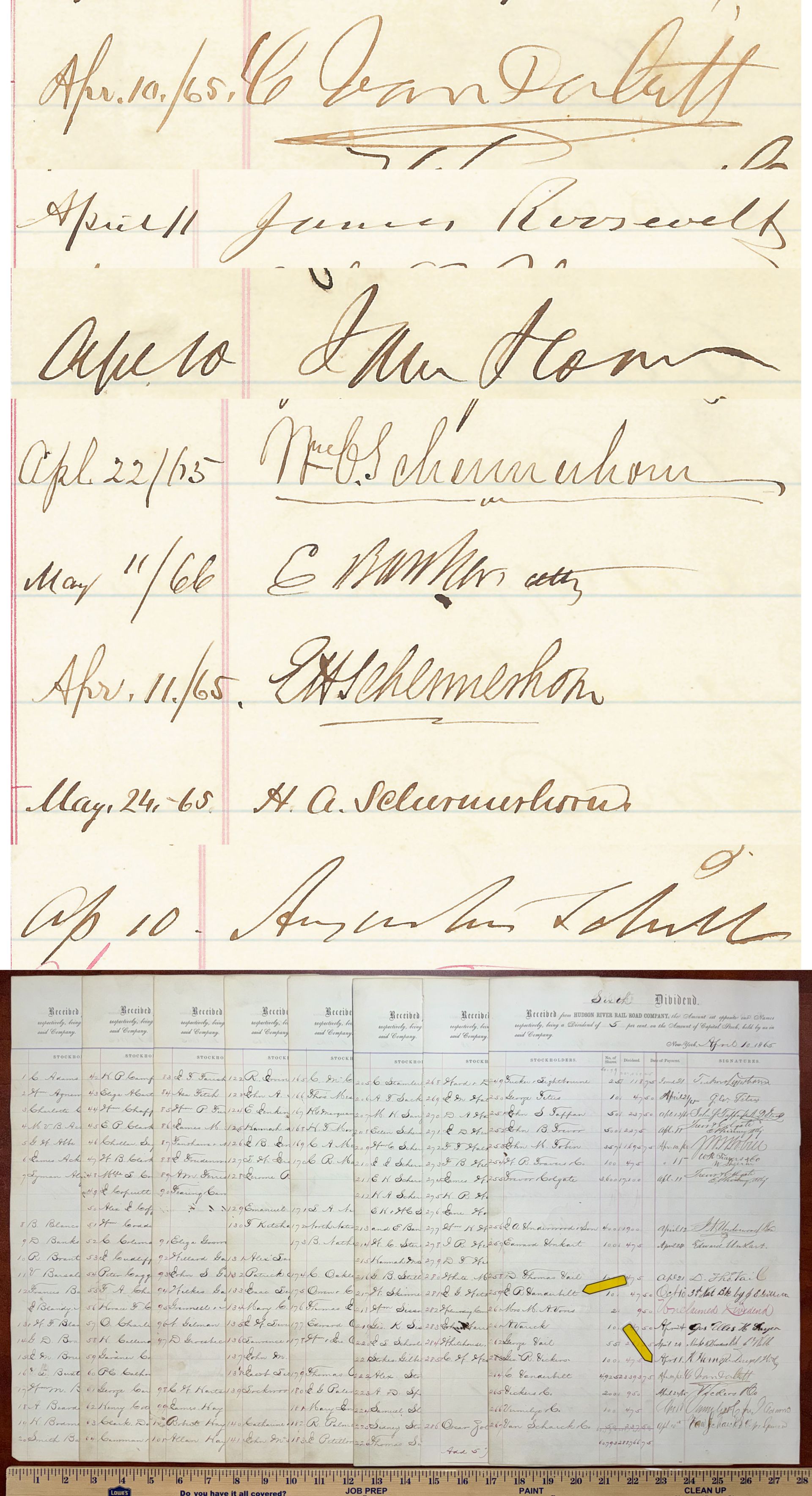
8 Stockholders Sheets for the Hudson River Railroad Company signed by Commodore Cornelius Vanderbilt. Also includes signatures of James Roosevelt, Samuel Sloan, Augustus Schell, William C. Shermerhorn, several Schermerhorn Family members and many others.

Cornelius “The Commodore” Vanderbilt (1794–1877) was an American business magnate who amassed a colossal fortune in the shipping and railroad industries, significantly transforming 19th-century American infrastructure. Born on Staten Island, he dropped out of school at the tender age of 10 to embark on a career in the maritime industry. This entrepreneurial spirit eventually led him to build a steamboat empire, which earned him his renowned nickname. Renowned for his ruthless competition, Vanderbilt made a strategic transition from shipping to railroads in his 60s. He consolidated various railroad lines to establish the New York Central Railroad system, solidifying his dominance in the industry.
At the time of his passing, Vanderbilt had accumulated one of the most substantial fortunes in American history, estimated to be over a million dollars. His legacy is marked by the founding of Vanderbilt University in Nashville and his unparalleled impact on the era of industrial capitalism. Through his exceptional efficiency and aggressive, unbridled free-market tactics, Vanderbilt revolutionized the transportation landscape. Tragically, he passed away in New York City, leaving most of his estate to his son, William Henry Vanderbilt. This decision laid the foundation for a dynasty that continues to shape modern transportation.
William C. Schermerhorn (1815–1903) was a prominent New York City philanthropist, lawyer, and real estate developer who significantly contributed to the expansion of Columbia University. Born into a wealthy and influential merchant family, he dedicated much of his life to managing his family’s extensive land holdings. However, his enduring legacy lies in his unwavering commitment to education and the arts. As the longtime Chairman of the Board of Trustees at Columbia, he played a pivotal role in the university’s historic relocation from its 49th Street location to its current campus in Morningside Heights.
Schermerhorn is perhaps best remembered for his generous financial contributions, particularly the funding of Schermerhorn Hall, which was initially constructed to house the university’s natural sciences departments. Beyond his work with Columbia, he was a devoted patron of the Metropolitan Museum of Art and the American Museum of Natural History. His life embodied the Gilded Age ideal of civic duty, as he utilized his inheritance and social standing to shape the intellectual and cultural landscape of New York City during a period of rapid urban transformation.
Augustus Schell (1812–1884) was a prominent 19th-century New York attorney, railroad executive, and influential Democratic politician. He was renowned for his expertise in corporate law and his close association with Cornelius Vanderbilt. Schell held significant positions within Tammany Hall, including Grand Sachem, head of the Democratic state committee, and Collector of the Port of New York.
Born in New York, Schell graduated from Union College and established a successful legal practice. Later, he transitioned into the railroad and financial industries, managing notable corporations such as the Harlem Railroad. Beyond his professional endeavors, Schell was actively involved in civic life. He chaired the New-York Historical Society’s executive committee for an impressive 19 years. Tragically, he passed away in 1884, leaving behind a lasting legacy as a pivotal figure in New York’s legal and political landscape.
Samuel Sloan (1817–1907) was a prominent figure in 19th-century American transportation, best known for his long tenure as president of the Delaware, Lackawanna & Western Railroad (DL&W). Born in Ireland and raised in New York, Sloan initially worked in the importing business before transitioning into railroad management in the 1850s. As president of the DL&W from 1867 to 1899, he transformed the company from a regional line into a highly profitable system. This transformation was largely achieved through the development of anthracite coal transportation and the expansion of passenger service between New York City and the Poconos. Sloan’s leadership made the DL&W one of the most successful railroads of its time, earning him the nickname “monarch of the land” and the title “actual ruler of the United States.”
Sloan was a shrewd financier and a close ally of J.P. Morgan. He held director positions in numerous railroads, banks, and utility companies, making him a dominant force in corporate America. Unlike contemporary “robber barons,” Sloan was known for his aversion to speculative tactics. He maintained a conservative yet highly effective management style throughout his career, serving as president of seventeen different railroad corporations. Even after retiring from the DL&W presidency, Sloan continued as chairman of the board until his death at the age of 89. Sloan’s legacy includes significant infrastructure development around New York City and his role as a founder of what would become Citibank.
James Roosevelt I (1828–1900), often called “Squire James,” was a prominent American businessman, railroad executive, and the father of President Franklin D. Roosevelt. Born in Hyde Park, New York, to a wealthy family with deep roots in the Hudson Valley, he graduated from Union College and Harvard Law School. He then embarked on a career that seamlessly blended law and corporate management. Although he briefly practiced law, Roosevelt quickly rose to prominence in business, particularly in the coal, transportation, and railroad sectors. He held positions such as vice president of the Delaware and Hudson Railway and president of the Southern Railway Security Company.
As a prominent industrial figure, Roosevelt was closely associated with several financial institutions. He served as a director of the New York Life Insurance Trust and a trustee of the Farmers’ Loan and Trust Company. With his substantial wealth, he established an impressive estate called “Springwood” in Hyde Park, which later became the residence of his son, FDR. Throughout his life, he was an active member of St. James Church and engaged in various local Dutchess County affairs. After the death of his first wife, Rebecca Howland, he married Sara Ann Delano in 1880. They had one other child, Franklin, who was born when James was 53 years old.
A stock certificate is issued by businesses, usually companies. A stock is part of the permanent finance of a business. Normally, they are never repaid, and the investor can recover his/her money only by selling to another investor. Most stocks, or also called shares, earn dividends, at the business's discretion, depending on how well it has traded. A stockholder or shareholder is a part-owner of the business that issued the stock certificates.




Ebay ID: labarre_galleries