


 Land and Mortgage Deed Most Likely Signed by Charles Crocker - 1869-1887 dated Autograph
Inv# AU1917
Autograph
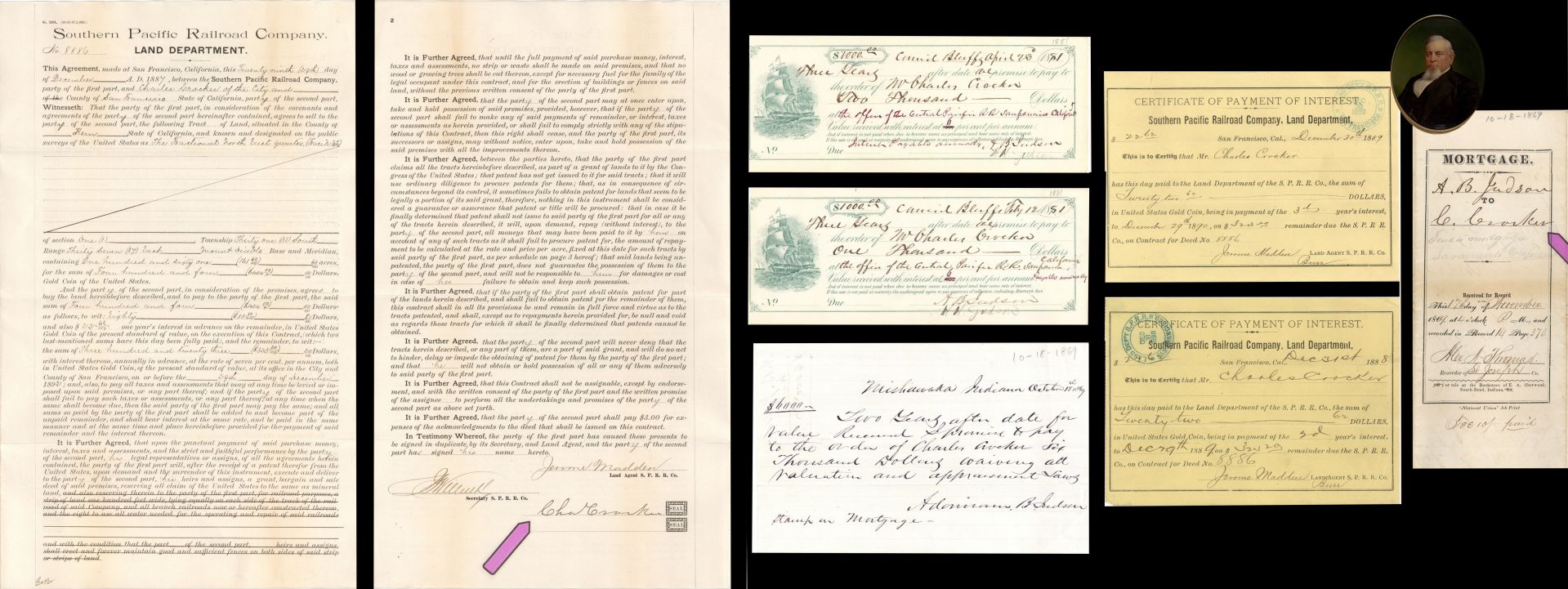
An archive of 7 documents related to the railroad builder Charles Crocker, including land mortgage deeds. Most likely Crocker's signature, further research needed. Also included are 2 envelopes.

Charles Crocker (September 16, 1822 – August 14, 1888) was an American railroad executive who was one of the founders of the Central Pacific Railroad, which constructed the westernmost portion of the first transcontinental railroad, and took control with partners of the Southern Pacific Railroad. Crocker was born in Troy, New York on September 16, 1822.He was the son of Eliza (née Wright) and Isaac Crocker, a modest family. They joined the nineteenth-century migration west and moved to Indiana when he was 14, where they had a farm. Crocker soon became independent, working on several farms, a sawmill, and at an iron forge.
At the age of 23, in 1845, he founded a small, independent iron forge of his own. He used money saved from his earnings to invest later in the new railroad business after moving to California, which had become a boom state since the Gold Rush. His older brother Edwin B. Crocker had become an attorney by the time Crocker was investing in railroads. In 1861, after hearing an intriguing presentation by Theodore Judah, he was one of the four principal investors, along with Mark Hopkins, Collis Huntington and Leland Stanford (also known as The Big Four), who formed the Central Pacific Railroad, which constructed the western portion of the First transcontinental railroad in North America. His position with the company was that of construction supervisor and president of Charles Crocker & Co., a Central Pacific subsidiary founded expressly for the purpose of building the railroad.
Crocker bought train plows to plow the tracks of snow through the mountains, but they derailed due to ice on the tracks. He had more than 40 miles (65 km) of snow sheds built to cover the tracks in the Sierra Nevada mountains, to prevent the tracks from getting covered with snow in the winter. This project cost over $2 million.
In 1864, Charles asked his older brother Edwin to serve as legal counsel for the Central Pacific Railroad.
While the Central Pacific was still under construction in 1868, Crocker and his three associates acquired control of the Southern Pacific Railroad. It built the westernmost portion of the second transcontinental railroad. Deming, New Mexico, is named after his wife, Mary Ann Deming Crocker. A silver spike was driven here in 1881 to commemorate the meeting of the Southern Pacific with the Atchison, Topeka and Santa Fe railroads, completing the construction of the second transcontinental railroad in the United States. On September 5, 1876, at the Lang Southern Pacific Station, a California Historic Landmark, Crocker hammered a golden spike into a railroad tie, the ceremonial spike was driven to celebrate the completion of San Joaquin Valley rail line. The completion of the line connected the City of Los Angeles with San Francisco and First transcontinental railroad line. Crocker was briefly the controlling shareholder of Wells Fargo in 1869 and served as president. After he sold down, he was replaced by John J. Valentine, Sr. Crocker also acquired controlling interest for his son William in Woolworth National Bank, which was renamed Crocker-Anglo Bank.
In 1963, Crocker-Anglo Bank merged with Los Angeles' Citizens National Bank, to become Crocker-Citizens Bank[ and later, Crocker National Bank. The San Francisco-based bank no longer exists, as it was acquired by Wells Fargo in 1986.




Ebay ID: labarre_galleries