

 Document signed by Walter Chrysler - 1913 dated Autograph
Inv# AU1916
Autograph
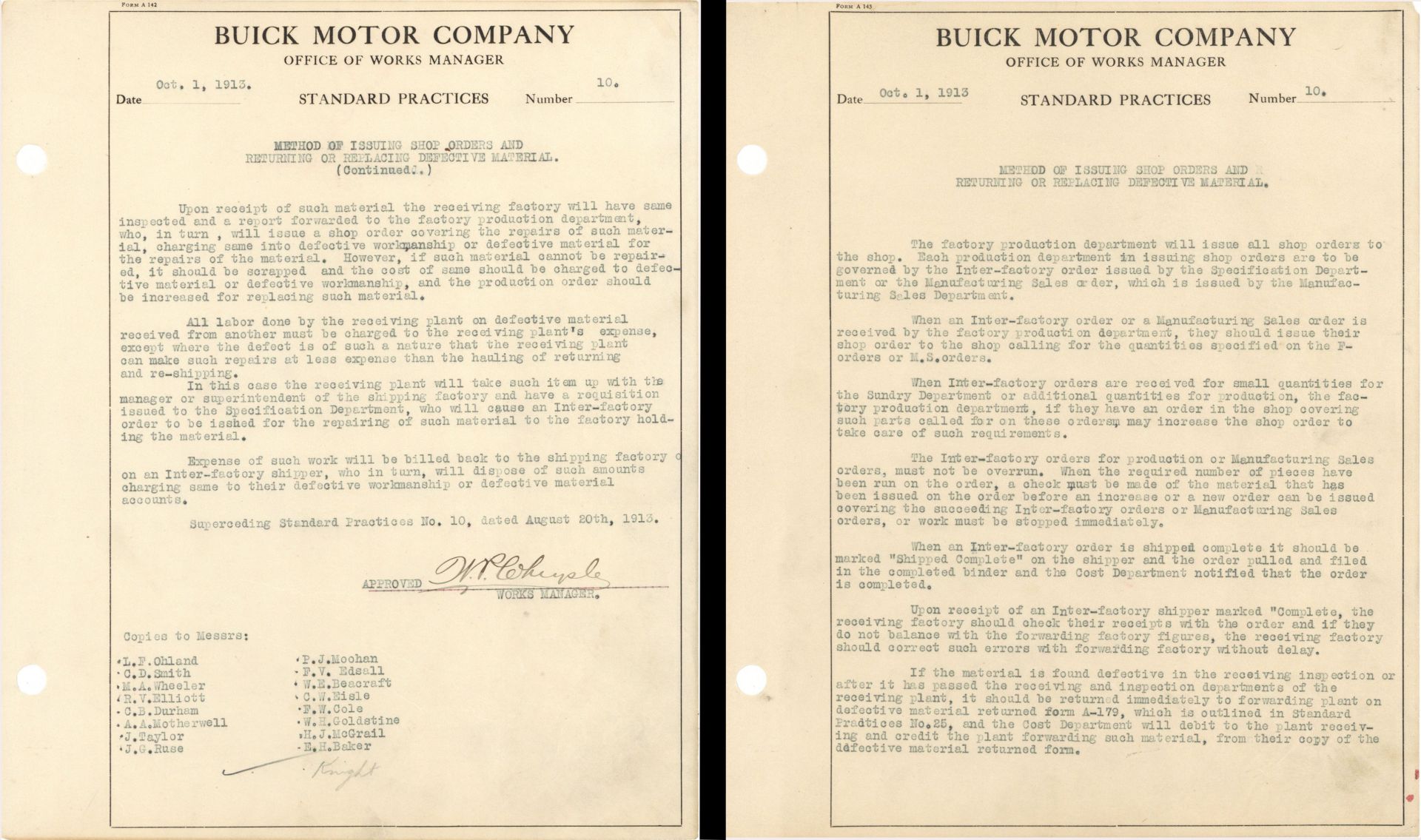
2 page document regarding Buick Motor Company Standard Practices signed by Walter Chrysler.
/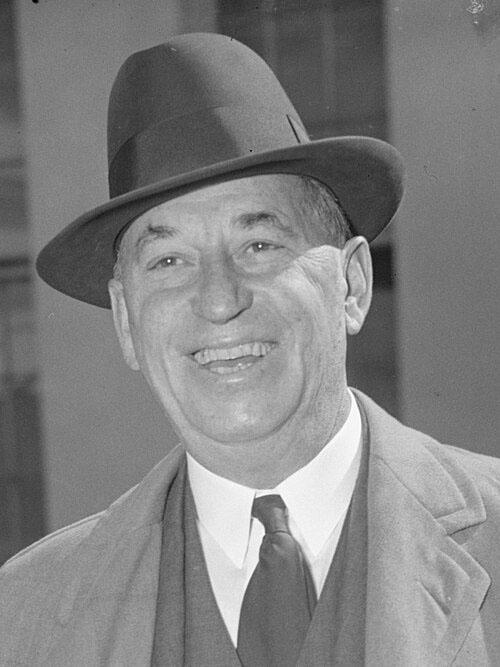
Walter Percy Chrysler (April 2, 1875 – August 18, 1940) was an American industrial pioneer in the automotive industry, automotive industry executive, and the founder and namesake of American Chrysler Corporation. Chrysler apprenticed in the railroad shops at Ellis as a machinist and railroad mechanic. He then spent a period of years roaming the west, working for various railroads as a roundhouse mechanic with a reputation of being good at valve-setting jobs. Chrysler moved frequently, first to Wellington, Kansas, in 1897, then to Denver, Colorado for two weeks, and finally Cheyenne, Wyoming. Some of his moves were due to restlessness and a quick temper, but his roaming was also a way to become more well-rounded in his railroad knowledge. He worked his way up through positions such as foreman in Trinidad, Colorado, superintendent, division master mechanic, and general master mechanic.
During 1905 and 1906, Chrysler worked for the Fort Worth and Denver Railway in Childress in West Texas. He later lived and worked in Oelwein, Iowa, at the main shops of the Chicago Great Western, where there is a small park dedicated to him.
The pinnacle of his railroading career came at Pittsburgh, Pennsylvania, where he became works manager of the Allegheny locomotive erecting shops of the American Locomotive Company (Alco). While working in Pittsburgh, Chrysler lived in the town of Bellevue, the first town outside of Pittsburgh on the north side of the Ohio River. Chrysler's automotive career began in 1911 when he received a summons to meet with James J. Storrow, a banker who was a director of Alco. Storrow asked him if he had given any thought to automobile manufacture. Chrysler had been an auto enthusiast for over five years by then, and was very interested. Storrow arranged a meeting with Charles W. Nash, then president of the Buick Motor Company, who was looking for a smart production chief. Chrysler, who had resigned from many railroading jobs over the years, made his final resignation from railroading to become works manager (in charge of production) at Buick in Flint, Michigan. He found many ways to reduce the costs of production, such as putting an end to finishing automobile undercarriages with the same luxurious quality of finish that the body warranted.
In 1916, William C. Durant, who founded General Motors in 1908, had retaken GM from bankers who had taken over the company. Chrysler, who was closely tied to the bankers, submitted his resignation to Durant, then based in New York City.
Durant took the first train to Flint to make an attempt to keep Chrysler at the helm of Buick. Durant made the then-unheard of salary offer of $10,000 (equivalent to $288,960 in 2024) a month for three years, with a $500,000 (equivalent to $14.4 million in 2024) bonus at the end of each year, or $500,000 (equivalent to $14.4 million in 2024) in stock. Additionally, Chrysler would report directly to Durant, and would have full run of Buick without interference from anyone. Apparently in shock, Chrysler asked Durant to repeat the offer, which he did. Chrysler immediately accepted.
Chrysler ran Buick successfully for three more years. Not long after his three-year contract was up, he resigned from his job as president of Buick in 1919. He did not agree with Durant's vision for the future of General Motors. Durant paid Chrysler $10 million (equivalent to $181 million in 2024) for his GM stock. Chrysler had started at Buick in 1911 for $6,000 a year (equivalent to $202,479 in 2024), and left one of the richest men in the United States. GM replaced Chrysler with Harry H. Bassett a protege who had risen through the ranks at the Weston-Mott axle manufacturing company, by then a subsidiary of Buick.
Chrysler was then hired to attempt a turnaround by bankers who foresaw the loss of their investment in Willys-Overland Motor Company in Toledo, Ohio. He demanded and received a salary of $1 million (equivalent to $18.1 million in 2024) a year for two years, an astonishing amount at that time. When Chrysler left Willys in 1921 after an unsuccessful attempt to wrestle control from John Willys, he acquired a controlling interest in the ailing Maxwell Motor Company. Chrysler phased out Maxwell and absorbed it into his new firm, the Chrysler Corporation, in Detroit, Michigan, in 1925. In addition to his namesake car company, Plymouth and DeSoto marques were created, and in 1928 Chrysler purchased Dodge Brothers and renamed it Dodge. The same year he financed the construction of the Chrysler Building in New York City, which was completed in 1930. Chrysler was named Time magazine's Man of the Year for 1928.
He was inducted into the Automotive Hall of Fame in 1967.




Ebay ID: labarre_galleries