


1789 dated Pay Order signed by Samuel Huntington - Signer of the Declaration of Independence - 1789 dated Autograph
Inv# AU1902 Autograph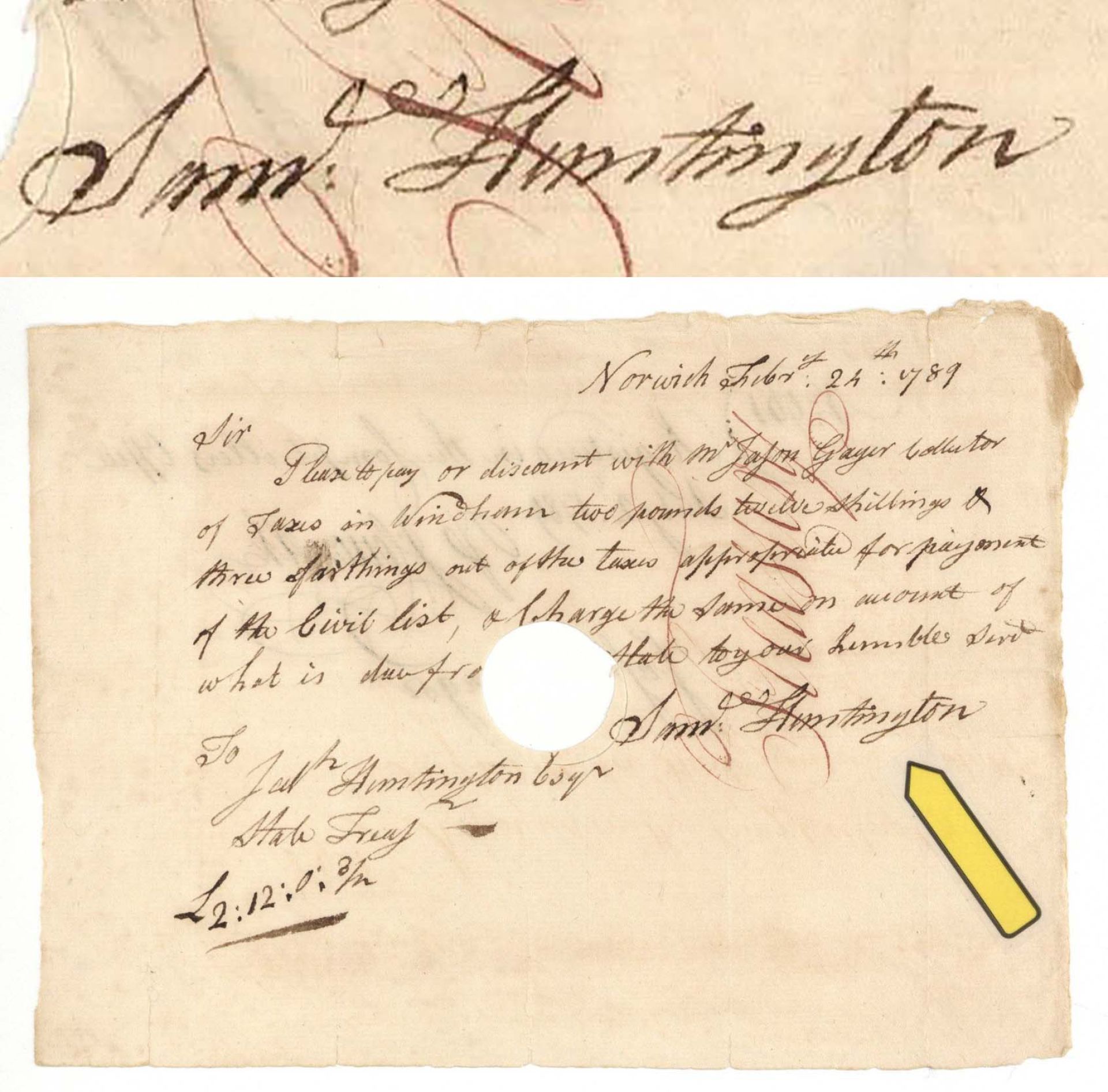
Pay order signed by Samuel Huntington, signer of the Declaration of Independence.

Samuel Huntington, born on July 16, 1731, in Connecticut, played a significant role in the American Revolution. He was a Founding Father of the United States, serving as a lawyer, jurist, statesman, and Patriot. As a delegate to the Continental Congress, Huntington signed the Declaration of Independence and the Articles of Confederation. He also held various positions, including President of the Continental Congress from 1779 to 1781, President of the United States in Congress Assembled in 1781, Chief Justice of the Connecticut Supreme Court from 1784 to 1785, and the 18th Governor of Connecticut from 1786 until his untimely death. Notably, he was the first United States governor to pass away while in office.
Huntington’s political journey began in earnest in 1764 when Norwich appointed him as one of their representatives to the lower house of the Connecticut Assembly. He served in this capacity until 1774. In 1775, he was elected to the upper house, the Governor’s Council, where he held office until 1784. Beyond his legislative roles, Huntington held several other positions. He was appointed king’s attorney for Connecticut in 1768 and later served as the colony’s supreme court, then known as the Supreme Court of Errors, from 1773 to 1784. In 1784, he was appointed Chief Justice of the Supreme Court until 1787.
Huntington was a vocal critic of the Coercive Acts of the British Parliament. In October 1775, the assembly elected him as one of their delegates to the Second Continental Congress in Philadelphia, marking a pivotal moment in his political career.
In January 1776, he joined Roger Sherman and Oliver Wolcott, who collectively represented the Connecticut Colony’s delegation in the Second Continental Congress. He actively participated in the voting process and signed the Declaration of Independence and the Articles of Confederation. He served in the Congress for three consecutive terms, from 1776 to 1778, 1781 to 1783, and 1783. During his tenure in Congress, he unfortunately contracted an attack of smallpox.




Ebay ID: labarre_galleries