


6 Cards signed by Supreme Court Justices - 1960's-1970's dated Autograph
Inv# AU1814 Autograph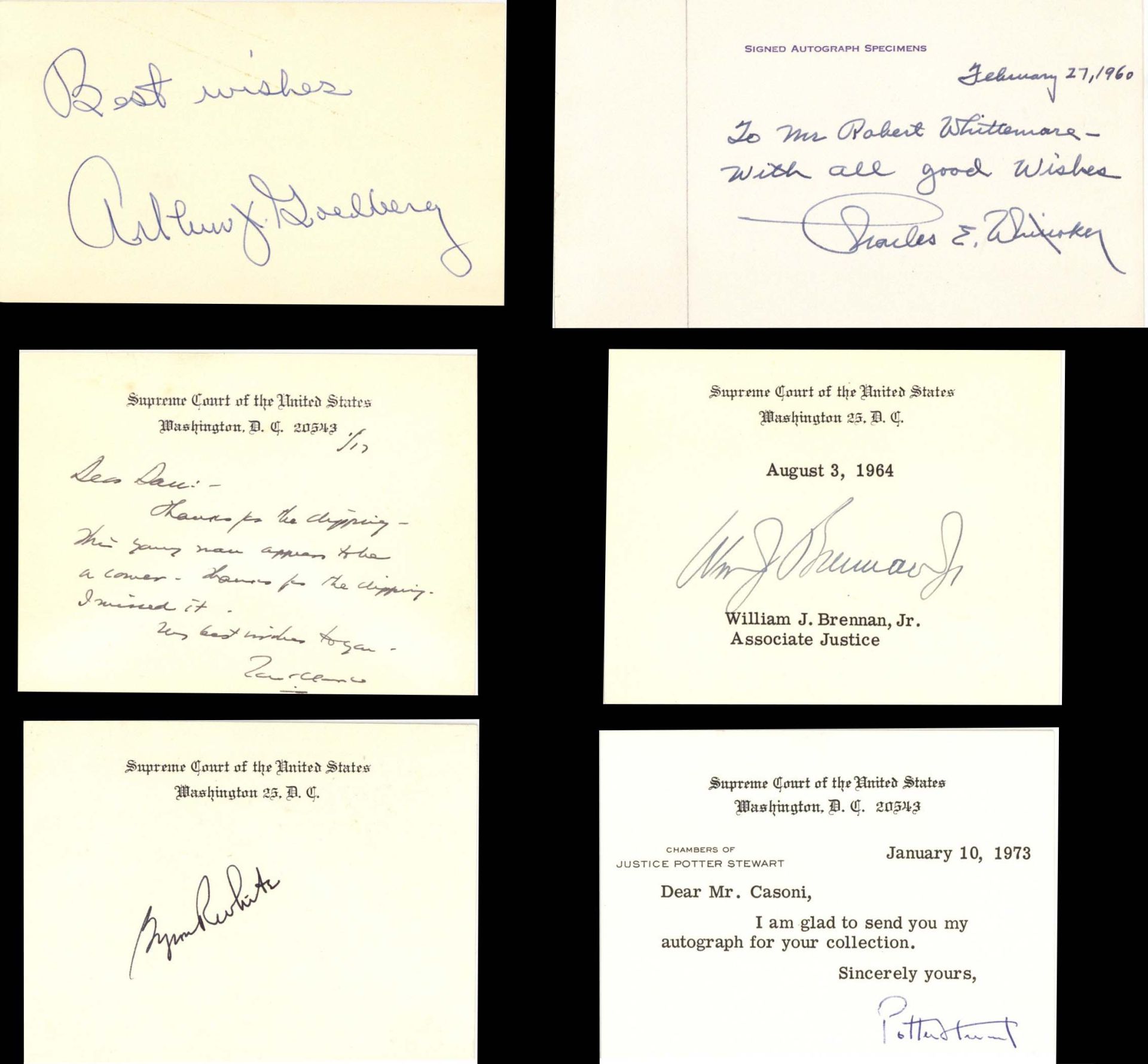
Cards signed by Supreme Court Justices; Arthur Goldberg, Charles Evans Whittaker, ??, William J. Brennan, Jr., Byron White and Potter Stewart.

Arthur Joseph Goldberg (August 8, 1908 – January 19, 1990) was an American statesman and jurist who served as the 9th U.S. Secretary of Labor, an Associate Justice of the Supreme Court of the United States, and the 6th United States Ambassador to the United Nations.
Born in Chicago, Illinois, Goldberg graduated from the Northwestern University School of Law in 1930. He became a prominent labor attorney and helped arrange the merger of the American Federation of Labor and the Congress of Industrial Organizations. During World War II, he served in the Office of Strategic Services, organizing European resistance to Nazi Germany. In 1961, President John F. Kennedy appointed Goldberg as the Secretary of Labor.
In 1962, Kennedy successfully nominated Goldberg to the Supreme Court to fill a vacancy created by the retirement of Felix Frankfurter. Goldberg aligned with the liberal bloc of justices and wrote the majority opinion in Escobedo v. Illinois. In 1965, Goldberg resigned from the bench to accept appointment by President Lyndon B. Johnson as the Ambassador to the United Nations. In that role, he helped draft UN Resolution 242 in the aftermath of the Six-Day War. He ran for governor of New York in 1970 but was defeated by Nelson Rockefeller. After his defeat, he served as president of the American Jewish Committee and continued to practice law.

Charles Evans Whittaker (February 22, 1901 – November 26, 1973) was an Associate Justice of the United States Supreme Court from 1957 to 1962. After working in private practice in Kansas City, Missouri, he was nominated for the United States District Court for the Western District of Missouri. In 1956, President Dwight D. Eisenhower nominated Whittaker to the United States Court of Appeals for the Eighth Circuit. In 1957, he won confirmation to the Supreme Court of the United States, thus becoming the first individual to serve as a judge on a federal district court, a federal court of appeals, and the United States Supreme Court. During his brief tenure on the Warren Court, Whittaker emerged as a swing vote. In 1962, he had a nervous breakdown and resigned from the Court. After leaving the Supreme Court, he served as chief counsel to General Motors and frequently criticized the Civil Rights Movement and the Warren Court.
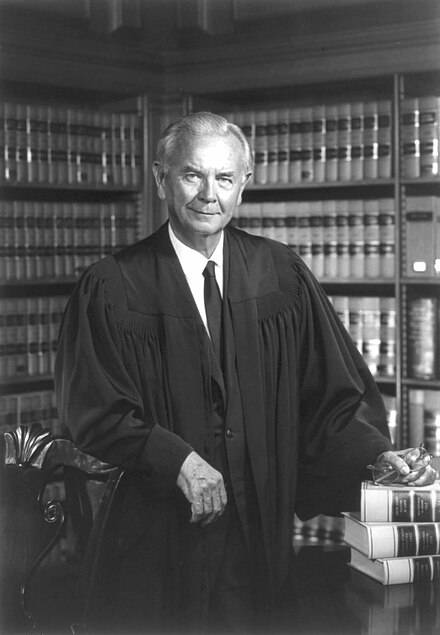
William Joseph Brennan Jr. (April 25, 1906 – July 24, 1997) was an American lawyer and jurist who served as an Associate Justice of the Supreme Court of the United States from 1956 to 1990. He was the seventh-longest serving justice in Supreme Court history, and was known for being a leader of the Court's liberal wing. Born in Newark to Irish immigrant parents, Brennan studied economics at the University of Pennsylvania and then attended Harvard Law School. He entered private legal practice in New Jersey and served in the U.S. Army during World War II. He was appointed in 1951 to the Supreme Court of New Jersey. Shortly before the 1956 presidential election, President Dwight D. Eisenhower used a recess appointment to place Brennan on the Supreme Court. Brennan won Senate confirmation the following year. He remained on the Court until his retirement in 1990, and was succeeded by David Souter. On the Supreme Court, Brennan was known for his outspoken progressive views, including opposition to the death penalty as he dissented in more than 1,400 cases in which the Supreme Court refused to review a death sentence, and support for abortion rights and gay rights. He authored numerous landmark case opinions, including: Baker v. Carr (1962), establishing that the apportionment of legislative districts is a justiciable issue; New York Times Co. v. Sullivan (1964), which required "actual malice" in libel suits brought by public officials; Eisenstadt v. Baird (1972), which established a legal right to contraception for unmarried people and helped solidify the sexual revolution; and Craig v. Boren (1976) which established that laws which discriminate on the basis of sex are subject to heightened scrutiny under the Equal Protection Clause. Due to his ability to shape a wide variety of opinions and bargain for votes in many cases, he was considered to be among the Court's most influential members. Justice Antonin Scalia called Brennan "probably the most influential Justice of the [20th] century." Read more at https://en.wikipedia.org/wiki/William_J._Brennan_Jr.
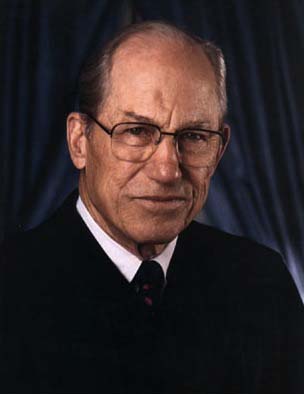
Byron Raymond "Whizzer" White (June 8, 1917 – April 15, 2002) was an American lawyer, jurist, and professional football player who served as an associate justice of the Supreme Court of the United States from 1962 until 1993. By his retirement, he was its only sitting Democrat and the last-living member of the progressive Warren Court.

Potter Stewart (January 23, 1915 – December 7, 1985) was an American lawyer and judge who served as an associate justice of the United States Supreme Court from 1958 to 1981. During his tenure, he made major contributions to criminal justice reform, civil rights, access to the courts, and Fourth Amendment jurisprudence.
After graduating from Yale Law School in 1941, Stewart served in World War II as a member of the United States Navy Reserve. After the war, he practiced law and served on the Cincinnati city council. In 1954, President Dwight D. Eisenhower appointed Stewart to a judgeship on the U.S. Court of Appeals for the Sixth Circuit. In 1958, Eisenhower nominated Stewart to succeed retiring Associate Justice Harold Hitz Burton, and Stewart won Senate confirmation afterwards. He was frequently in the minority during the Warren Court but emerged as a centrist swing vote on the Burger Court. Stewart retired in 1981 and was succeeded by the first female United States Supreme Court justice, Sandra Day O'Connor.
Stewart wrote the majority opinion in cases such as Jones v. Alfred H. Mayer Co., Katz v. United States, Chimel v. California, and Sierra Club v. Morton. He wrote dissenting opinions in cases such as Engel v. Vitale, In re Gault and Griswold v. Connecticut. He popularized the phrase "I know it when I see it" with a concurring opinion in Jacobellis v. Ohio, in which a theater owner had been fined for showing a supposedly obscene film.




Ebay ID: labarre_galleries