


Aaron Burr issued to Pennsylvania Population Co. 1794 dated Stock Certificate - Signed by John Nicholson and Tench Francis Jr.
Inv# AG2685 Autograph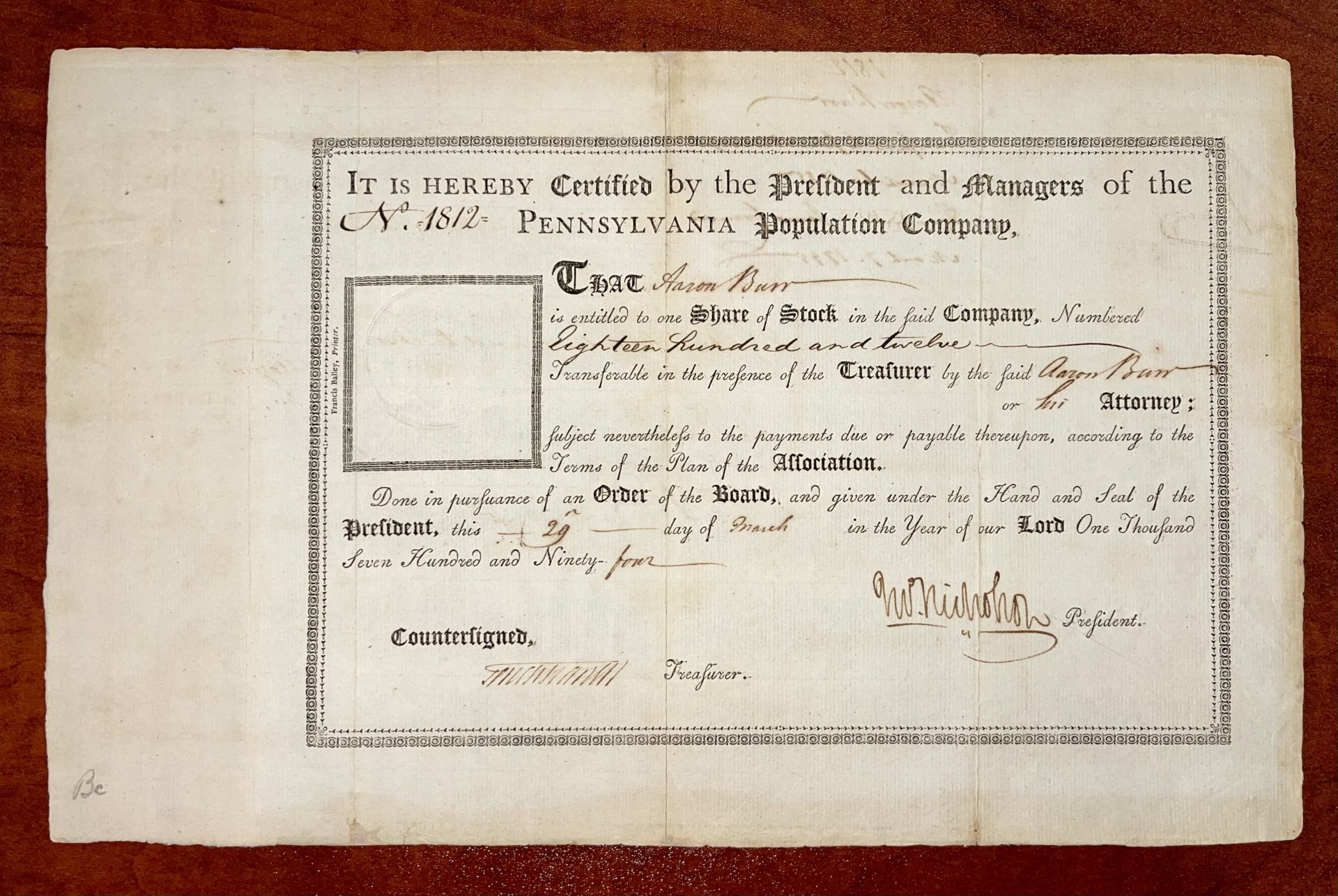
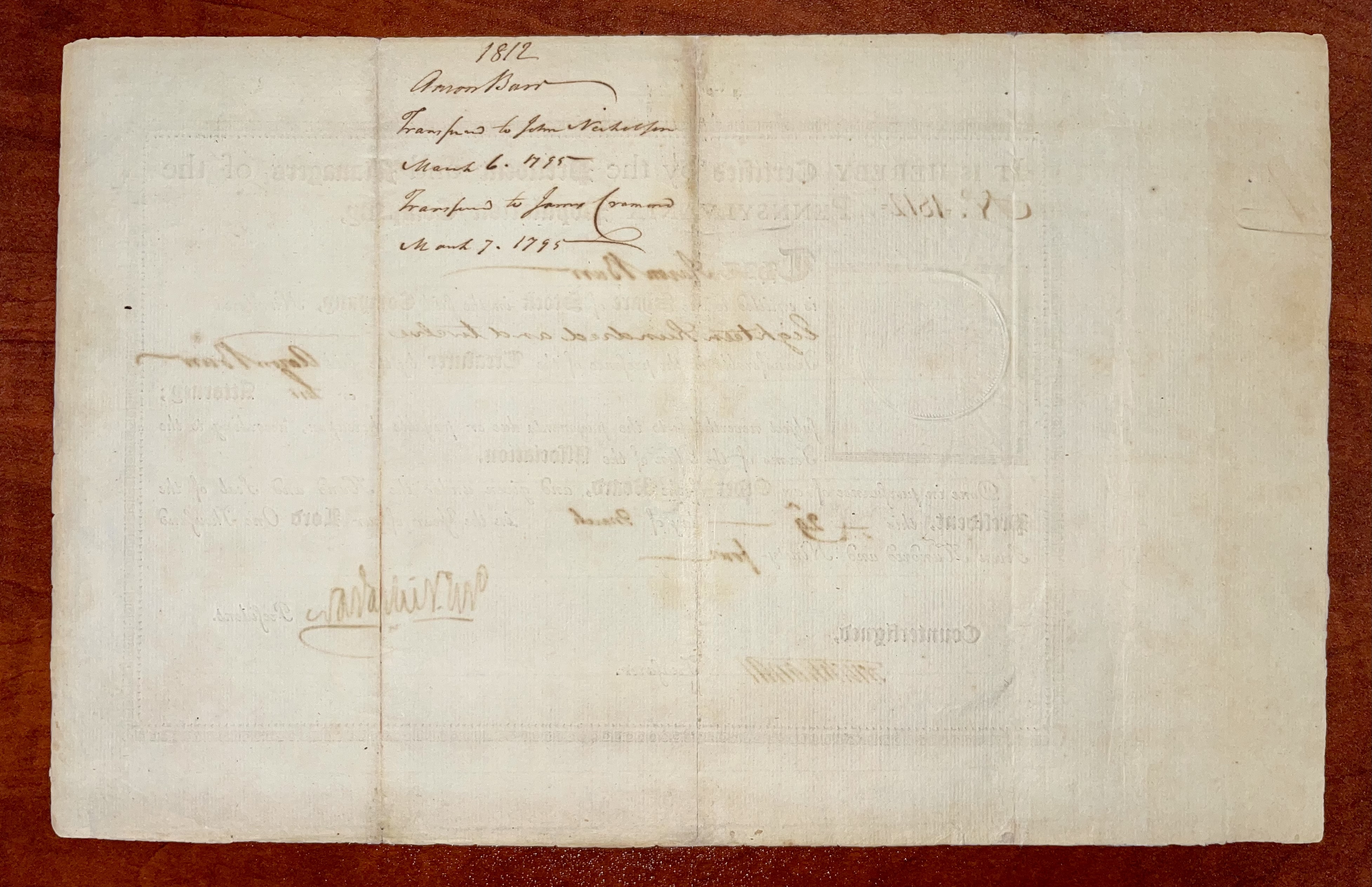
This stock is dated March 29, 1794. Certificate for one share issued to Aaron Burr, not signed. Serial #1812. No 1785. Few exist of this type. This company was formed about 1792 by John Nicholson, comptroller general of Pennsylvania, 1782-1794, and an important land speculator. Nicholson was reputed to be one of the wealthiest men in the country. With other investors, he formed the company as a cover for their monopoly of land in the Erie Triangle area. He bought 202,000 acres from the U.S. government in 1792, and also obtained warrants covering all the rest of that area (a total of some 500,000 acres). All the land was capitalized into the Pennsylvania Population Company. Nicholson was, however, impeached in 1794 for defrauding the state government, but continued his land speculation. However, land prices fell before he could resell the land, and in 1799, he was consigned to the debtor’s prison. The state acquired the land, and the company was doubtless dissolved. Nicholson himself died in prison in 1800.
The share is signed by Nicholson as President. Counter signed by Tench Francis as Treasurer. Most interestingly, this stock was issued to Aaron Burr. Burr (1756-1836) is regarded as one of the Founding Fathers of the U.S. and served as the third vice president of the United States during Thomas Jefferson's first term (1801-1805). Burr's legacy is defined by his famous personal conflict with Alexander Hamilton that culminated in Burr killing Hamilton in a duel in 1804. A highlight piece, partly because two big names in American history are found on this single share (issued to Aaron Burr, signed as president by J. Nicholson) and partly because of its age, of course. Also, the company's business - property development on a huge scale - is exemplary for the USA at that time: a country that still had to discover, populate, and develop much of its territory.
Aaron Burr (1756–1836), a brilliant yet controversial figure in early American history, is best remembered as the third U.S. vice president and the man who assassinated Alexander Hamilton. Born into a prestigious family, his grandfather was the renowned theologian Jonathan Edwards. Burr displayed exceptional talent from a young age, graduating from Princeton at the tender age of 16. He distinguished himself as a Continental Army officer during the Revolutionary War and later established a successful legal and political career in New York. Burr was a master of political organization and played a pivotal role in transforming the Tammany Society into a formidable political machine. This strategic maneuver ultimately secured him a tie with Thomas Jefferson in the presidential election of 1800, leading to his appointment as Vice President.
However, Burr’s political ascent was abruptly halted by his long-standing rivalry with Alexander Hamilton. This rivalry culminated in a fateful duel in Weehawken, New Jersey, in 1804. While the duel effectively ended Burr’s mainstream political career, his life took an even more dramatic turn when he became entangled in a mysterious plan to establish an independent empire in the American West and Mexico. This ambitious endeavor led to his arrest and trial for treason in 1807. Despite being acquitted due to a lack of concrete evidence, Burr’s reputation suffered irreparable damage. He spent several years in self-imposed exile in Europe before eventually returning to New York to practice law. Throughout his final years, Burr lived in relative obscurity, yet he remained one of the most enigmatic figures among the “Founding Fathers.”
Tench Francis Jr. (1731–1800), a prominent American merchant, Revolutionary patriot, and financier, played a pivotal role in establishing the financial and logistical foundations of the early United States. Born in Talbot County, Maryland, to a family of legal professionals, he relocated to Philadelphia, where he achieved success as a businessman and served as the agent for the Penn family’s proprietary interests. During the American Revolution, Francis wholeheartedly supported the patriot cause, reportedly contributing substantial personal funds. He also served as the inaugural cashier of the Bank of North America, which was instrumental in stabilizing the new nation’s economy.
Beyond his contributions to the war effort, Tench Francis Jr. is widely regarded as the “father” of the United States Navy Supply Corps. In February 1795, President George Washington appointed him as the first Purveyor of Public Supplies, a position established to consolidate and manage the logistical needs of the fledgling Navy. In this role, he implemented a system for procuring materials and distributing supplies, significantly enhancing operational efficiency. Later in life, he spearheaded the commission tasked with laying out the city of Pittsburgh before passing away in Philadelphia in 1800.
John Nicholson (1757–1800), a Welsh-born financier and public official, served as Pennsylvania’s first Comptroller General from 1782 to 1794. His role was pivotal in stabilizing the state’s finances after the Revolutionary War. Before the war, Nicholson had emigrated to Philadelphia and swiftly rose from a clerk in the Board of Treasury to wielding significant authority over Pennsylvania’s accounts. Many regarded him as a “virtual fiscal dictator.” During his tenure, he was a prominent Anti-Federalist who championed industrial innovation and contributed to Pennsylvania’s financial recovery. However, his tendency to intertwine personal business interests with public office drew severe criticism from Federalist opponents in the state legislature.
In 1793, Nicholson faced impeachment by the Pennsylvania House of Representatives on charges of diverting state funds and creating fraudulent certificates. Despite being acquitted by the Senate in 1794, the ensuing political turmoil led to his resignation from public office. Subsequently, he embarked on substantial, speculative land ventures in partnership with Robert Morris, acquiring millions of acres. These ventures, however, collapsed in 1797 during a market panic. Following defaulting on substantial debts, Nicholson was imprisoned. He passed away in debtors’ prison in Philadelphia on December 5, 1800, leaving behind a family and an overwhelming debt of over four million dollars.




Ebay ID: labarre_galleries