


Boss Tweed signed 1870 dated City of New York Invoice - William M. Tweed - Autograph
Inv# AU1736 Autograph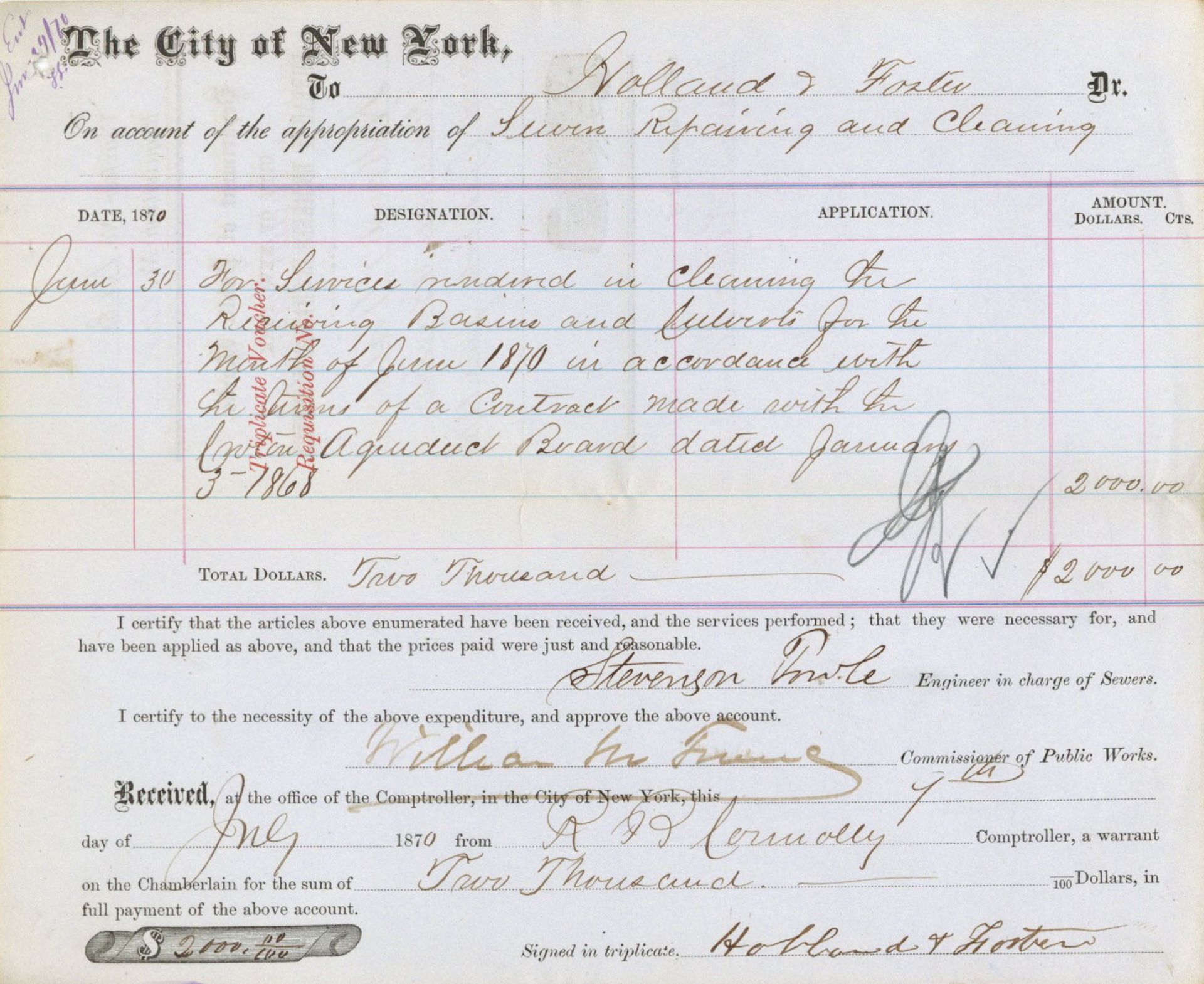
Invoice from the City of New York, Department of Public Works, signed by William M. Tweed (know as Boss Tweed).

William Magear “Boss” Tweed (1823–1878) epitomized the corruption of the Gilded Age. He rose from humble beginnings as a chairmaker and volunteer firefighter to become the undisputed ruler of New York City politics. In 1858, he assumed control of Tammany Hall, the Democratic Party’s formidable political machine. While he held various official positions, including a seat in the U.S. House of Representatives and the New York State Senate, his true power resided in his control over political patronage. By providing essential services and jobs to the city’s rapidly growing immigrant population, Tweed garnered a loyal voter base that enabled him to systematically embezzle the city’s treasury. His “Tweed Ring” siphoned an estimated $30 million to $200 million through inflated city contracts. The most notorious example was the construction of the New York County Courthouse, which cost taxpayers over $13 million for a project initially budgeted at a mere $250,000.
The downfall of “Boss” Tweed was orchestrated by a relentless media campaign spearheaded by The New York Times and the satirical cartoons of Thomas Nast in Harper’s Weekly. Nast’s caricatures proved particularly effective because they reached illiterate constituents who couldn’t read the newspaper exposés but could easily recognize Tweed as a bloated thief. In 1871, evidence of his massive fraud was leaked, leading to his arrest and subsequent conviction for forgery and larceny in 1873. After a daring escape to Spain in 1875—ironically identified by authorities through a Nast cartoon—he was extradited back to the United States. Tweed spent his final years in the Ludlow Street Jail, a facility he had once helped fund during his time in power. Tragically, he succumbed to pneumonia in 1878. Despite his notoriety, he is also credited with spearheading significant infrastructure projects that contributed to New York’s growth, including the widening of Broadway and the early development of Central Park.




Ebay ID: labarre_galleries