


Stockholders Divident Sheet of Hudson River Rail Road Co. signed by Commodore Cornelius Vanderbilt - Autographs
Inv# AU1272C Stock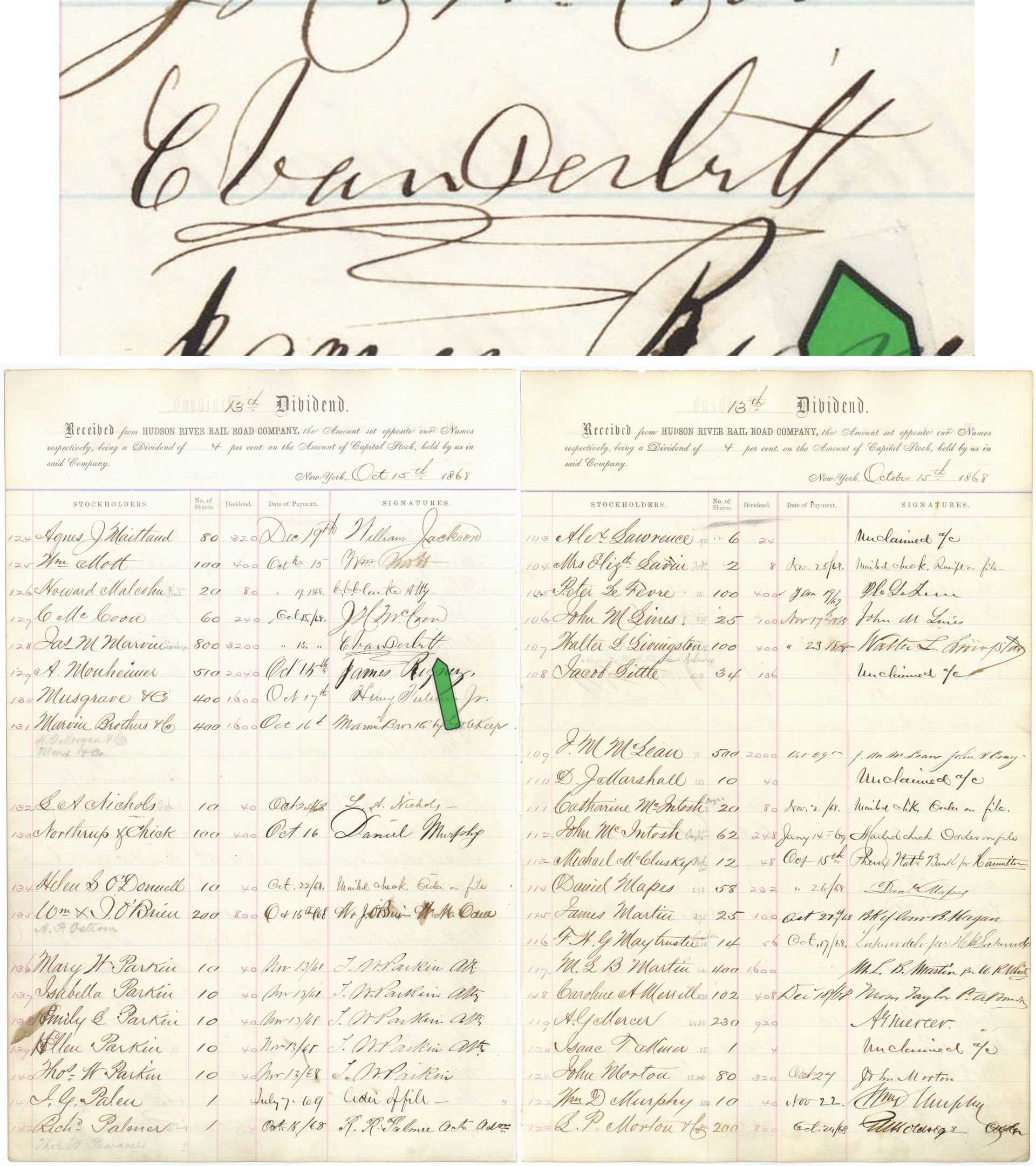
2 sided Stockholders Sheet for the Hudson River Railroad Company signed by Commodore Cornelius Vanderbilt.

Commodore Cornelius Vanderbilt (1794-1877) was a steamship and railroad promoter and capitalist. He founded the family fortune that still exists today and stands as one of the greatest American capitalists. Vanderbilt’s journey began at the tender age of 16 when he became the owner-operator of a small ferryboat that operated between Staten Island and New York City. After several years of running a hotel and various other enterprises, Vanderbilt ventured into the steamboat business in 1829, operating a shipping service on the Hudson River. By the early 1850s, he had established numerous shipping lines, extending his routes to Europe and San Francisco via a Nicaraguan land route. Vanderbilt’s dominance in the steamboat industry was widely recognized, and he earned the prestigious title of “Commodore” around 1845 due to his significant shipping interests.
As he approached his 70th birthday, Vanderbilt decided to sell his shipping interests and shift his focus to railroads. This move led to the creation of one of the nation’s most remarkable transportation systems. Vanderbilt’s journey in railroads began in the early 1860s when he acquired control of the New York & Harlem Railroad. Shortly after, he took over the struggling Hudson River Railroad. However, Daniel Drew and other stock manipulators attempted to exploit Vanderbilt’s interests by short-selling stock in these companies and attempting to drive down the stock price. Vanderbilt, however, outsmarted their schemes, resulting in substantial financial losses for many of his adversaries.
In 1867, Vanderbilt acquired the New York Central Railroad, and in 1869, he merged it with the Hudson River Railroad, forming the New York Central & Hudson River Railroad. However, in 1868, Vanderbilt attempted to gain control of the Erie Railroad but was outwitted by Drew, James Fisk, and Jay Gould, who were in control of the railroad. They dumped 50,000 shares of fraudulent stock on the market, hoping that Vanderbilt would buy them up. The trio then escaped to New Jersey to avoid both Vanderbilt’s wrath and prosecution for their scheme. Vanderbilt’s well-documented battles with Drew and Gould for control of the New York & Harlem, Hudson River, and Erie railroads became some of the most colorful and exciting pages in U.S. financial history.
In 1873, convinced by his son, William, that they should extend their rail system to Chicago, Vanderbilt bought the Lake Shore & Michigan Southern Railway. In 1875, he acquired the Michigan Central and Canada Southern railroads. During the panic of 1873, Vanderbilt announced that the New York Central would continue paying its dividends and even let out contracts for the construction of the Grand Central Terminal. In this way, Vanderbilt used his wealth as a stabilizing influence in the U.S. economy during the final years of his life.
A stock certificate is issued by businesses, usually companies. A stock is part of the permanent finance of a business. Normally, they are never repaid, and the investor can recover his/her money only by selling to another investor. Most stocks, or also called shares, earn dividends, at the business's discretion, depending on how well it has traded. A stockholder or shareholder is a part-owner of the business that issued the stock certificates.




Ebay ID: labarre_galleries