


Sidney Dillon signed Oregon and Transcontinental Co. - 1888 dated Autograph Railroad Stock Certificate
Inv# AU1521 Stock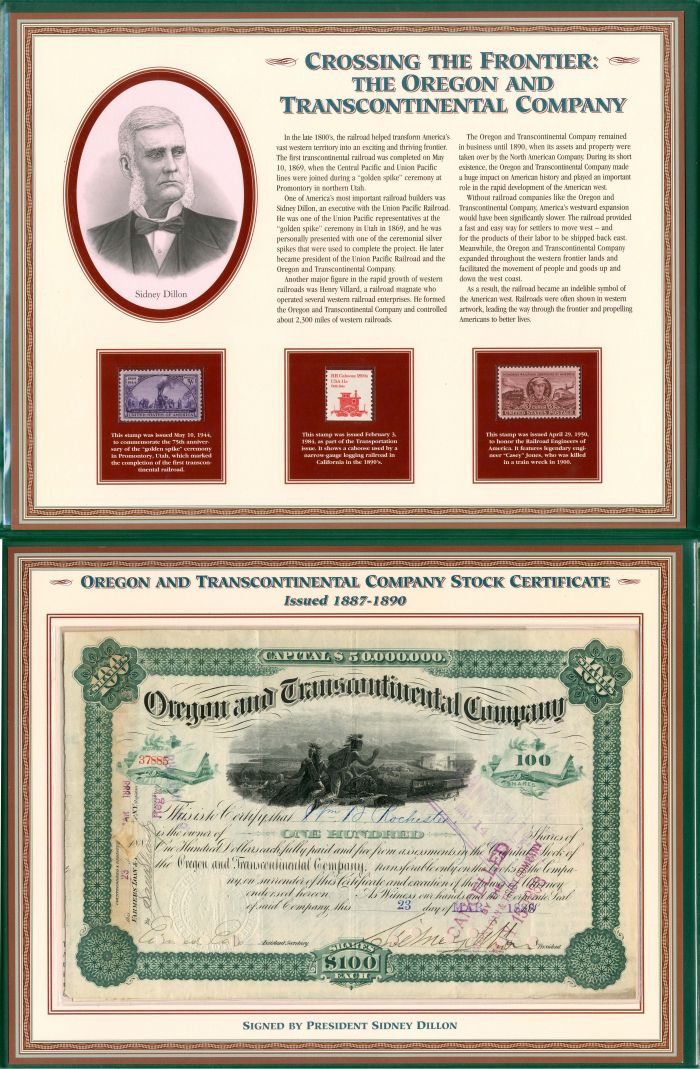
Stock and information page signed by Sidney Dillon inside Postal Commemorative Society binder.
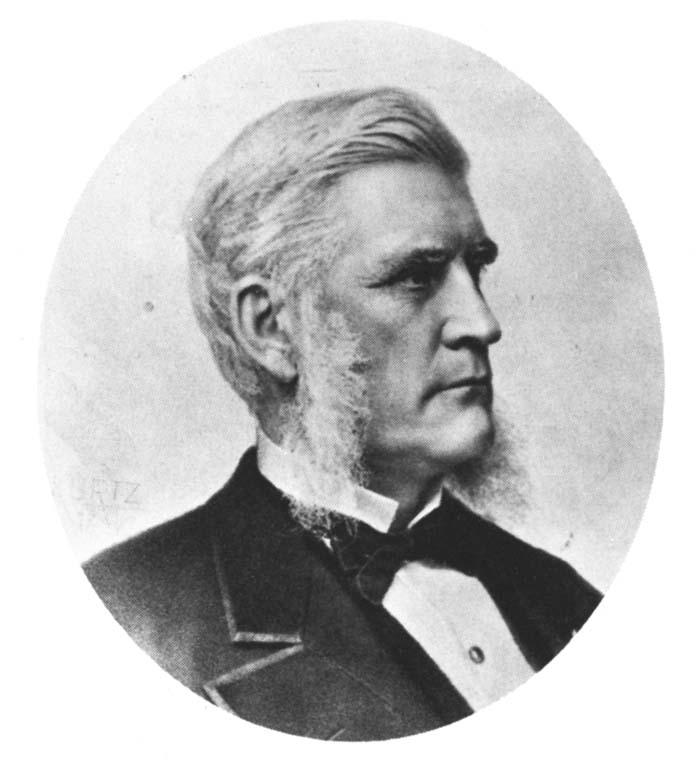
Sidney Dillon, an American industrialist and railroad executive, played a significant role in the construction of the First transcontinental railroad in the 19th century. His journey began as a humble water boy on the Mohawk and Hudson Railroad, but he eventually rose to become the president of the Union Pacific Railroad, serving multiple terms between 1874 and 1892.
Dillon was a key figure at the 1869 “Golden Spike” ceremony in Promontory, Utah, which marked the completion of the transcontinental line. He famously kept one of the ceremonial silver spikes on his desk for the rest of his life. His legacy is preserved in the names of several American towns, including Dillon, Montana, and Sidney, Nebraska.
Beyond his operational leadership, Dillon was a major financier and a central, though controversial, figure in the expansion of American infrastructure. He was heavily involved with the Crédit Mobilier of America, a construction company used by Union Pacific officers to manipulate stock prices and over-invoice the U.S. government. This led to one of the era’s most significant political scandals. Despite these controversies, Dillon’s influence extended into other major industries through his service on the board of the Western Union Telegraph Company and his collaboration with notable financiers like Jay Gould.
Dillon passed away in New York City in 1892, leaving behind a complex legacy as a master builder of the Gilded Age.
The Oregon and Transcontinental Company, a prominent 19th-century American holding company, was established in 1881 by financier Henry Villard. Incorporated in Oregon, its primary objective was to consolidate control over two significant transportation entities: the Northern Pacific Railroad and the Oregon Railway and Navigation Company. Villard’s strategic move involved acquiring a dominant stake in these firms, aiming to secure a monopoly on rail access to the Pacific Northwest. This strategic move effectively made Portland the primary terminus for transcontinental traffic, preventing rival lines from bypassing his established networks.
However, despite its initial strategic dominance, the company faced significant financial challenges due to aggressive expansion policies and the payment of unjustified dividends. By the late 1880s, the firm was entangled in legal and financial disputes with prominent competitors such as the Union Pacific Railroad. Recognizing the need for more favorable corporate laws, the Oregon and Transcontinental Company sought to re-incorporate in New Jersey in 1890. This transformation led to its renaming as the North American Company. This transition allowed the company to diversify its investments beyond railroads, expanding into a broader range of businesses. Nevertheless, its original rail interests were eventually absorbed by larger corporations like the Union Pacific.
A stock certificate is issued by businesses, usually companies. A stock is part of the permanent finance of a business. Normally, they are never repaid, and the investor can recover his/her money only by selling to another investor. Most stocks, or also called shares, earn dividends, at the business's discretion, depending on how well it has traded. A stockholder or shareholder is a part-owner of the business that issued the stock certificates.




Ebay ID: labarre_galleries