


50 Pieces of Chase Manhattan Corporation - With David Rockefeller's Facimile Signature - 50 Stock Certificates dated 1969-70
Inv# WW1024 Stock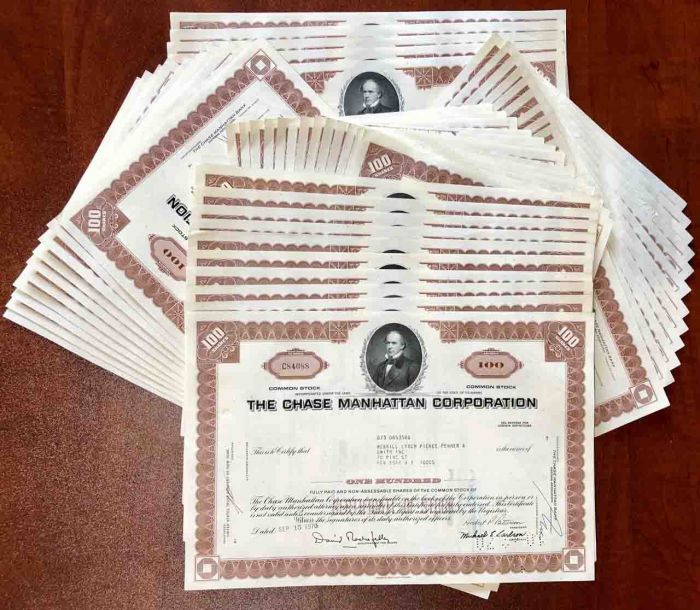
Classic vignette of Secretary of the Treasury, Salmon P. Chase by American Bank Note. One of the largest banks in the world. Mixed colors. 50 pieces.
The history of the Chase Manhattan Corporation is intertwined with two prominent 19th-century New York institutions. The earliest predecessor, the Bank of the Manhattan Company, was established in 1799 by Aaron Burr under the guise of a water utility. Burr ingeniously incorporated a charter clause that allowed the company to utilize surplus capital for banking purposes, enabling it to compete with Alexander Hamilton’s Bank of New York. Decades later, in 1877, John Thompson founded Chase National Bank, naming it in honor of the former U.S. Treasury Secretary, Salmon P. Chase. By the mid-20th century, Chase National had emerged as one of the world’s largest commercial banks, primarily due to its aggressive acquisitions and close association with the Rockefeller family.
The modern entity began to take shape in 1955 when the Bank of the Manhattan Company and Chase National Bank merged to form The Chase Manhattan Bank. Although Chase National was the larger institution, the merger was legally structured as an acquisition by the Manhattan Company to safeguard its unique 1799 charter. In 1969, under the leadership of David Rockefeller, the bank underwent a reorganization and transformed into a holding company known as the Chase Manhattan Corporation. This era witnessed the bank’s pioneering global expansions and technological advancements, including the introduction of early automated teller machines (ATMs). In 1996, the corporation was acquired by Chemical Banking Corporation, which retained the esteemed “Chase” name. This trajectory culminated in 2000 with a merger with J.P. Morgan & Co., resulting in the formation of the present-day JPMorgan Chase & Co.
A stock certificate is issued by businesses, usually companies. A stock is part of the permanent finance of a business. Normally, they are never repaid, and the investor can recover his/her money only by selling to another investor. Most stocks, or also called shares, earn dividends, at the business's discretion, depending on how well it has traded. A stockholder or shareholder is a part-owner of the business that issued the stock certificates.




Ebay ID: labarre_galleries