


1777 dated Oliver Ellsworth, Jesse Root and William Pitkin signed Revolutionary War Pay Order - Connecticut - American Revolutionary War Autograph
Inv# CT1358 Autograph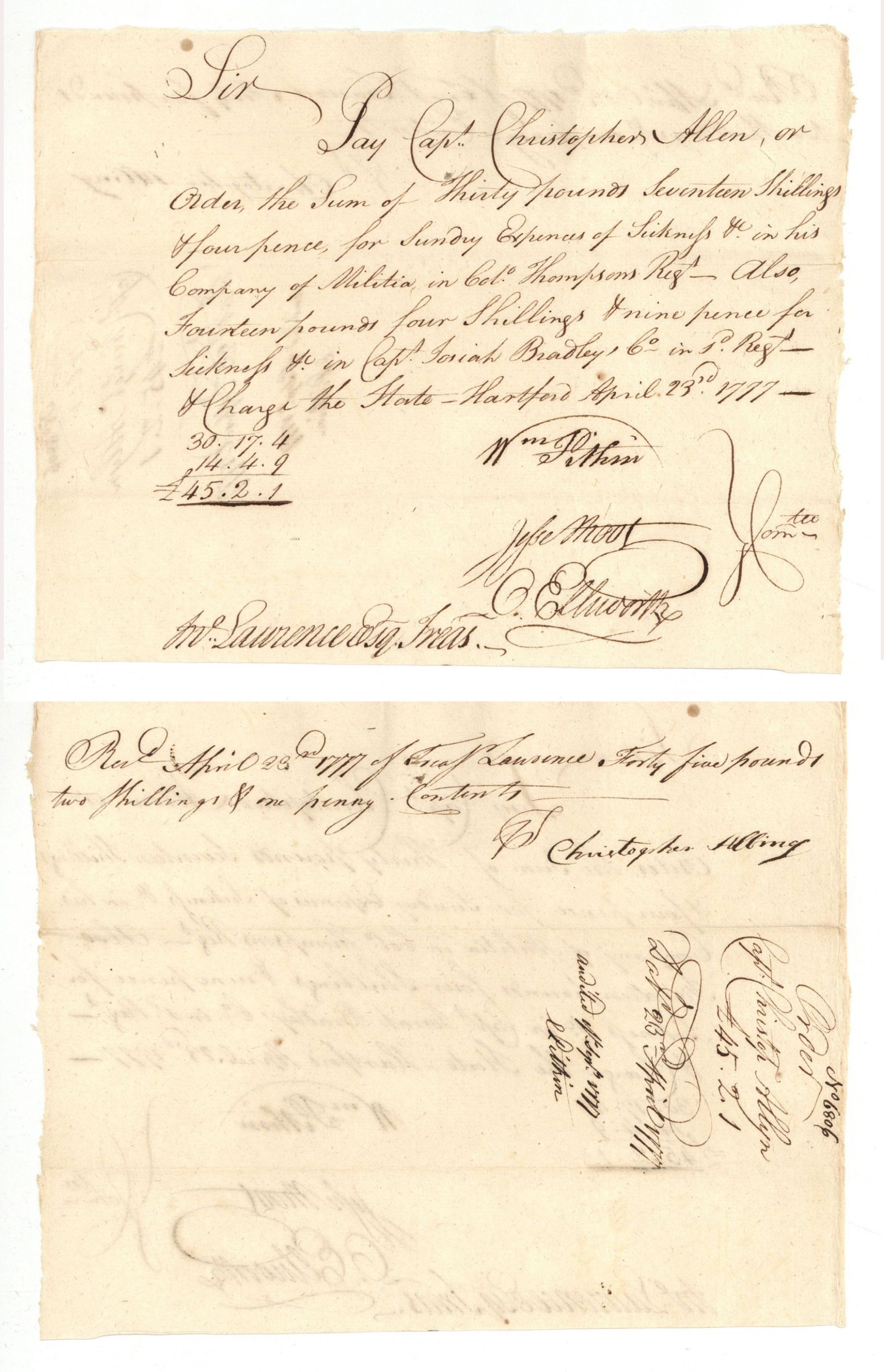
Pay Order signed by Oliver Ellsworth, Jesse Root and William Pitkin. Front and back shown.
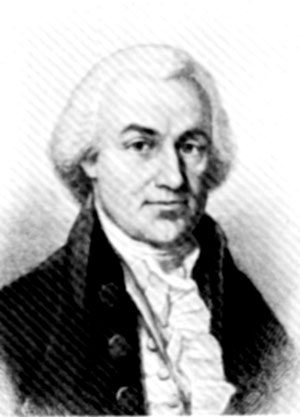
Oliver Ellsworth (April 29, 1745 – November 26, 1807) was a prominent Founding Father of the United States, recognized for his roles as an attorney, jurist, politician, and diplomat. He played a significant part in the drafting of the United States Constitution, served as a United States senator from Connecticut, and held the position of the third chief justice of the United States. In the 1796 presidential election, he garnered 11 electoral votes.
Ellsworth's contributions were instrumental in securing Connecticut's ratification of the Constitution, and he was elected as one of the first two senators from the state, serving from 1789 to 1796. He was the principal author of the Judiciary Act of 1789, which established the framework for the federal judiciary and affirmed the Supreme Court's authority to invalidate state supreme court rulings that conflicted with the United States Constitution. As a key ally of Alexander Hamilton in the Senate, Ellsworth was affiliated with the Federalist Party and played a pivotal role in the passage of Hamilton's initiatives, including the Funding Act of 1790 and the Bank Bill of 1791. He also supported the United States Bill of Rights and the Jay Treaty.

Jesse Root (December 28, 1736 – March 29, 1822) was a prominent American minister and attorney hailing from Coventry, Connecticut. Throughout the American Revolution, he played a significant role on the Connecticut Council of Safety and within the Connecticut militia. Initially appointed as a lieutenant colonel in Peekskill in 1777, he advanced to the position of Adjutant-General of the Connecticut Line. Root represented Connecticut as a delegate to the Continental Congress from 1778 to 1782 and served as the chief justice of the Connecticut Supreme Court from 1796 to 1807, in addition to holding the position of a state court judge. He was an active member of the Connecticut House of Representatives and participated in the Connecticut Constitutional Convention. Furthermore, he was affiliated with the First Company, Governor's Foot Guard, where he held the role of commandant from May 1798 to October 1802. His lineage includes his grandson, Austin Cornelius Dunham.
William Pitkin IV was born in 1725 (Died 1789), the Honorable, Colonel William Pitkin IV, a son of Governor William Pitkin, was a member of a family dynasty then at its peak as one of a handful of powerful families that ran the affairs of first the colony and then the state of Connecticut throughout the entire 18th century.
The Pitkins were a wealthy extensive clan of blended generations, securely based on the east side of the Great River. William Pitkin continued carrying on long established family traditions in law, politics and entrepreneurial endeavors. Like his father he was a prominent lawyer who became a Superior Court judge. As a politician, he was elected to the 2nd Continental Congress in 1784, and was Clerk of the State Legislature for 19 years.
Pitkin was also an entrepreneur of much business acumen, involved in a variety of already established family endeavors, plus in the founding of new ones. Pitkins were always part of the Congregational Church, the establishment church of Connecticut. For instance, one brother Timothy, a Yale graduate, followed in the steps of his maternal grandfather and namesake, in becoming a Congregational minister in Farmington Connecticut.
Early in the Revolutionary War, William and his brother George were partners in what is believed to be the country’s first gunpowder mill. The mill was located on the Hochanum River across from the site of the present day Marco Polo Restaurant. Not long after the Revolutionary War the mill was badly damaged by fire. Being Pitkins always in search of new sources of income, William and George joined Pitkin cousins Richard and Ellisha and other investors to found the Pitkin Glass Works in Manchester, then the Orford Parish of East Hartford.
Glass making was a difficult and expensive business, but in recompense for their losses in supplying gun powder to the Connecticut militias the State Legislature granted them a 25 year, tax-free, monopoly, thus making potential profit seem feasible for their chancy investment. The Glass Works was the first successful glass factory in Connecticut, remaining in business until about around 1830. Romantic stone ruins of the factory still remain, and examples of Pitkin glass are now rare, quite expensive, and much sought after by collectors.




Ebay ID: labarre_galleries