


1778-1786 dated Connecticut Line Notes Issued to Samuel Squire - Connecticut - American Revolutionary War - Very Rare to Find
Inv# CT1177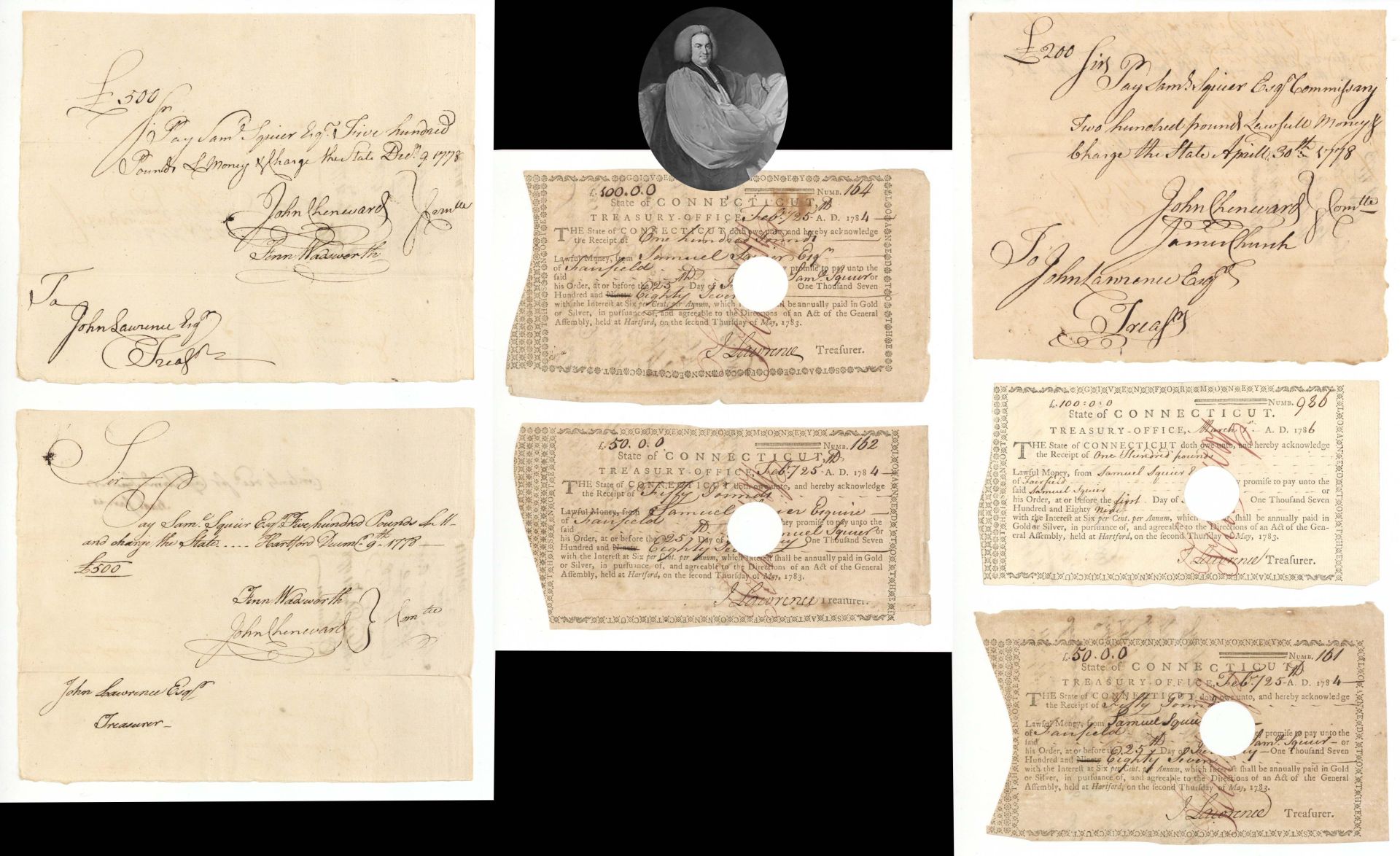
7 Connecticut Line Notes all issued to Samuel Squire. American Revolutionary War. Rare!

Samuel Squire (1714 – 7 May 1766) was a Bishop of the Church of England and a historian. Squire was the son of a druggist in Warminster, Wiltshire, and was first educated at Lord Weymouth's Grammar School. He matriculated at St John's College, Cambridge in 1730 and graduated BA in 1734, winning the Craven scholarship the same year. He was elected a fellow of St John's in 1735, proceeded MA in 1737, and was made a Doctor of Divinity in 1749. Squire began his church career in 1739 when he was ordained a deacon of the Church of England; he was ordained priest in 1741, in which year he was appointed vicar of Minting, Lincolnshire. In 1743 was made a canon of Wells Cathedral, and Archdeacon of Bath, holding both preferments until 1761. Adding to his growing number of parish livings, he was appointed rector of Toppesfield, Essex (1749–50) and subsequently of St Anne's Church, Soho (1750–66), and vicar of St Alphege's, Greenwich (1751–66), where William Paley, who later achieved fame as a theologian and philosopher, served as his curate. He was briefly Dean of Bristol (1760) and was finally appointed Bishop of St David's in 1761. His attainment of offices was due to his open attachment to the court Whigs; he was chaplain to the Duke of Newcastle, whose use of patronage for the court Whig interest was renowned. In the 1740s Squire published five essays on political subjects in which he voiced his support for the Whig party. His Letter to a Young Gentleman of Distinction (1740) argued for the benefits of a standing army against a militia to protect Britain in its wars against France and Spain. Squire advocated Britain's continental commitment of troops in The Important Question Discussed (1746). He came to the aid of Henry Pelham's administration by trumpeting its Whig principles in A Letter to a Tory Friend (1746). Squire also disputed the arguments of the Jacobite historian Thomas Carte by publishing two pamphlets in 1748: Remarks upon Mr. Carte's Specimen and A Letter to John Trot-Plaid. In the Remarks, Squire used natural law theory to contend against Carte's support of the House of Stuart, and in A Letter he satirised Carte by mocking his interpretation of the past in terms of the present.
Squire also published two works on English history, An Enquiry into the Foundation of the English Constitution (1745) and Historical Essay upon the Balance of Civil Power in England (1748). In An Enquiry, Squire wrote on the German and Anglo-Saxon love of liberty and constitutionalism. In his Historical Essay, Squire wrote that liberty depended upon an equipoise among competing institutions and groups in society, suggesting that whenever such an equipoise collapses an arbitrary government takes its place. The Glorious Revolution of 1688 had ended the struggle to secure a balance and thus ensure liberty.
The Connecticut Line was a formation within the Continental Army. The term "Connecticut Line" referred to the quota of numbered infantry regiments assigned to Connecticut at various times by the Continental Congress, the size of its allocation determined by the size of its population relative to that of other states. These, together with similarly apportioned contingents from the other twelve states, formed the Continental Line. The concept was particularly important in relation to the promotion of commissioned officers. Officers of the Continental Army below the rank of brigadier general were ordinarily ineligible for promotion except in the line of their own state.
In the course of the war, 27 infantry regiments were assigned to the Connecticut Line. This included the eight provincial regiments of 1775, Wooster's Provisional Regiment (formed by consolidation of the remnants of the original 1st, 4th, and 5th Regiments), the five numbered Continental regiments of 1776, the eight Connecticut regiments of 1777, S.B. Webb's Additional Continental Regiment, which later became the 9th Connecticut Regiment, and four new regiments created by consolidation in 1781.
Not all Continental infantry regiments raised in a state were part of a state quota, however. On December 27, 1776, the Continental Congress gave Washington temporary control over certain military decisions that the Congress ordinarily regarded as its own prerogative. These “dictatorial powers” included the authority to raise sixteen additional Continental infantry regiments at large.
Early in 1777, Washington offered command of one of these additional regiments to Samuel Blatchley Webb, who accepted. Webb had formerly served as one of Washington’s personal aides. Webb’s Regiment was allotted to the Connecticut Line on July 24, 1780, and officially designated the 9th Connecticut Regiment. The 9th Connecticut Regiment was consolidated with the 2d Connecticut Regiment on January 1, 1781.




Ebay ID: labarre_galleries