


U.S. Treasury Document - 1940's dated FORM TFEL-2 - Engraved portrait of John Marshall - Americana
Inv# TB1011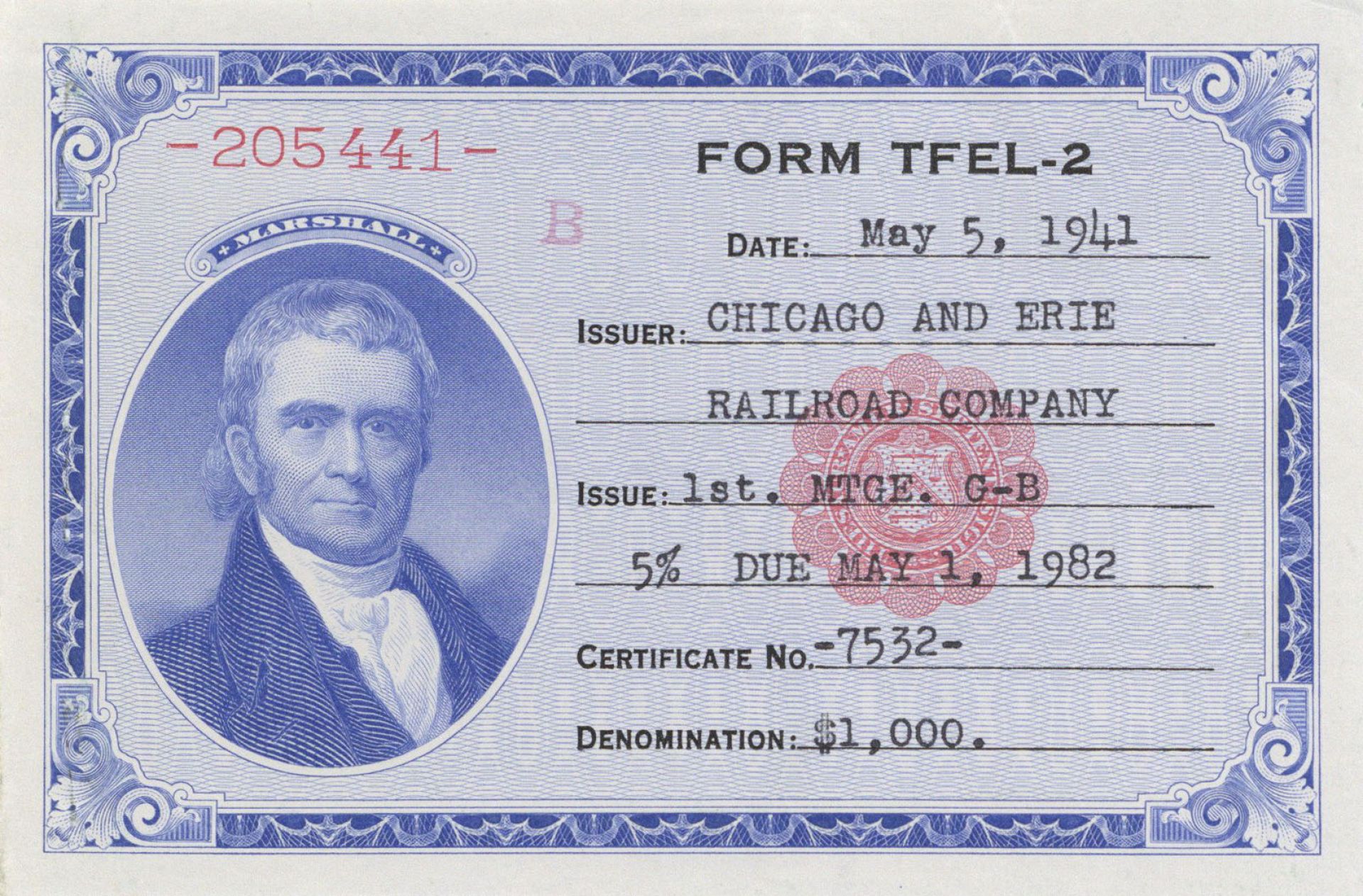
Form TFEL-2. Engraved portrait of John Marshall and red Treasury Seal. Likely printed by the Bureau of Engraving and Printing. Sometimes found with old bonds. Size 3.625" x 5.25". Attractive. This small certificate bears a U.S. Treasury Department Seal and is sporadically found attached to bonds (and occasionally stocks). The certificates encountered so far seem to date from 1941 to 1943.
Form TFEL-2, a specific U.S. Treasury document, played a crucial role during the economic defense measures of the early 1940s. This period was marked by the onset of World War II and the implementation of foreign funds control regulations. The primary function of Form TFEL-2 was to accompany securities placed in the United States for safekeeping when presented to a Federal Reserve Bank. This was required by a specific deadline: on or before February 1, 1942, provided it was accompanied by a description on Form TFR-10. The regulations, including the use of Form TFEL-2, aimed to safeguard American financial institutions from potential adverse claims related to the war and prevent a conquering nation from acquiring the financial assets of the conquered country held within the U.S.
After the initial deadline, the process for attaching Form TFEL-2 became more discretionary and stringent. The Secretary of the Treasury had the authority to grant exceptions, but only after the applicant filed an appropriate application with a Federal Reserve Bank. This application required a detailed tracing of the security’s ownership history since January 1, 1942, and a satisfactory explanation for why the security had not been presented before the February 1 deadline. Form TFEL-2 serves as a historical artifact, a tangible reminder of the extensive financial controls implemented by the U.S. government to stabilize the financial system and manage foreign assets during a time of global conflict.
John Marshall, the fourth Chief Justice of the United States, is widely regarded as the architect of the American judicial system. Appointed by President John Adams in 1801, Marshall served an unprecedented 34 years, the longest tenure of any Chief Justice in history. Before his illustrious judicial career, he held various positions, including captain in the Continental Army during the American Revolution, diplomat to France, and U.S. Secretary of State. As a staunch Federalist, he dedicated his life to strengthening the federal government, often clashing with political rivals like his cousin Thomas Jefferson.
Marshall’s greatest legacy lies in establishing the Supreme Court as a co-equal branch of government through the principle of judicial review. In the landmark 1803 case Marbury v. Madison, he asserted the Court’s authority to invalidate laws that contradict the Constitution, famously declaring, “It is the province and duty of the Judicial Department to say what the law is.” His subsequent decisions, such as McCulloch v. Maryland and Gibbons v. Ogden, further solidified federal supremacy over state laws and expanded the scope of the Commerce Clause. By the time of his passing in 1835, Marshall had transformed the judiciary into a formidable, independent institution, ensuring that the Constitution remained the supreme law of the land.




Ebay ID: labarre_galleries