

Maryland Trust Co. for a $1,000 Bond of the Georgia and Alabama Railroad Company - 1895 dated Unissued Gold Railway Bond
Inv# BS1039 Stock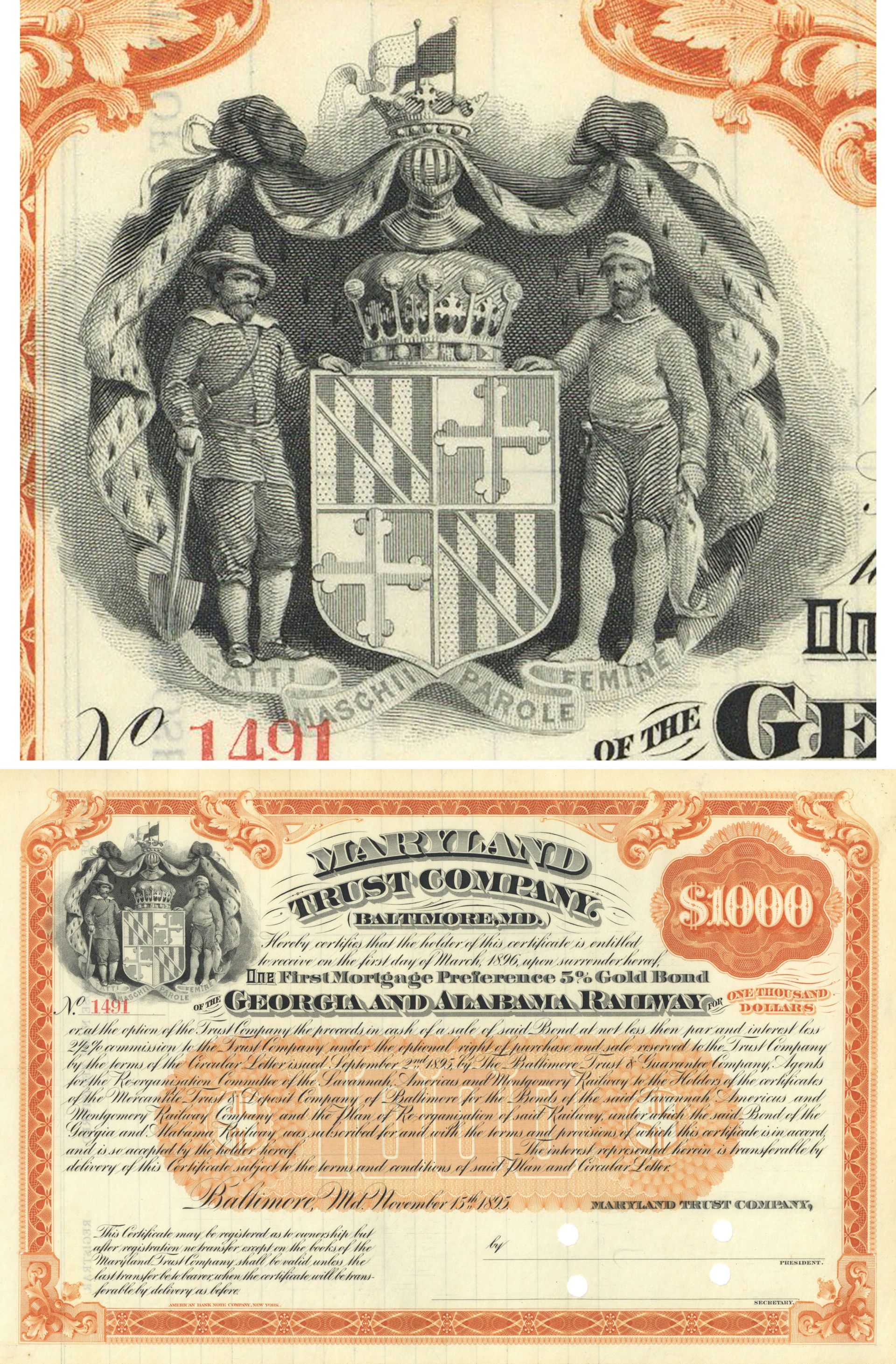
Nice vignette by American Bank Note Co.
The Maryland Trust Company, a prominent financial institution based in Baltimore, was established during the late 19th-century boom of post-Civil War commerce. By the turn of the century, it operated out of a one-story Beaux-Arts building designed by the architectural firm Wyatt and Nolting at 23-27 East Baltimore Street. This structure was remarkable for its survival of the Great Baltimore Fire of 1904, a devastating event that destroyed much of the city’s central business district, but left the bank’s fireproof masonry intact.
As the regional banking landscape evolved through the mid-20th century, the Maryland Trust Company underwent significant consolidation. In 1959, it joined a larger network through a series of mergers, eventually becoming a part of the County Trust Company of Maryland. By 1961, these entities merged with Baltimore National Bank to form Maryland National Bank. This bank served as one of the state’s largest financial pillars for decades before its eventual integration into larger national systems like NationsBank and Bank of America.
The Georgia and Alabama Railway, with its roots in the mid-19th century, began with the incorporation of the original Georgia and Alabama Railroad in Rome, Georgia, in 1853. After the Civil War, the line underwent several consolidations in 1866, including the Dalton and Jacksonville Railroad and the Alabama and Tennessee River Railroad Company. It briefly operated under the name Selma, Rome and Dalton Railroad Company before reverting to its original name in various business dealings. By 1895, under the leadership of John Skelton Williams, an entrepreneur, the system was reorganized as the Georgia and Alabama Railway. Williams significantly expanded its reach, connecting Savannah, Georgia, to Montgomery, Alabama, over approximately 458 miles of track.
At the turn of the 20th century, the railway became a crucial component of the growing Seaboard Air Line (SAL) Railway. In 1899, Williams’ syndicate leveraged the Georgia and Alabama’s extensive terminal properties in Savannah to acquire a controlling interest in the Seaboard and Roanoke Railroad. This led to the formal formation of the SAL system in 1900. Under Seaboard control, the former G&A routes became vital corridors for both passenger and freight traffic, including the renowned “Red Ball” express freights, until the mid-20th century. Although the company name eventually faded into the larger Seaboard identity and later into CSX Transportation through the 1967 merger with the Atlantic Coast Line, portions of the route remain active today as essential components of the Southeastern rail network.
A stock certificate is issued by businesses, usually companies. A stock is part of the permanent finance of a business. Normally, they are never repaid, and the investor can recover his/her money only by selling to another investor. Most stocks, or also called shares, earn dividends, at the business's discretion, depending on how well it has traded. A stockholder or shareholder is a part-owner of the business that issued the stock certificates.
| You may be interested in these related items: | |
|---|---|
|
Maryland Trust Co. - Stock Certificate BS1022 |




Ebay ID: labarre_galleries