

Mesa Petroleum Co. - Founded by T. Boone Pickens - Important Court Case with Unocal Corp. - 1974-78 dated Stock Certificate - Amazing Story
Inv# OS1132 Stock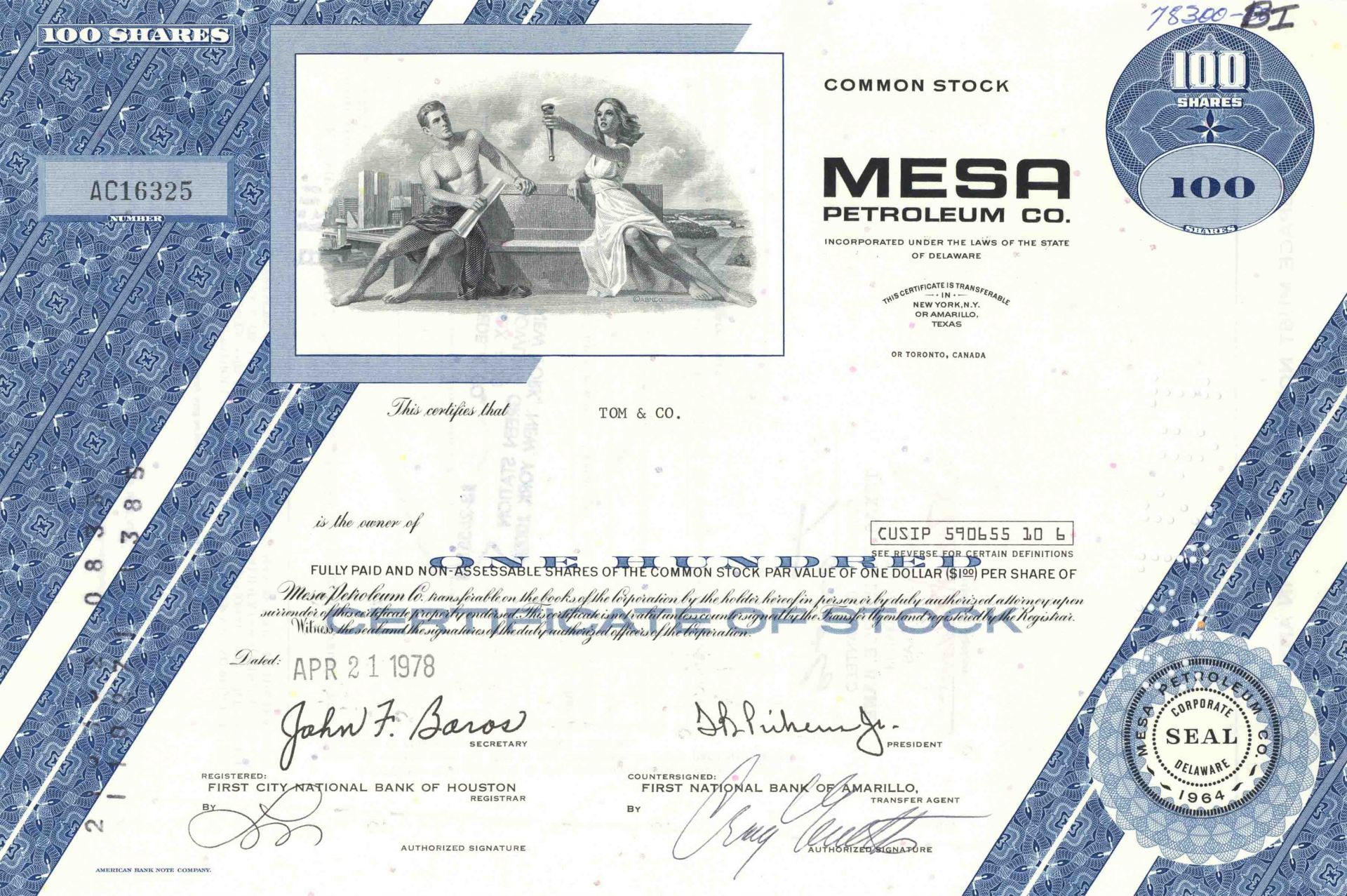
American Bank Note Co.
Mesa Petroleum Co. embarked on its journey in 1956 when the renowned and often polarizing figure T. Boone Pickens founded it as Petroleum Exploration, Inc. Based in Amarillo, Texas, the company initially concentrated on oil and gas exploration in the Texas Panhandle and Canada. After going public in 1964 and rebranding as Mesa Petroleum, it swiftly established a reputation for aggressive growth. By the 1970s, Mesa had emerged as one of the largest independent oil companies in the United States, propelled by Pickens’ exceptional ability to identify undervalued assets and his pioneering adoption of innovative financing strategies that challenged the dominance of “Big Oil.”
The 1980s witnessed a transformative and contentious phase for Mesa as it transitioned from a conventional producer to a vehicle for corporate raiding. Pickens leveraged Mesa to initiate audacious, multi-billion dollar hostile takeover bids against industry giants such as Gulf Oil, Phillips Petroleum, and Unocal. While Mesa’s success in acquiring these giants was limited, the strategic maneuvers often compelled restructurings that resulted in stock price increases, ultimately yielding substantial profits for Mesa and its shareholders. However, the substantial debt accumulated during these battles, coupled with a sharp decline in natural gas prices in the early 1990s, eventually strained the company’s financial stability. Consequently, Pickens departed in 1996, leading to Mesa’s eventual merger with Parker & Parsley in 1997, resulting in the formation of Pioneer Natural Resources.
Unocal v. Mesa Petroleum Co., 493 A.2d 946 (Del. 1985), a landmark Delaware Supreme Court decision, addressed corporate defensive tactics against takeover bids. Prior to Unocal, the Delaware courts applied the business judgment rule to takeover defenses, mergers, and sales.
In Unocal, the Court ruled that a board of directors can only prevent a takeover if there’s a threat to corporate policy and the defensive measure is proportional and reasonable. This is known as the Unocal test for board of directors, later modified in Unitrin, Inc. v. American General Corp., which required the tactics to be “coercive” or “preclusive.”
Mesa Petroleum’s hostile bid for Unocal Corporation involved a front-end loaded two-tiered deal: $54 in cash and $54 in junk bonds. Shareholders were expected to tender their shares, even if they deemed the price unfair. Refusal to tender risked being cashed-out for risky debt instruments instead of cash.
A stock certificate is issued by businesses, usually companies. A stock is part of the permanent finance of a business. Normally, they are never repaid, and the investor can recover his/her money only by selling to another investor. Most stocks, or also called shares, earn dividends, at the business's discretion, depending on how well it has traded. A stockholder or shareholder is a part-owner of the business that issued the stock certificates.




Ebay ID: labarre_galleries