

Standard Oil Trust issued to L.L. Rothschild and signed by John D. Archbold and W.H. Tilford - 1895 dated Autographed Stock Certificate
Inv# AG3008 Autograph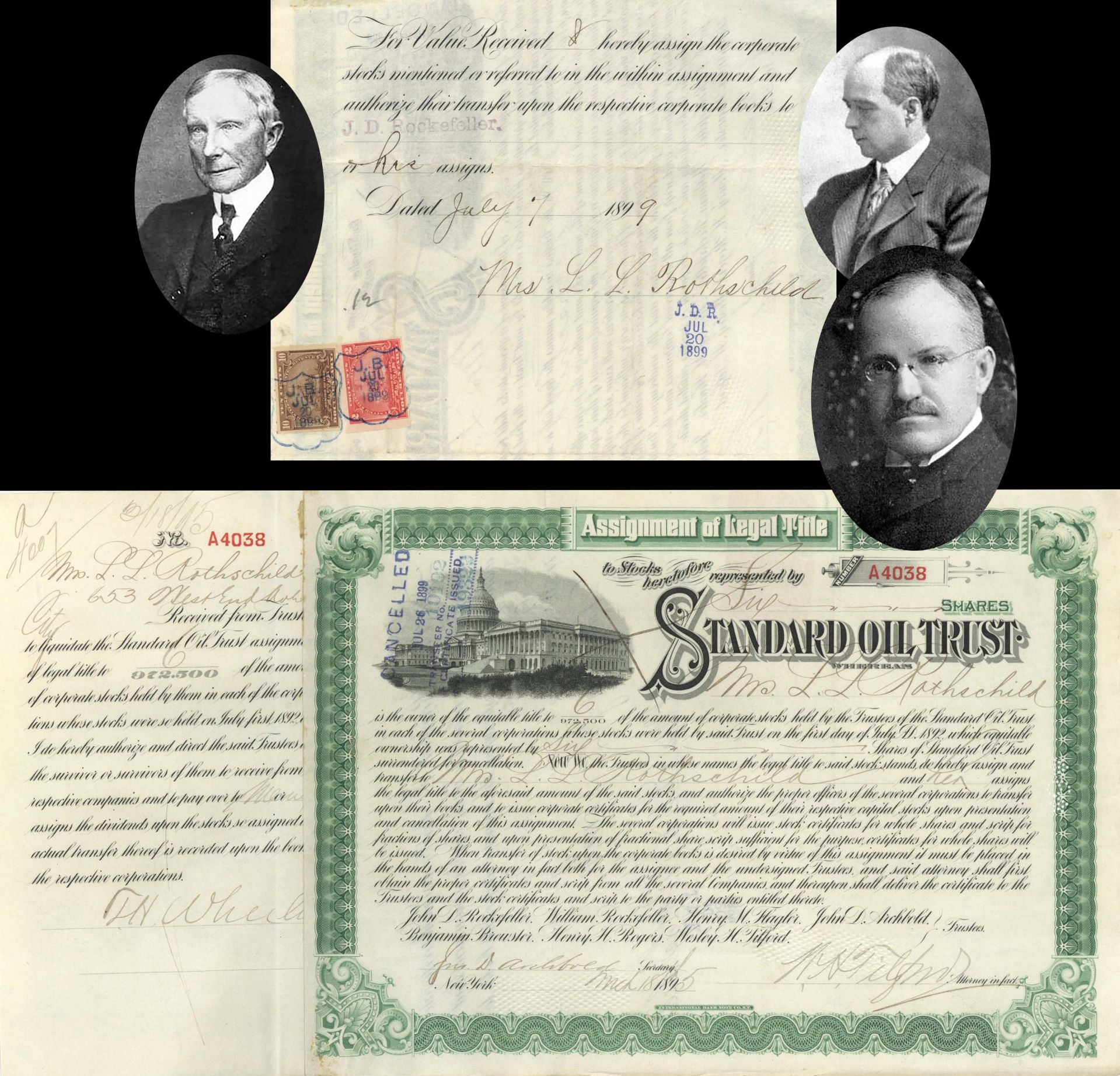
Stock issued to L.L. Rothschild and signed by W.H. Tilford as attorney and Jno.D. Archbold as secretary. Transferred to J.D. Rockefeller on back as well. Portraits and biographies of all three included. 2 and 10 cents revenue stamps on back! Further research needed on Rothschild.

John Dustin Archbold (July 26, 1848 in Leesburg, Ohio – December 6, 1916 in Tarrytown, New York) was an American capitalist and one of the United States' earliest oil refiners. His small oil company was bought out by John D Rockefeller's Standard Oil Company. Archbold rose rapidly at Standard Oil, handling many of the complex secret negotiations over the years. By 1882 he was Rockefeller's closest associate, and typically acted as the company's primary spokesman. Rockefeller after 1896 left business matters to Archbold while he pursued his philanthropy; as vice president Archbold effectively ran Standard Oil until his death in 1916. Inspired by Rockefeller's policies, Archbold's main goals were stabilization, efficiency, and minimizing waste in refining and distributing petroleum products. The company was broken up by the Supreme Court in 1911 into three dozen smaller operations, Archbold became president of the largest one, Standard Oil of New Jersey. Archbold was born to Methodist minister Reverend Israel Archbold and Frances Foster Dana (Archbold) in Leesburg, Ohio. After being educated in public schools, he moved to Pennsylvania by 1864. On February 20, 1870 Archbold married Annie Eliza Mills, "daughter of Samuel Myers Mills of Titusville and Lavinia Jenkins.” The couple had four children: • Mary Lavina Archbold (b 1871) • Anne Mills Archbold (b 1873), mother of John Dana Archbold • Frances Dana Archbold (b 1875) • John Foster Archbold (b 1877-1930), father of zoologist Richard Archbold In 1885, Archbold purchased a large mansion in Tarrytown, New York. The estate, called Cedar Cliff, was located at 279 S. Broadway just across from the Carmelite Transfiguration Church. In 1864 Archbold went to the north-west Pennsylvania oil fields and spent 11 years in the oil industry there. When John D. Rockefeller's Standard Oil Company began buying up refiners in this oil-rich region, many independent refiners felt squeezed out, and Archbold was among Standard's harshest and loudest critics. In 1885 after becoming skeptical of reports of oil discoveries in Oklahoma, he sold-out at a loss, saying “I’ll drink every gallon produced west of the Mississippi!” Archbold was subsequently recruited by Rockefeller to Standard Oil, where he became a director and served as its vice-president and president until its dissolution in 1911.
In 1911-1916 Archbold was president of the Standard Oil Company of New Jersey. In 1886 Archbold became a member of the board of trustees of Syracuse University, and was the board’s president from 1893 until his death in 1916. From 1893 to 1914, he contributed nearly $6,000,000 for eight buildings, including the full cost of Archbold Stadium (opened 1907, demolished 1978; the Carrier Dome was built on this site), Sims Hall (men's dormitory, 1907), Archbold Gymnasium (1908, nearly destroyed by fire in 1947, but still in use), and the oval athletic field. Archbold was involved in a scandalous affair involving monetary gifts to the Republican Party. In 1912 he was called to testify before a committee which was investigating political contributions made by the Standard Oil Company to the campaign funds of political parties. He claimed that President Theodore Roosevelt was aware of the $125,000 contribution made by Standard Oil Company to the 1904 campaign fund of the Republican Party, but President Roosevelt produced letters written by him which directed his campaign managers to return such monetary contributions if they were offered. Archbold died of complications from appendicitis in Tarrytown, New York on December 6, 1916. He is buried in Sleepy Hollow Cemetery in Sleepy Hollow, New York. -In 1914, the "John Dustin Archbold College of Liberal Arts" at Syracuse University was renamed in his honor. The entrance to the university's Hall of Languages remains inscribed with this name. -The John D. Archbold Memorial Hospital, now the Archbold Medical Center, in Thomasville, Georgia, was established in 1925, through a donation by his son, John Foster Archbold. -His grandson, John Dana Archbold, was a member of the Board of Trustees of Syracuse University from 1976 to 1993. -The John Dana Archbold Theatre at Syracuse Stage (Central New York's only professional theater) is named after his grandson.

Wesley Hunt Tilford was born in Lexington, Kentucky, on July 14, 1850. His boyhood was spent there. His father, John B. Tilford, had long been a banker in Lexington, but at the close of the sixties, he pulled up stakes, and came to New York, where he once more took up the banking business. Young Wesley went to Columbia College where he studied for a couple of years, but the call of business was too strong to allow him to wait for his bachelor's degree. His elder brother, John B. Tilford, Jr., had entered the fleld of oil, associating himself with Jabez A. Bostwick in the firm of Bostwick & Tilford. Attracted by the prospects of petroleum, Wesley gave up his college course, and entered as a clerk in the firm of his brother, then doing business in Pearl Street. When the firm dissolved the two brothers joined in a partnership of their own under the title of John B. Tilford Jr. & Co., which did well from the start and continued to prosper until, at the period of the Eastern oil amalgamations, a substantial offer from the Standard Oil Company induced them to cast their fortunes with that vigorous organization. As has been said, those were busy formative times in the oil business, and the new recruit proved his mettle by the splendid success of his visit to the Pacific slope in 1878. He there organized the oil trade in California, Oregon, Colorado and the surrounding States. On his return to the East he was welcomed to a high place in the home office, taking charge of the vast transportation problem with vigor and effectiveness. And so, strong in the esteem and confidence of all his co-workers, he continued to the end. He was a member of the New York Chamber of Commerce and belonged to the Metropolitan and Tuxedo Clubs.
Tilford, one of the Vice Presidents of the Standard Oil Company, left behind him a notable record of over thirty years in the service of the Company and of some years before that in a petroleum business with which his family was connected. ln his time he had passed through all grades of the merchandising of petroleum, filling post after post with loyalty, credit and acumen. For nine years before his elevation to the Vice Presidency in 1908, he had filled the office of Treasurer of the Standard Oil Company, and from 1892 onward he had been a Director. Despite this long and prominent career, few outside the oil business knew him, so unobtrusive was he by nature. He was a man of few words but of great grasp of affairs, particularly strong in organizing qualities, and gifted with fine and accurate judgment. ln addition he was a man of wide information and varied reading. He was courtly, kind-hearted and charitable. The great good fortune of the Standard Oil Company was the securing of the service of such a man. Ordinary qualities sharpened by business experience may carry a man safely through the details of an established business easily filling its place in the commercial economy; but to win and retain a leading place in a business ever growing, ever reaching out, ever conquering new worlds and gaining and holding new markets, called for qualities far beyond the ordinary, and it is the testimony of his associates that he always deserved his promotions. This is high praise from men themselves the peers of the giants of business in all ages and all climes.

John Davison Rockefeller (1839-1937) Founder and one of the original partners of Standard Oil; Oil industry pioneer; Capitalist. At one time reputedly the world's richest man, Rockefeller began his career in Cleveland, Ohio as a successful merchant, prior to the Civil War. In 1863, he and his partners built a refinery which grew into a business that eventually absorbed many other Cleveland refineries and expanded into Pennsylvania oil fields to become the world's largest refining concern. During this time, he was able to expand his operations while others were failing due the talented people with whom he had surrounded himself, to the efficiency of his operations, and to a variety of what are now considered unscrupulous business practices for which he became famous.
In 1870, Rockefeller organized the Standard Oil Company of Ohio in order to improve the efficiency with which his operations were being run. In 1882, in part to streamline operations, and in part to avoid state controls, Rockefeller took a step which had a profound significance for American business by creating the Standard Oil Trust. Under this arrangement, a board of trustees took the stock of both the Standard Oil Company of Ohio and of all of its subsidiaries, and ran the combination through the board's executive committee. By this time, public criticism of Rockefeller and his methods was running at near-fever pitch and, in 1892, the Trust was dissolved by the Ohio Supreme Court. The Trust was divided into some 18-later over 30-corporations before being folded into another holding company, Standard Oil of New Jersey (1899).
In 1911, the U.S. Supreme Court ordered this latter company dissolved, declaring that it was "a monopoly in restraint of trade," and thus illegal under the Sherman Anti-Trust Act. By this time Rockefeller had almost completely removed himself from business concerns, and was concentrating solely on his philanthropic projects. While the extent of his philanthropies are too numerous to list, among the most prominent are his founding of the University of Chicago (1889), the Rockefeller Institute for Medical Research (1901), the General Education Board (1902) and the Rockefeller Foundation (1913). It is estimated that Rockefeller gave away some $550 million during his lifetime.
Some of the old headlines read “Rockefeller Indicted Again”, “Standard Oil Before the Bar”, “Standard Oil Magnates Dodge Subpoenas”, “Rockefeller Faces Justice”, Later headlines changed dramatically in tone including “Rockefeller Gives Another Million to Unemployment Fund”, “Rockefeller Foundation Fights Pellagra in Georgia”, and “John D. Gives Dimes to Children”. Some speculate that his habit of giving dimes to people he met was based on the advice of Ivy Ledbetter Lee in 1914 who was hired to help manage the Rockefeller Empire’s image. Lee is considered the leading pioneer of today’s public relations industry, working first for J.P. Morgan, then for Rockefeller.
John D. Rockefeller soon engaged in the practice of carrying around a bag of dimes, handing one to everyone he met. Many people feel that this was John D Rockefeller’s way of getting closer to the public. It is said that he used to do it with relish, and so when someone approached him he would hand him a shiny dime in order to start a conversation. Late in life Rockefeller became known as "The Man Who Gave Away Shiny New Dimes". He reportedly gave away about $10,000 worth of dimes before his death, 100,000 Mercury dimes! A quote from Golf Digest-2002… “By 1920 Rockefeller already had become famous for handing out dimes to street urchins whom he thought deserving of spiritual encouragement or moral reward, and in Florida one winter he bestowed a dime on Harvey Firestone, president of the tire and rubber company, for having made a long and treacherous downhill putt.”
An additional quote from the biography “John D. Rockefeller” by Barnie F. Winkelman states “The shiny dimes that the aging Rockefeller handed out were a symbol and a sermon. The symbol was frequently misunderstood and the moral of the sermon quite generally distorted. The little gift was a token and a good-luck piece. In a broad sense it emphasized thrift, but not as a sure road to wealth, rather as a way and a habit of life.” Winkelman further offers a quote by Rockefeller “It is the duty of a man to get all the money he honestly can and to give all he can. This is the basis of progress. In this way morality and religion move forward and civilization is advanced.”




Ebay ID: labarre_galleries