


Standard Oil Trust issued to and signed by W.H. Tilford and H. M. Flagler and J. D. Rockefeller - 1889 dated Autograph Stock Certificate
Inv# AG2990 Autograph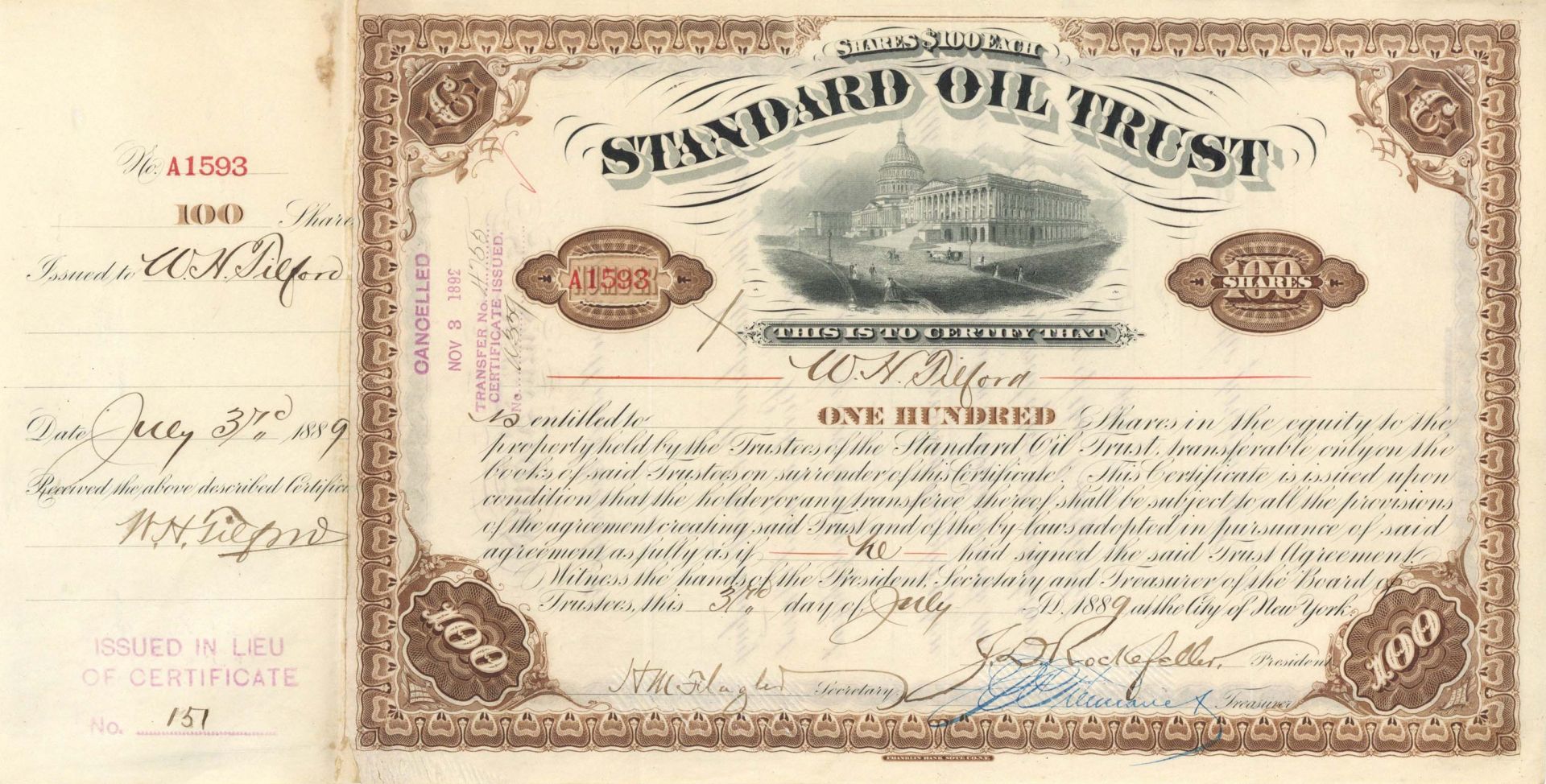
Stock issued to W.H. Tilford and signed at stub. Also signed by H.M. Flagler as secretary and J.D. Rockefeller as president.

Henry Morrison Flagler (January 2, 1830 – May 20, 1913) was an American industrialist and a founder of Standard Oil, which was first based in Ohio. He was also a key figure in the development of the Atlantic coast of Florida and founder of the Florida East Coast Railway, much of which he built through convict leasing. He is known as the father of Miami and Palm Beach, Florida.

John D. Rockefeller (1839-1937) was an influential industrialist and philanthropist. At the age of 30, he established the first oil trust, and within a decade, he had monopolized 85% of the oil industry, becoming the world's first billionaire. Known for his disdain for waste and inefficiency, Rockefeller focused on eliminating poorly managed sectors of the industry, often driving competitors out of business or acquiring them. This aggressive approach made him one of the most reviled figures in the nation, necessitating the presence of a bodyguard at all times. Throughout his life, he contributed approximately $750 million to science and education. In a pioneering public relations effort, he would distribute shiny new dimes to those he encountered. Alongside Henry M. Flagler, a prominent capitalist and promoter, Rockefeller acknowledged in court that Flagler was “the brains behind the Standard Oil Trust.” Flagler played a significant role in transforming Florida’s previously overlooked beaches and swamplands into one of the world's most opulent recreational destinations.

Wesley Hunt Tilford was born in Lexington, Kentucky, on July 14, 1850. His boyhood was spent there. His father, John B. Tilford, had long been a banker in Lexington, but at the close of the sixties, he pulled up stakes, and came to New York, where he once more took up the banking business. Young Wesley went to Columbia College where he studied for a couple of years, but the call of business was too strong to allow him to wait for his bachelor's degree. His elder brother, John B. Tilford, Jr., had entered the fleld of oil, associating himself with Jabez A. Bostwick in the firm of Bostwick & Tilford. Attracted by the prospects of petroleum, Wesley gave up his college course, and entered as a clerk in the firm of his brother, then doing business in Pearl Street. When the firm dissolved the two brothers joined in a partnership of their own under the title of John B. Tilford Jr. & Co., which did well from the start and continued to prosper until, at the period of the Eastern oil amalgamations, a substantial offer from the Standard Oil Company induced them to cast their fortunes with that vigorous organization. As has been said, those were busy formative times in the oil business, and the new recruit proved his mettle by the splendid success of his visit to the Pacific slope in 1878. He there organized the oil trade in California, Oregon, Colorado and the surrounding States. On his return to the East he was welcomed to a high place in the home office, taking charge of the vast transportation problem with vigor and effectiveness. And so, strong in the esteem and confidence of all his co-workers, he continued to the end. He was a member of the New York Chamber of Commerce and belonged to the Metropolitan and Tuxedo Clubs.
Tilford, one of the Vice Presidents of the Standard Oil Company, left behind him a notable record of over thirty years in the service of the Company and of some years before that in a petroleum business with which his family was connected. ln his time he had passed through all grades of the merchandising of petroleum, filling post after post with loyalty, credit and acumen. For nine years before his elevation to the Vice Presidency in 1908, he had filled the office of Treasurer of the Standard Oil Company, and from 1892 onward he had been a Director. Despite this long and prominent career, few outside the oil business knew him, so unobtrusive was he by nature. He was a man of few words but of great grasp of affairs, particularly strong in organizing qualities, and gifted with fine and accurate judgment. ln addition he was a man of wide information and varied reading. He was courtly, kind-hearted and charitable. The great good fortune of the Standard Oil Company was the securing of the service of such a man. Ordinary qualities sharpened by business experience may carry a man safely through the details of an established business easily filling its place in the commercial economy; but to win and retain a leading place in a business ever growing, ever reaching out, ever conquering new worlds and gaining and holding new markets, called for qualities far beyond the ordinary, and it is the testimony of his associates that he always deserved his promotions. This is high praise from men themselves the peers of the giants of business in all ages and all climes.




Ebay ID: labarre_galleries