

Standard Oil Trust Issued to and signed by H.H. Rogers - Signed by W.H. Beardsley, J. D. Rockefeller, H.M. Flagler and J.A. Bostwick - 1883 dated Autograph Stock Certificate
Inv# AG2319 Autograph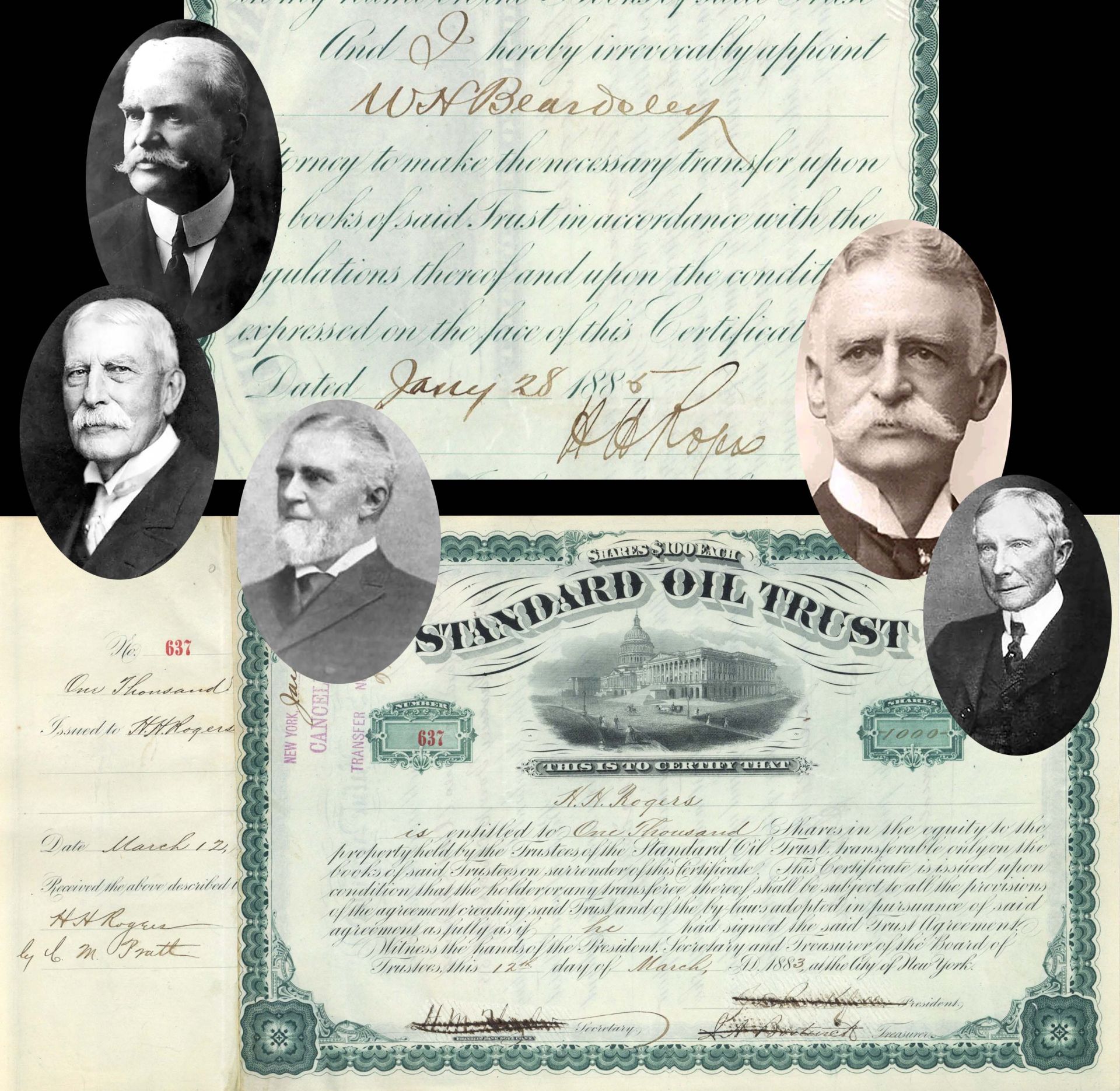
Stock issued to and signed on back by H.H. Rogers and W.H. Beardsley on back. Also signed by H.M. Flagler as secretary, J.D. Rockefeller as president and J.A. Bostwick as treasurer on front. 1,000 Shares! Rare!
Henry Huttleston Rogers (1840-1909) was born into a working-class family in Mattapoisett, Massachusetts. He was the offspring of Rowland Rogers and Mary Eldredge Huttleston Rogers, both of whom traced their ancestry back to the pilgrims who arrived in the 17th century on the Mayflower. Notably, his mother's family had previously used the spelling 'Huddleston' instead of 'Huttleston,' leading to frequent misspellings of Henry Rogers' name using this earlier variant. In 1861, at the age of 21, Henry combined his savings of around $600 with a friend, Charles P. Ellis, to venture into the newly discovered oil fields of western Pennsylvania. After borrowing an additional $600, the young entrepreneurs established a small refinery in McClintocksville, near Oil City, which they named Wamsutta Oil Refinery. In 1870, John D. Rockefeller founded the Standard Oil Company of Ohio and initiated a strategy to acquire competitors and consolidate oil refining under a single entity. During this time, the interests of Pratt and Henry Rogers were incorporated into Standard Oil, which by 1878 controlled approximately 90% of the refining capacity in the United States. In early 1871-72, H. H. Rogers was employed by Pratt and Company, where he and other refiners became embroiled in a dispute with John D. Rockefeller, Samuel Andrews, and Henry M. Flagler, as well as the notorious South Improvement Company. This company was essentially a scheme to secure secret advantageous net rates from Tom Scott of the Pennsylvania Railroad and other railroads through undisclosed rebates, which incited outrage among many independent oil producers and refinery owners, both near and far.

Henry Morrison Flagler (1830-1913) encountered John D. Rockefeller through the grain and distillery industry in Bellevue, Ohio. Following a setback in his salt manufacturing business in Saginaw, Michigan, he relocated to Cleveland, where he partnered with Rockefeller and chemist Samuel Andrews to establish Rockefeller, Andrews & Flagler in 1867, which later evolved into Standard Oil. By 1872, this company dominated the American oil refining sector, producing 10,000 barrels daily. In 1877, Standard Oil relocated its headquarters to New York City, prompting Flagler and his family to move there as well. He was joined by Henry H. Rogers, another prominent figure in Standard Oil, who also contributed to the development of American railroads, including those on Staten Island, the Union Pacific Railroad, and later in West Virginia, where he constructed the notable Virginian Railway to transport coal to Hampton Roads, Virginia. However, Flagler's pursuits outside of Standard Oil diverged from those of Rogers. In 1878, on his physician's recommendation, Flagler traveled to Jacksonville, Florida for the winter with his first wife, Mary (née Harkness) Flagler, who was gravely ill. After her passing in 1881, he remarried Ida Alice (née Shrouds) Flagler, who had cared for Mary. Following their marriage, the couple visited St. Augustine, Florida, where Flagler found the city appealing but noted the inadequacy of hotel accommodations and transportation. Recognizing Florida's potential to draw visitors from other states, he returned to St. Augustine in 1885 and initiated the construction of the 540-room Hotel Ponce de Leon. Aware of the necessity for a reliable transportation network to support his hotel projects, Flagler acquired the Jacksonville, St. Augustine and Halifax Railroad, marking the inception of what would be known as the 'Flagler System' or the Florida East Coast Railway.

John Davison Rockefeller (1839-1937) was the founder and one of the initial partners of Standard Oil, a pioneer in the oil industry and a prominent capitalist. Once regarded as the wealthiest individual in the world, Rockefeller commenced his career as a successful merchant in Cleveland, Ohio, before the Civil War. In 1863, he and his associates established a refinery that evolved into a business which ultimately absorbed numerous other refineries in Cleveland and expanded into the oil fields of Pennsylvania, becoming the largest refining enterprise globally. During this period, he managed to grow his operations while others faltered, thanks to the skilled individuals he employed, the operational efficiency he implemented, and various business practices that are now deemed unethical, for which he gained notoriety. In 1870, Rockefeller founded the Standard Oil Company of Ohio to enhance the efficiency of his operations. In 1882, partly to streamline operations and partly to circumvent state regulations, he made a significant move in American business history by establishing the Standard Oil Trust. This arrangement involved a board of trustees taking control of the stock of both the Standard Oil Company of Ohio and its subsidiaries, managing the conglomerate through the board's executive committee. By this time, public disapproval of Rockefeller and his practices was escalating, and in 1892, the Ohio Supreme Court dissolved the Trust. It was subsequently divided into approximately 18, later over 30, corporations before being incorporated into another holding company, Standard Oil of New Jersey, in 1899. In 1911, the U.S. Supreme Court mandated the dissolution of this company, labeling it as 'a monopoly in restraint of trade' and thus illegal under the Sherman Anti-Trust Act. By this stage, Rockefeller had largely distanced himself from business activities, focusing exclusively on his philanthropic endeavors.

William Henry Beardsley (April 7, 1852 - December 13, 1925) served as the private secretary to Henry Flagler, the Chairman of the Florida East Coast Railway Company. Born on April 7, 1852, in Cleveland, Ohio, he was the son of I. L. Beardsley, a journalist originally from New York who relocated to Cleveland in 1838. I. L. Beardsley was instrumental in founding the "Plain Dealer" and later ventured into the wholesale grocery business. William completed his education in Cleveland, graduating from Central High School in 1869. He initially worked alongside his father in the grocery sector before moving to New York, where he was employed by the Standard Oil Company from 1880 to 1890. In 1890, H. M. Flagler, a co-founder of Standard Oil, appointed Mr. Beardsley as his financial representative. He subsequently took on the role of treasurer for the Florida & East Coast Railroad, the Florida East Coast Steamship Company, and all properties under Mr. Flagler's control. On February 26, 1874, Mr. Beardsley married Miss Lillian, the daughter of Marcus S. Sterling from Bridgeport, Connecticut, whose grandfather had once served as the mayor of the city. The couple had three children: Sterling S., Lillian, and William Jr. Mr. Beardsley was an active member of the Field and Marine Club, the Midwood Club, and the Ohio Society of New York, enjoying a prominent position in social circles and a distinguished reputation in financial matters. Following Henry Flagler's passing, William ascended to the presidency of the Florida East Coast Railway, succeeding Flagler, and also became a trustee of the Flagler estate. He later retired from the presidency but continued to serve as Chairman of the Board until his death on December 13, 1925. Mr. Beardsley was cremated, and his ashes were interred in the Beardsley Family Mausoleum at Woodlawn Cemetery in the Bronx, New York, alongside his wife, her family, and their children.

Jabez Abel Bostwick (September 23, 1830 – August 16, 1892) was an American businessman who was a founding partner of Standard Oil.
Bostwick was born in Delhi, New York on September 23, 1830. He was a son of Abel Bostwick (1798–1861) and Sally (née Fitch) Bostwick (1797–1869). While still a boy, his family moved to a farm in Ohio. As a young man, Jabez Bostwick first worked in a hardware store then opened his own.
He next ventured into the cotton brokerage business in Cincinnati but soon moved to New York City where he became involved in the production side of the oil business through his firm, Tilford & Bostwick established in 1866. He bought out Tilford and in 1878 went into successful partnership with Henry Flagler and the Rockefeller brothers, John and William. Jabez Bostwick served as the Secretary-Treasurer of the Standard Oil Trust.
Jabez Bostwick was also a major shareholder and President of the New York and New England Railroad, a substantial shareholder in the Housatonic Railroad, a member of the New York Cotton Exchange, and who sat on numerous other corporate boards. In spite of the enormous wealth he obtained, Bostwick was known as a modest man of exemplary character who was a devout member of the Baptist Church. He donated money to his church and to educational institutions such as Wake Forest College in Winston-Salem, North Carolina and Richmond College in Richmond, Virginia.
Bostwick was married to Helen Celia Ford (1848–1920). Helen was the daughter of Smith Reed Ford and Frances Lee (née Fox) Ford. Together, they were the parents of:
- Nellie Ford Bostwick (1868–1906), who married Francis Lee Morrell (1863–1893) in 1887. After his death, she remarried to Hamilton Wilkes Cary (1862–1917) in 1895.
- Frances Evelyn "Fannie" Bostwick (1872–1921), who married Capt. Albert J. Carstairs (1862–1927) in 1895. They divorced and she married Francis Francis (1853–1928), son of English writer Francis Francis, in 1903. They also divorced and she married Count Roger Marie Felix Symon de Perigny (1875–1945) in 1915. They also divorced and she married Dr. Serge Abrahamovitch Voronoff (1866–1951) in 1919.
- Albert Carlton Bostwick (1878–1911), who married Marie Lillian Stokes (1877–1962). After his death, Marie remarried to Fitch Gilbert.
On August 16, 1892, Bostwick died in a freak stable fire at Friedheim, his summer residence in Mamaroneck in Westchester County. During the fire he tried to save his horses and carriages. As he and the stable hands pushed a coach from the carriage house he got overrun by a Private Coach weighing 2000/3000 lbs. His widow, Helen C. Bostwick, upon her death on April 27, 1920 left an estate per public record that was valued at $29,264,181.00, including nearly $20 million of Standard Oil stock.
Through his daughter Fannie, he was the grandfather of Marion Barbara "Joe" Carstairs(1900–1993), a power boat racer known for her speed and her eccentric lifestyle, and Francis Francis (1906–1982), a pilot.
Through his son Albert, he was the grandfather of five grandchildren, including: Dorothy Stokes Bostwick (1899–2001), a philanthropist and the first woman to hold a helicopter pilot's license; Albert C. Bostwick Jr. (1901–1980), a thoroughbred racehorse owner and breeder whose horse Mate won the 1931 Preakness Stakes; Lillian Bostwick Phipps(1906–1987), an owner of Thoroughbred steeplechase racehorses who won the American Grand National eight times and who married Ogden Phipps; Dunbar Wright Bostwick(1908–2006), the chairman of the Aviation Instrument Manufacturing Corp. who was a standardbred horse breeder; and George Herbert "Pete" Bostwick (1909–1982), a Hall of Fame polo player, U.S. Racing Hall of Fame steeplechase jockey and horse trainer.




Ebay ID: labarre_galleries