

Standard Oil Trust signed by Henry H. Rogers, John D. Archbold, Wesley H. Tilford and transferred to J.D. Rockefeller - 1896 and 1899 signed Autographed Stock Certificate
Inv# AG1918 Autograph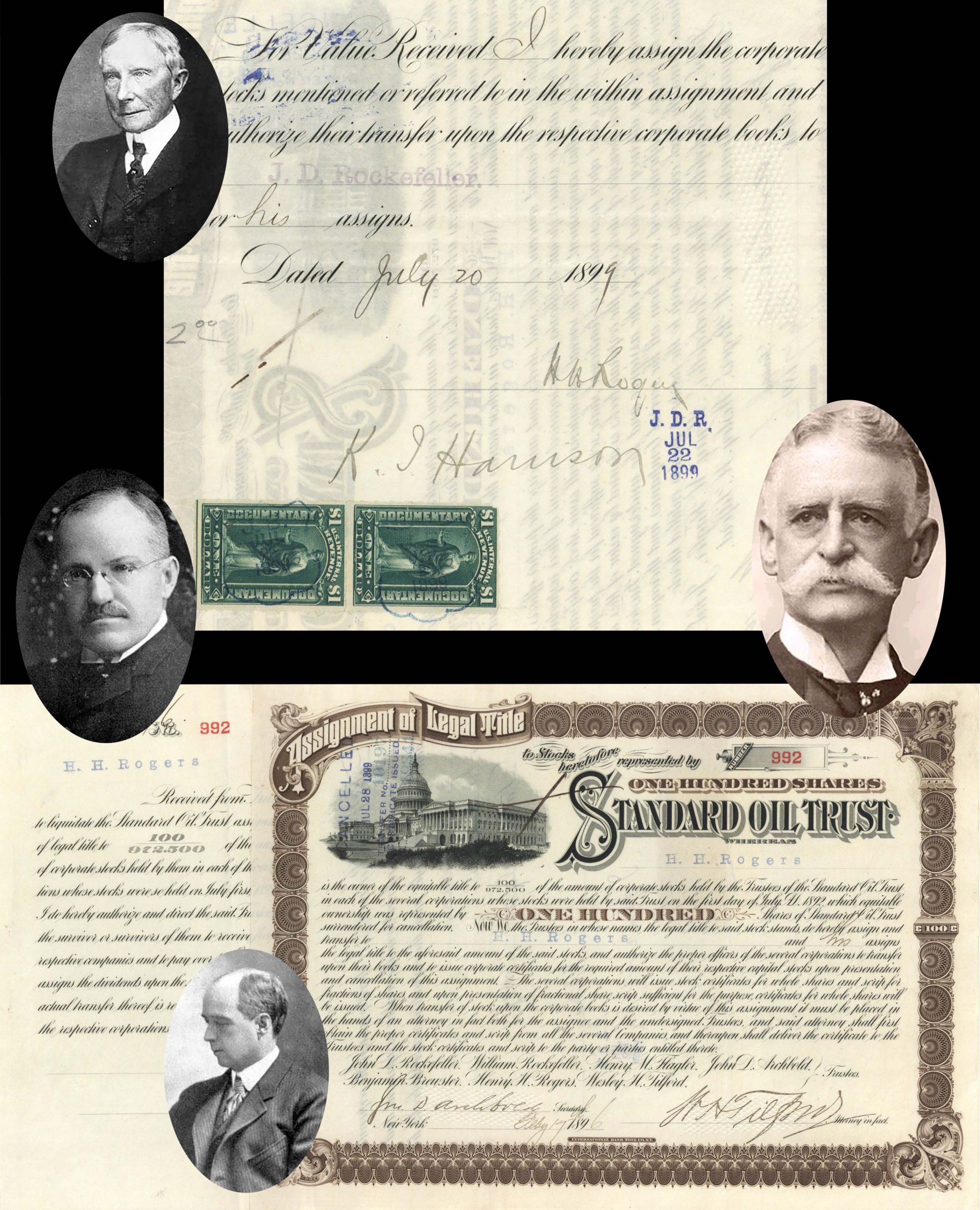
Stock issued to and signed by H.H. Rogers on back. Also signed by John D. Archbold as secretary and W.H. Tilford as attorney on front and transferred to J.D. Rockefeller. 2 green $1 revenue stamps on back. Printed by International Bank Note Co., N.Y. Portraits available upon request.

John Dustin Archbold (born July 26, 1848, in Leesburg, Ohio; died December 6, 1916, in Tarrytown, New York) was a prominent American capitalist and one of the pioneering oil refiners in the United States. His modest oil enterprise was acquired by John D. Rockefeller's Standard Oil Company. Archbold quickly advanced within Standard Oil, managing numerous intricate and confidential negotiations throughout the years. By 1882, he had become Rockefeller's closest confidant and frequently served as the company's principal spokesperson. Following 1896, Rockefeller delegated business responsibilities to Archbold as he focused on his philanthropic endeavors; as vice president, Archbold effectively oversaw the operations of Standard Oil until his passing in 1916. Influenced by Rockefeller's strategies, Archbold prioritized stabilization, efficiency, and the reduction of waste in the refining and distribution of petroleum products. In 1911, the Supreme Court mandated the dissolution of the company into approximately thirty-six smaller entities, after which Archbold assumed the presidency of the largest, Standard Oil of New Jersey.

Wesley H. Tilford (1850-1909) was born on July 14, 1850, in Lexington, Kentucky. He attended Columbia College for a brief period; however, the allure of the business world compelled him toabandon his pursuit of a bachelor's degree. Drawn by the potential of the petroleum industry, Wesley left his studies and took a position as a clerk at his brother's firm, Bostwick & Tilford, located on Pearl Street. Following the dissolution of the firm, the brothers established their own partnership under the name John B. Tilford Jr. & Co., which experienced immediate success and continued to thrive. Eventually, during the era of Eastern oil consolidations, they received a lucrative offer from the Standard Oil Company, prompting them to align their interests with this dynamic organization. These were indeed pivotal times in the oil sector, and Wesley demonstrated his capabilities through a highly successful trip to the Pacific Coast in 1878, where he played a key role in organizing the oil trade across California, Oregon, Colorado, and neighboring states.
Upon his return to the East, he was greeted with a prominent position within the home office, where he energetically and effectively addressed the extensive transportation challenges. With the respect and trust of his colleagues firmly established, he maintained this standing until the end of his career. Tilford, who served as one of the Vice Presidents of the Standard Oil Company, left behind a distinguished legacy of over thirty years with the Company, along with several years in a petroleum enterprise associated with his family. Throughout his career, he navigated all levels of petroleum merchandising, consistently demonstrating loyalty, integrity, and insight in each role he undertook. Prior to his promotion to Vice President in 1908, he served as Treasurer of the Standard Oil Company for nine years and had been a Director since 1892. Despite his extensive and notable career, he remained relatively unknown outside the oil industry due to his unassuming nature. He was a man of few words, yet possessed a profound understanding of business matters, particularly excelling in organizational skills and possessing sound judgment. Additionally, he was well-read and knowledgeable across various subjects. His demeanor was courteous, compassionate, and generous. While ordinary qualities, enhanced by business experience, may suffice for navigating the intricacies of an established enterprise, achieving and maintaining a leading position in a dynamic and expanding business requires exceptional attributes. His colleagues attested that he consistently merited his advancements, a commendation from individuals who themselves were contemporaries of the titans of business throughout history.
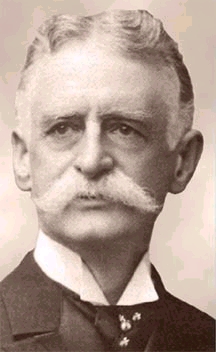
Henry Huttleston Rogers (1840-1909) Henry Huttleston Rogers was born into a working-class family in Mattapoisett, Mass. He was the son of Rowland Rogers and Mary Eldredge Huttleston Rogers. Both parents had roots back to the pilgrims, who arrived in the 17th century aboard the Mayflower. His mother's family earlier had used the spelling "Huddleston" rather than "Huttleston," and Henry Rogers' name is often misspelled using this earlier version. In 1861, 21-year-old Henry pooled his savings of approximately $600 with a friend, Charles P. Ellis. They set out to western Pennsylvania and its newly discovered oil fields. Borrowing another $600, the young partners began a small refinery at McClintocksville near Oil City. They named their new enterprise Wamsutta Oil Refinery. In 1870, John D. Rockefeller formed Standard Oil Company of Ohio and started his strategy of buying up the competition and consolidating all oil refining under one company. It was during this period that the Pratt and Henry Rogers interests were brought into the fold. By 1878 Standard Oil held about 90% of the refining capacity in the United States. In the early 1871-72, H. H. Rogers was working for Pratt and Company and other refiners became involved in a conflict with John D. Rockefeller, Samuel Andrews, and Henry M. Flagler and the infamous South Improvement Company. South Improvement was basically a scheme to obtain secret favorable net rates from Tom Scott of the Pennsylvania Railroad and other railroads through secret rebates. The unfairness of the scheme outraged many independent oil producers and owners of refineries far and new alike. His final business achievement, working with partner William Nelson Page, was the building of the Virginian Railway from the coal fields of southern West Virginia to port near Norfolk at Sewell's Point, Virginia, in the harbor of Hampton Roads. For many years, it was labeled both an engineering marvel and the "richest little railroad in the world," forming part of today's rail network for Norfolk Southern. While considered ruthless in business matters, Henry Rogers also had a much kinder and generous side. His hometown of Fairhaven, Massachusetts continues to enjoy his many infrastructure gifts. Rogers' late life friendships included such diverse persons as Mark Twain, Ida Tarbell, Helen Keller, and Booker T. Washington. Rogers was a low-profile philanthropist with a widely hated public image as a robber baron. It was only after his death in 1909 that Dr. Washington felt he could publicly reveal that, over a period of more than 15 years, Henry Rogers had been funding over 65 small country schools and several larger institutions in the South for the betterment and education of African Americans. Dr. Washington not only credited Rogers with substantial aid and encouragement, but with instituting the then-innovative procedure of matching funds. Rogers felt that as well as extending the financial reach, their participation contributed to the beneficiaries' self-esteem and steps to self-sufficiency. He was listed in a 1996 study as one of the 25 all-time most wealthy individuals in United States history.

John Davison Rockefeller, born in 1839 and passing away in 1937, was a prominent figure in the oil industry. He founded Standard Oil and was one of its original partners. Rockefeller was a capitalist and, at one point, was considered the world’s richest man.
Rockefeller’s career began in Cleveland, Ohio, where he was a successful merchant before the Civil War. In 1863, he and his partners established a refinery that grew into a thriving business. Over time, Standard Oil absorbed many other Cleveland refineries and expanded into Pennsylvania oil fields, eventually becoming the world’s largest refining concern.
Rockefeller’s success was attributed to several factors. He surrounded himself with talented individuals, streamlined his operations, and employed unscrupulous business practices that made him famous. In 1870, he organized the Standard Oil Company of Ohio to improve efficiency. In 1882, he created the Standard Oil Trust to streamline operations and avoid state controls.
However, public criticism of Rockefeller and his methods intensified, leading to the dissolution of the Trust by the Ohio Supreme Court in 1892. Despite this setback, Rockefeller’s legacy as a pioneering figure in the oil industry remains significant. The Trust was initially composed of approximately 18 smaller corporations, but over time, it expanded to include over 30. In 1899, these corporations were folded into another holding company, Standard Oil of New Jersey. However, in 1911, the U.S. Supreme Court ordered the dissolution of Standard Oil of New Jersey, declaring it a monopoly in restraint of trade and thus illegal under the Sherman Anti-Trust Act. By this time, Rockefeller had largely withdrawn from business activities and was solely focused on his philanthropic endeavors. While the scope of his philanthropic efforts is vast and difficult to quantify, some of his most notable contributions include the establishment of the University of Chicago in 1889, the Rockefeller Institute for Medical Research in 1901, the General Education Board in 1902, and the Rockefeller Foundation in 1913. It is estimated that Rockefeller donated a significant amount of money, approximately $550 million, during his lifetime.




Ebay ID: labarre_galleries