


Saint Paul and Duluth Railroad Co. Issued to and signed by Edward White Clark - 1877-1881 dated Autograph Stock Certificate
Inv# AG2100 Autograph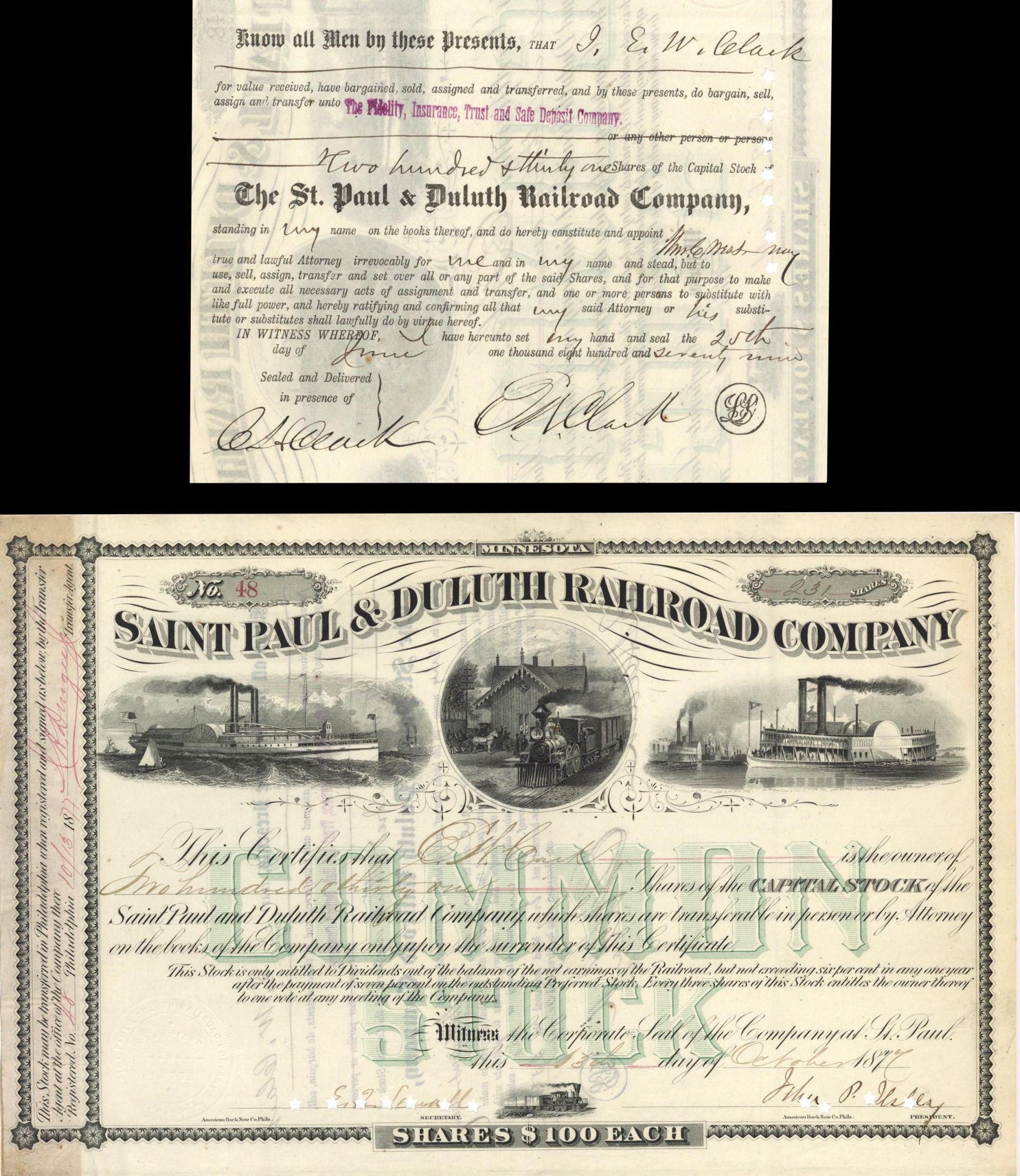
Stock Issued to and stamp signed on back by Edward White Clark, son of Enoch White Clark. Available with out green imprinted "Common Stock".
Edward White Clark, born in 1828 and passing away in 1904, was a prominent American banker and a key figure in the nation’s financial development during the late 19th century. As the head of the influential investment firm E.W. Clark & Co., he played a central role in financing the rapid expansion of the nation’s infrastructure, particularly the thriving railroad industry. Clark’s influence extended beyond mere financial backing; he was renowned for his strategic foresight and ability to navigate the turbulent economic shifts of the post-Civil War era. His contributions helped stabilize markets during several financial panics. Clark’s reputation for integrity and fiscal conservatism made him a trusted advisor to industrial titans and a pillar of the Philadelphia financial elite.
Beyond his professional accomplishments, Clark was a dedicated philanthropist and an enthusiastic advocate for the arts and sciences. He is perhaps most remembered for his significant contributions to the University of Pennsylvania, where he established the Department of Archaeology and Anthropology. His passion for history led him to fund major archaeological expeditions, including the groundbreaking excavations at Nippur in ancient Mesopotamia. By bridging the gap between high finance and intellectual discovery, Clark left an enduring legacy that transformed Philadelphia into a center of both commercial power and world-class scholarship.
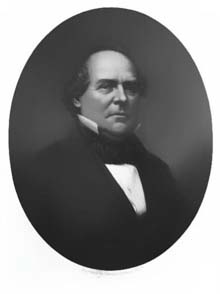
Enoch White Clark, born in 1797 and passing away in 1856, played a pivotal role in shaping the 19th-century American financial landscape. He is best known as the founder of the influential private banking house E.W. Clark & Company. Clark, a native of New Jersey, relocated to Philadelphia and established his firm in 1837 amidst a period of significant economic upheaval. Despite the financial panics of the era, Clark’s astute business acumen and unwavering integrity enabled the firm to thrive. Consequently, it expanded its operations, establishing branches in New York, Boston, and St. Louis. Clark’s bank played a pivotal role in financing the rapid industrialization of the United States, providing the necessary capital for the burgeoning railroad industry and state internal improvements.
Beyond his individual achievements, Clark is remembered as a mentor to some of the most prominent financiers in American history. Notably, he hired and trained a young Jay Cooke, who later became the “Financier of the Civil War.” Clark’s reputation for conservative and reliable banking practices contributed to the stabilization of the domestic exchange market during a time when the national banking system was still in its infancy. By the time of his passing in 1856, Clark had not only amassed a substantial fortune but had also established a lasting financial legacy that supported the Union’s economic infrastructure for decades to come.




Ebay ID: labarre_galleries