

Standard Oil Trust issued to George H. Lincoln and signed by John D. Rockefeller and Henry M. Flagler - Autograph Stock Certificate
Inv# AG1629 Stock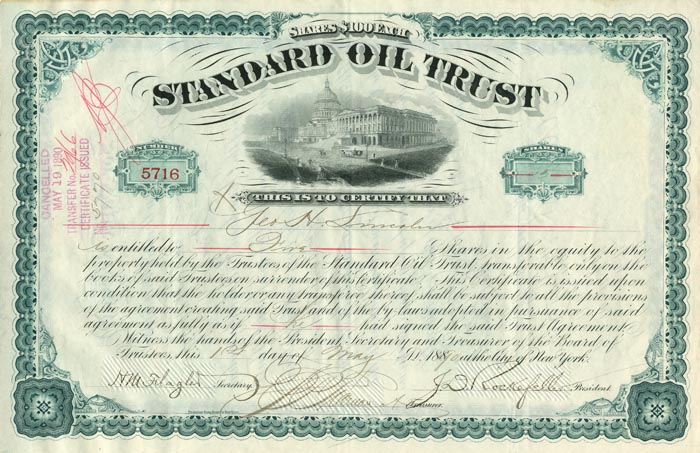
Ohio
Stock printed by Franklin Bank Note Co., New York. Issued to George H. Lincoln, broker for the Standard Oil Company and signed by John D. Rockefeller as president and H.M. Flagler as secretary. Superb! Portraits and biography included.
While the name George H. Lincoln might not be as immediately recognizable as John D. Rockefeller in connection with Standard Oil, Lincoln was an important figure in the Standard Oil Trust. He was among the individuals to whom the Standard Oil Trust certificates were issued in 1890, alongside prominent figures like John D. Rockefeller and John D. Archbold. This indicates that Lincoln held a significant stake in the massive oil empire and played a role in the workings of the trust that controlled a substantial portion of the American oil industry at the time.
The Standard Oil Trust, founded by John D. Rockefeller in 1882, revolutionized American business by consolidating control over numerous oil companies and introducing a corporate structure that operated across state lines. Lincoln's involvement in this complex and powerful organization places him within the circle of influential individuals who shaped the burgeoning oil industry in the late 19th century. Although the trust's commercial dominance ultimately led to its breakup in 1911 due to antitrust laws, Lincoln's association with Standard Oil represents a connection to a pivotal era of industrial growth and the emergence of corporate power in the United States.
John D. Rockefeller (1839-1937) was an American industrialist and philanthropist, widely considered to be one of the wealthiest individuals in history. He began his career in the oil business in 1863, and in 1870, he founded the Standard Oil Company. Through innovative and often aggressive business practices, including negotiating favorable railroad rates and acquiring or driving out competitors, Rockefeller's company achieved a near-monopoly in the oil industry, controlling an estimated 90% of US refineries and pipelines by the early 1880s. Standard Oil's dominance sparked public concern, leading to the passage of antitrust laws and, in 1911, the Supreme Court ordered the company's dissolution. Despite the controversies surrounding his business methods, Rockefeller dedicated the latter part of his life to philanthropy, contributing over $500 million to various educational, religious, and scientific causes, including the establishment of the University of Chicago and the Rockefeller Foundation.
Henry Morrison Flagler, born on January 2, 1830, in Hopewell, New York, was an American industrialist and the founder of Standard Oil, initially established in Ohio. He played a pivotal role in the development of the Atlantic coast of Florida and founded the Florida East Coast Railway. Notably, much of this railway was constructed through convict leasing. Flagler is often referred to as the “father of Miami and Palm Beach, Florida.”
Flagler’s parents were Isaac Flagler, a Presbyterian minister, and Elizabeth Caldwell (Morrison) Harkness. Elizabeth had two sons from her previous marriage to Dr. David Harkness of Milan, Ohio. Flagler’s son from his first marriage, Stephen V. Harkness, became Elizabeth’s stepson. Together, David and Elizabeth had a son named Daniel M. Harkness before his passing.
Flagler’s paternal lineage traced back to Germany, specifically the Palatinate region. His immigrant ancestor, Zacharra Flegler, initially settled in Walworth, England, before relocating to America. Flegler arrived in New York in 1710 and eventually settled in Dutchess County. It was his grandson, Solomon Flagler, who first adopted the variant spelling of the surname. Solomon had eleven children, including Isaac, Flagler’s father.
By 1896, Flagler’s railroad, the Florida East Coast Railway, had reached Biscayne Bay. Flagler then embarked on a series of transformative projects, including dredging a channel, constructing streets, establishing the city’s first water and power systems, and even financing the establishment of The Metropolis, the city’s inaugural newspaper. When the city was officially incorporated in 1896, its citizens expressed their desire to honor the man responsible for its growth by naming it “Flagler.” However, Flagler declined this honor, instead suggesting that they use an old Indian name, “Mayaimi.” Consequently, an artificial island named Flagler Monument Island was constructed in Biscayne Bay. In 1897, Flagler opened the exclusive Royal Palm Hotel on the north bank of the Miami River, overlooking the breathtaking view of Biscayne Bay. This remarkable achievement solidified his reputation as the “Father of Miami, Florida.”
A stock certificate is issued by businesses, usually companies. A stock is part of the permanent finance of a business. Normally, they are never repaid, and the investor can recover his/her money only by selling to another investor. Most stocks, or also called shares, earn dividends, at the business's discretion, depending on how well it has traded. A stockholder or shareholder is a part-owner of the business that issued the stock certificates.




Ebay ID: labarre_galleries