

Baltimore and Ohio Railroad Co. Transferred to Joseph Pulitzer - 1894 dated Autographed Stock Certificate
Inv# AG3030 Autograph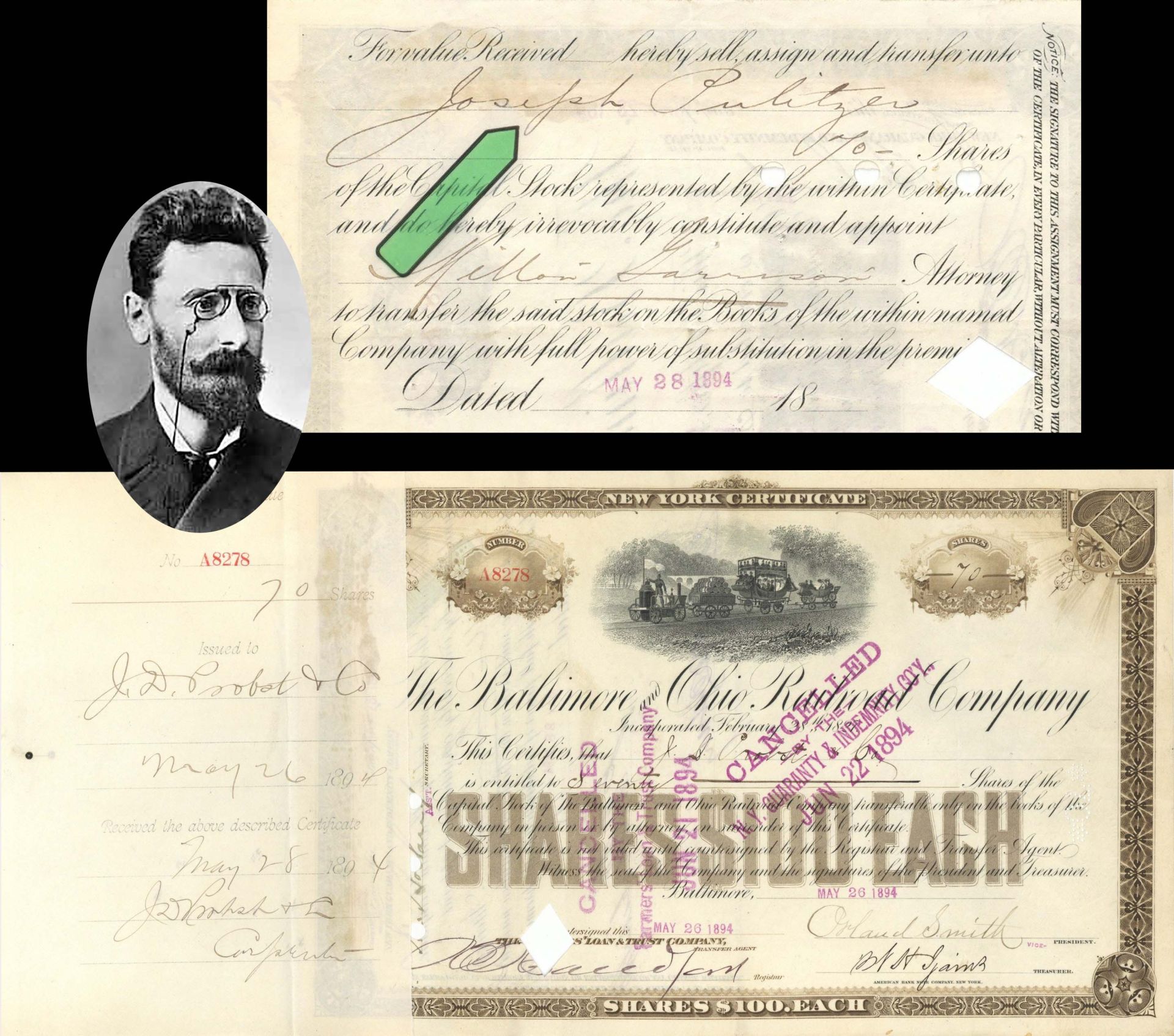
Ohio
Stock transferred on back to Joseph Pulitzer. Signed by Orland Smith on front as vice-president.

Joseph Pulitzer, born József Pulitzer on April 10, 1847, in Hungary, was a prominent newspaper publisher known for the St. Louis Post-Dispatch and the New York World. He became a leading figure in the Democratic Party, elected to Congress from New York. Pulitzer championed against big business and corruption, and his efforts helped preserve the Statue of Liberty in New York.
In the 1890s, the intense competition between his World and William Randolph Hearst’s New York Journal led to the development of yellow journalism, which employed sensationalism, sex, crime, and graphic horrors to attract readers. This approach paved the way for mass-circulation newspapers that relied on advertising revenue and offered a diverse range of news, gossip, entertainment, and advertising.
Today, Pulitzer’s legacy is best known for the Pulitzer Prizes, established in 1917 through his endowment to Columbia University. These annual awards recognize and reward excellence in American journalism, photography, literature, history, poetry, music, and drama. Pulitzer’s philanthropic bequest also led to the founding of the Columbia School of Journalism in 1912.
Orland Smith, born on May 2, 1825, and dying on October 3, 1903, made significant contributions as a railroad executive and Union Army commander during the Civil War. In 1863, he led a daring bayonet charge at the Battle of Wauhatchie, capturing a crucial Confederate position.
Enlisting in the Union army, Smith was appointed colonel of the 73rd Ohio Infantry, established in Chillicothe in November 1861 and trained at Camp Logan. Among the volunteers was Pvt. George Nixon III, later the great-grandfather of President Richard Nixon. Smith’s regiment fought in western Virginia, including the Battles of McDowell and Cross Keys. Later, as part of the Army of Virginia, the 73rd OVI engaged in the Second Battle of Bull Run near Manassas.
Smith took command of the XI Corps on October 25, 1862, but missed the Battle of Chancellorsville. He returned to command shortly before the Gettysburg Campaign, replacing Brig. Gen. Francis C. Barlow. Smith’s troops held Cemetery Hill on the first day of Gettysburg, anchoring the Federal retreat. On the second day, three regiments skirmished near Cemetery Hill. The 33rd Massachusetts repelled an assault by Col. Isaac E. Avery’s North Carolina brigade.
In autumn 1863, Smith’s Brigade joined the XI Corps in the Western Theater. During the Chattanooga Campaign, he led a bayonet charge up a hill now named Smith’s Hill during the Battle of Wauhatchie. Later that year, his brigade was disbanded. Smith resumed command of the 73rd OVI on January 3, 1864, but resigned as colonel on February 17. At war’s end, he was promoted to brevet brigadier general in the omnibus promotions.
After the war, he resumed his career as a railroad officer, holding various positions, including President of the Cincinnati, Washington, and Baltimore Railroad and First Vice President of the Baltimore and Ohio Railroad in Baltimore, Maryland. From 1884 to 1899, he served as President of the Columbus and Cincinnati Midland Railroad. He passed away in Chicago, Illinois.




Ebay ID: labarre_galleries