

Baltimore and Ohio Rail Road Co. signed by Robert Garrett - 1883 dated Autographed Stock Certificate
Inv# AG2923 Autograph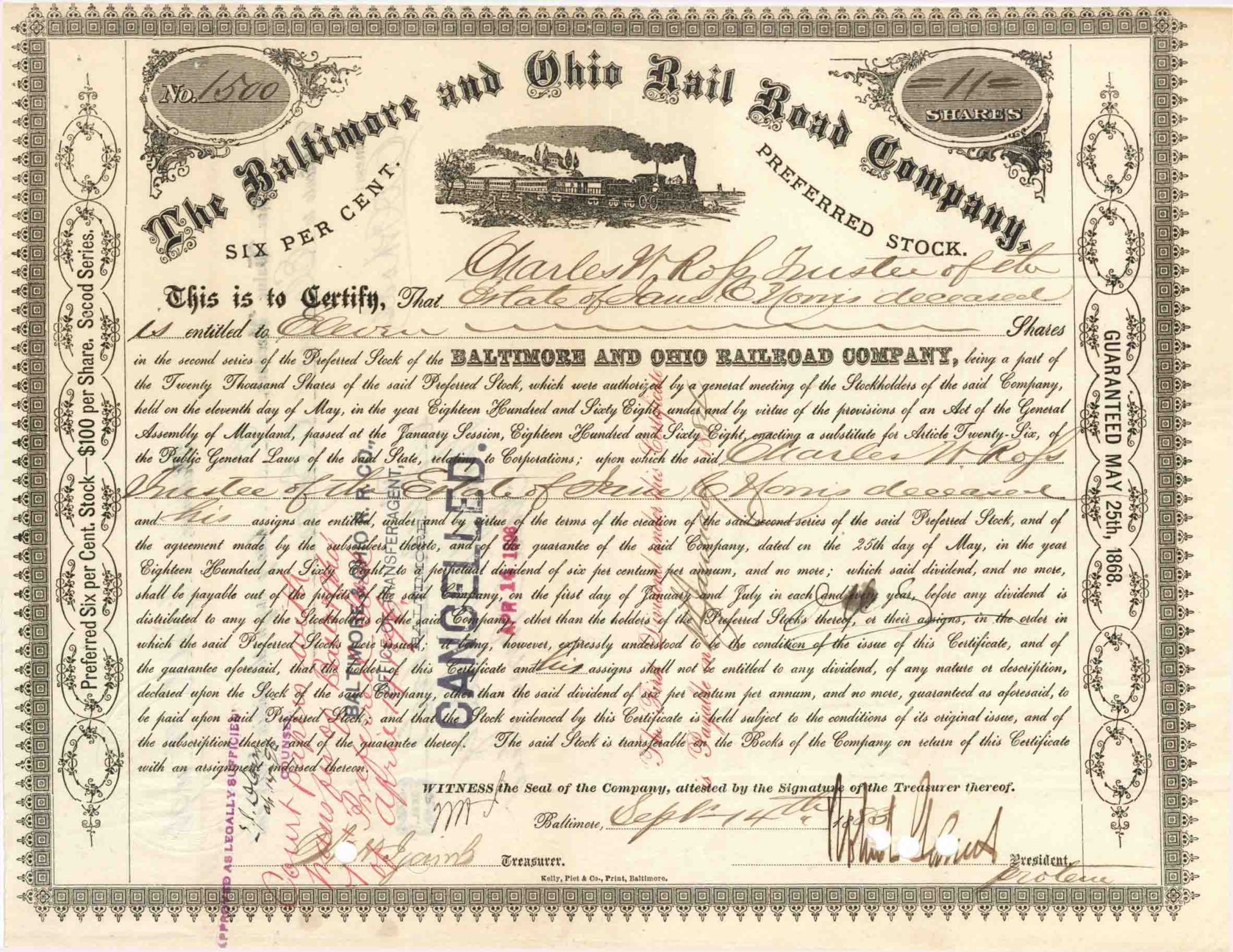
Ohio
Stock signed by Robert Garrett as president.

Robert Garrett (1783-1857), merchant, financier. He came to America as a child; settled in Baltimore, Md., 1800. Alert to that city's business possibilities and energetic in civic enterprises, Garrett established faster transportation to capture Western trade and developed his own banking house for foreign commerce.
The Baltimore and Ohio Railroad (reporting marks B&O, BO) was the pioneering common carrier railroad and the oldest railroad in the United States. Its inaugural section opened in 1830. Merchants from Baltimore, which had benefited from the construction of the National Road early in the century, sought to maintain their competitive advantage in trade with trans-Appalachian settlers. This competition was fueled by the newly constructed Erie Canal, which served New York City, and another canal being proposed by Pennsylvania that would connect Philadelphia and Pittsburgh. Additionally, the Chesapeake and Ohio Canal, which connected to Washington, D.C., although it never reached Ohio, and the James River Canal, which directed traffic toward Richmond and Norfolk, Virginia, were also contenders. Initially, the B&O was confined to Maryland, with its original line extending from Baltimore’s port west to Sandy Hook (opened in 1834). From Sandy Hook, it connected with Harper’s Ferry by boat, then by the Wager Bridge, across the Potomac into Virginia. It also connected with the navigable Shenandoah River. However, competition with the Chesapeake and Ohio Canal for trade with coal fields in western Maryland prevented the B&O from using the C&O right-of-way west of Harpers Ferry. To continue westward through the Appalachian Mountains, the B&O constructed the B & O Railroad Potomac River Crossing (1837) at Harpers Ferry, Virginia (since 1863, West Virginia).
The line extended through Virginia, reaching a point just west of the junction of Patterson Creek and the North Branch Potomac River. From there, it crossed back into Maryland and reached Cumberland in 1842, connecting with the National Road, the primary route westward. In 1852, it reached the Ohio River at Moundsville, Virginia, and in 1853, it reached Wheeling, where it established a terminus. A few years later, in 1857, it also reached Parkersburg, Virginia, below rapids that posed challenges to navigation during certain periods of the year. The Baltimore and Ohio Railroad played a pivotal role in Union success during the American Civil War, although the conflict also resulted in significant damage and repair costs. After the war’s conclusion, the B&O consolidated several feeder lines in Virginia and West Virginia and expanded westward into Ohio, including a junction at Portsmouth, Indiana, and Illinois. B&O advertising later adopted the motto: “Linking 13 Great States with the Nation.”




Ebay ID: labarre_galleries