


Standard Oil Trust Transferred and Signed by Henry M. Flagler & Wesley H. Tilford - 1897 dated Autograph Oil Stock Certificate
Inv# AG1746A Autograph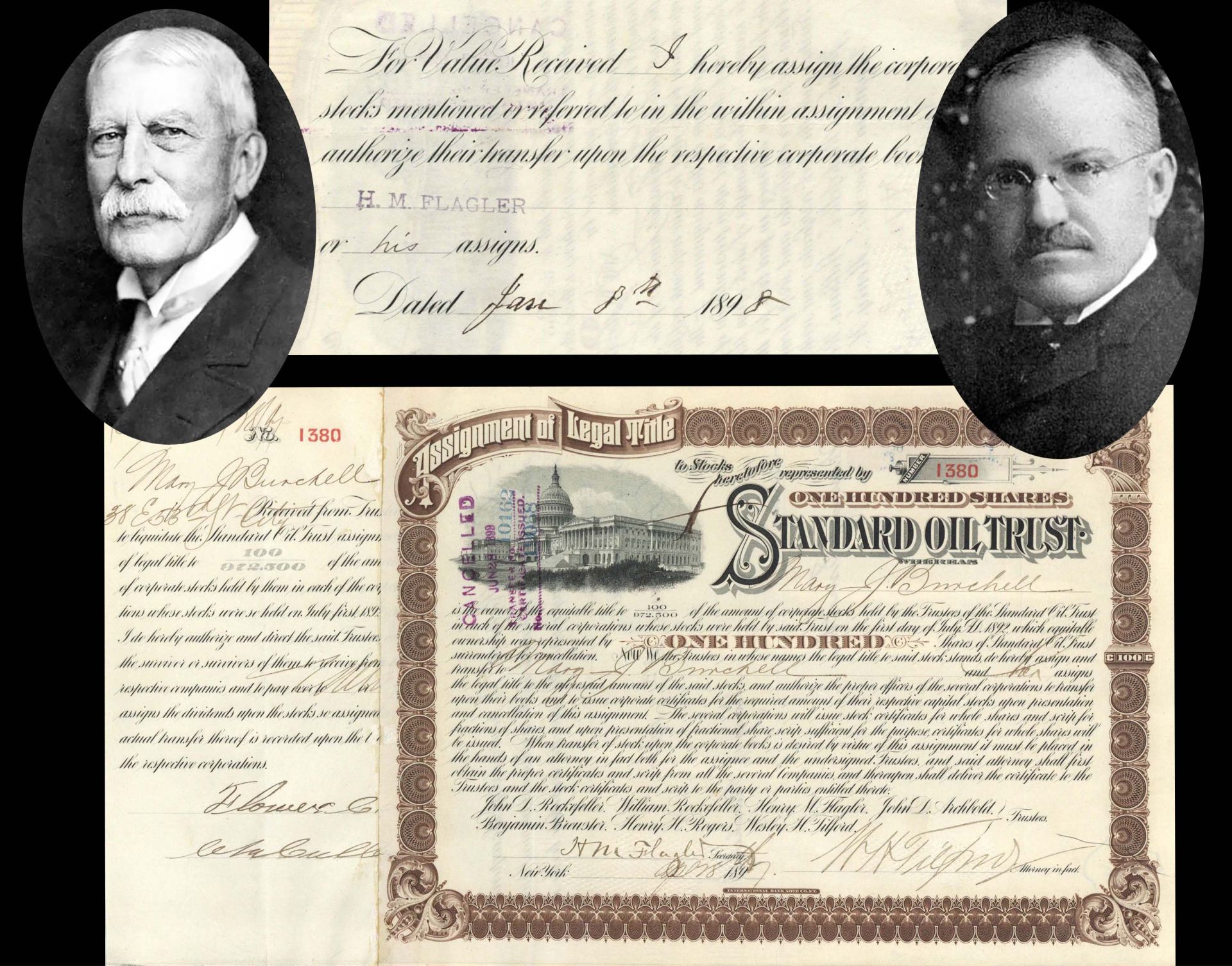
Stock signed by Henry Morrison Flagler as secretary and Wesley Hunt Tilford as attorney in fact. Transferred to Flagler on back. Printed by International Bank Note Co., N.Y. Portrait and biography included.

Wesley H. Tilford (1850-1909) was born on July 14, 1850, in Lexington, Kentucky. He attended Columbia College for a brief period; however, the allure of the business world compelled him to abandon his pursuit of a bachelor's degree. Drawn by the potential of the petroleum industry, Wesley left his studies and took a position as a clerk at his brother's firm, Bostwick & Tilford, located on Pearl Street. Following the dissolution of the firm, the brothers established their own partnership under the name John B. Tilford Jr. & Co., which experienced immediate success and continued to thrive. Eventually, during the era of Eastern oil consolidations, they received a lucrative offer from the Standard Oil Company, prompting them to align their interests with this dynamic organization. These were indeed pivotal times in the oil sector, and Wesley demonstrated his capabilities through a highly successful trip to the Pacific Coast in 1878, where he played a key role in organizing the oil trade across California, Oregon, Colorado, and neighboring states.
Upon his return to the East, he was greeted with a prominent position within the home office, where he energetically and effectively addressed the extensive transportation challenges. With the respect and trust of his colleagues firmly established, he maintained this standing until the end of his career. Tilford, who served as one of the Vice Presidents of the Standard Oil Company, left behind a distinguished legacy of over thirty years with the Company, along with several years in a petroleum enterprise associated with his family. Throughout his career, he navigated all levels of petroleum merchandising, consistently demonstrating loyalty, integrity, and insight in each role he undertook. Prior to his promotion to Vice President in 1908, he served as Treasurer of the Standard Oil Company for nine years and had been a Director since 1892. Despite his extensive and notable career, he remained relatively unknown outside the oil industry due to his unassuming nature. He was a man of few words, yet possessed a profound understanding of business matters, particularly excelling in organizational skills and possessing sound judgment. Additionally, he was well-read and knowledgeable across various subjects. His demeanor was courteous, compassionate, and generous. While ordinary qualities, enhanced by business experience, may suffice for navigating the intricacies of an established enterprise, achieving and maintaining a leading position in a dynamic and expanding business requires exceptional attributes. His colleagues attested that he consistently merited his advancements, a commendation from individuals who themselves were contemporaries of the titans of business throughout history.

Henry Morrison Flagler (1830–1913), a titan of the Gilded Age, possessed immense foresight and capital that transformed both American industry and the geography of Florida. Born in Hopewell, New York, Flagler initially worked as a grain merchant before partnering with John D. Rockefeller in 1867 to co-found the Standard Oil Company. As a master of the monopoly’s logistics and organization, he amassed a substantial fortune, enabling him to retire from day-to-day oil operations in the early 1880s to pursue a new vision. After a trip to St. Augustine, Florida, with his ailing first wife, Flagler recognized the untapped potential of the state as a winter resort for the affluent, shifting his focus from oil to becoming the primary developer of Florida’s East Coast.
Renowned as “the Father of Modern Florida,” Flagler invested millions in constructing the Florida East Coast Railway, strategically building it southward alongside a series of luxury hotels, including the Ponce de Leon in St. Augustine, the Royal Poinciana in Palm Beach, and the Royal Palm in Miami. In essence, he laid the foundation for the cities of Palm Beach and Miami, providing the essential infrastructure, power, and railroads that transformed a malarial swamp into a thriving tourism hub. Despite facing numerous challenges and critics labeling his endeavors as “Flagler’s Folly,” his final, audacious achievement was the completion of the Over-Sea Railroad to Key West in 1912, effectively connecting the entire east coast by rail. Flagler passed away in 1913, leaving behind a monumental legacy that transformed Florida from a sparsely populated frontier into a vibrant and prosperous state.




Ebay ID: labarre_galleries