


New York and Harlem Rail Road Co. signed by William H. Vanderbilt and Cornelius Vanderbilt - 1850 dated Autographed Stock Certificate
Inv# AG2773 Bond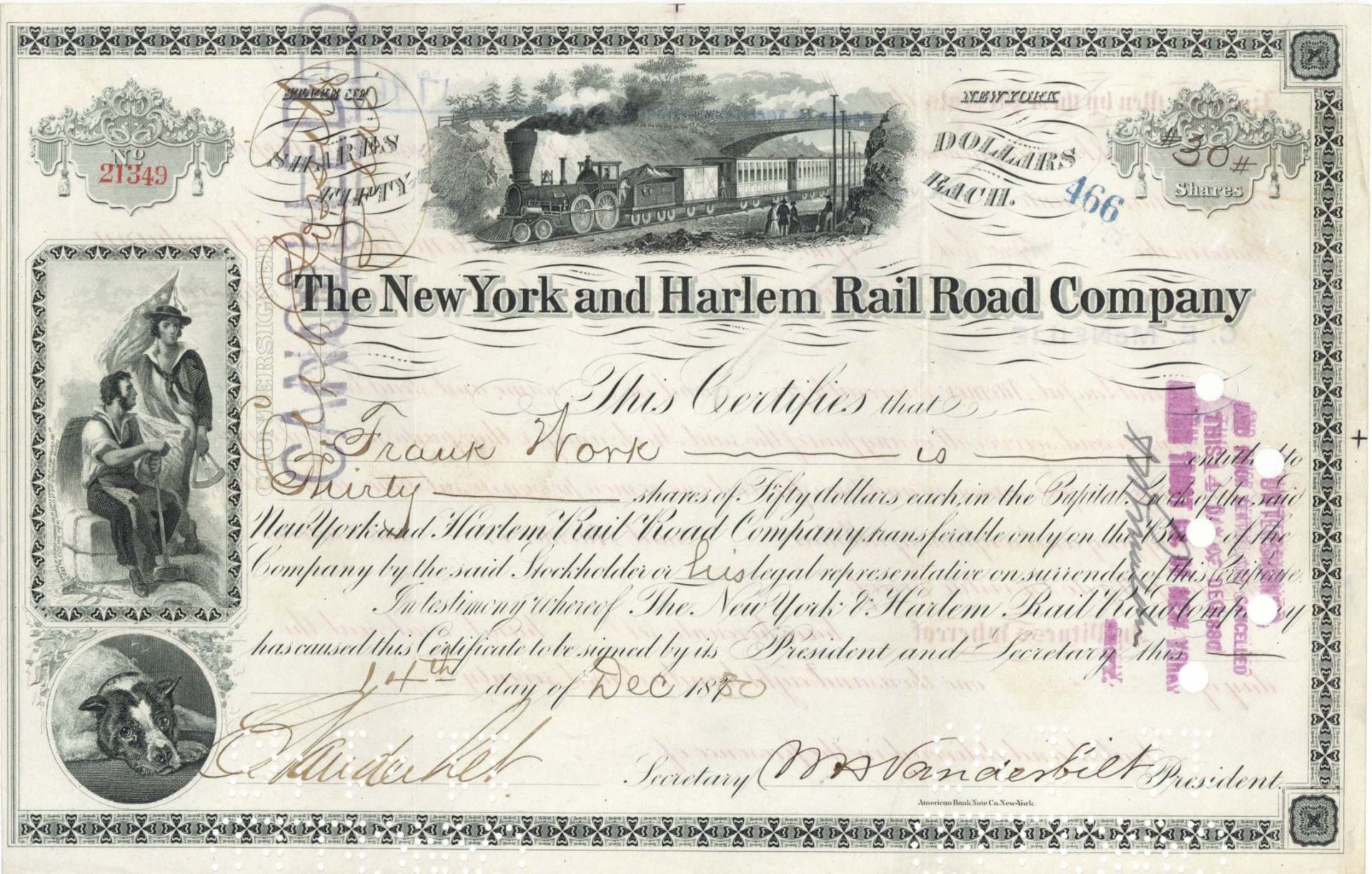
Stock signed by W.H. Vanderbilt as president and Cornelius Vanderbilt as secretary.

William H. Vanderbilt (1821-1885) is represented by this fractional stock issued from New York during the 1860s. It remains unissued and features a fine uncanceled signature of William H. Vanderbilt. The stock is available in PMG grade 58 and showcases a striking portrait of Vanderbilt. It is in mint condition and is considered rare, originating from the Syracuse University Collection. William Henry "Billy" Vanderbilt, born on May 8, 1821, and passing on December 8, 1885, was a notable American businessman and philanthropist. As the eldest son of Commodore Cornelius Vanderbilt, he inherited a significant fortune and became a key figure in the Vanderbilt family. Following his father's death in 1877, he was recognized as the wealthiest American until his own passing in 1885, leaving a considerable portion of his wealth to his wife and children, especially to his sons Cornelius II and William. Upon his father's death, he inherited nearly $100 million, a sum that had doubled by the time of his own death less than nine years later.

Cornelius Vanderbilt (1794-1877), known as "Commodore," was a prominent promoter of steamships and railroads, as well as a significant capitalist. He is recognized as the founder of a family fortune that endures to this day, marking him as one of the most influential American capitalists. Vanderbilt's journey began at the age of 16 when he became the owner-operator of a small ferryboat service between Staten Island and New York City. In 1829, after several years managing a hotel and engaging in various business ventures, he ventured into the steamboat industry, establishing a shipping service on the Hudson River. By the early 1850s, he had developed multiple shipping lines, including routes to Europe and San Francisco via a Nicaraguan land passage, earning a reputation as the foremost steamboat owner in the United States. He acquired the title "Commodore" around 1845 due to his shipping endeavors. As he approached the age of 70, Vanderbilt divested his shipping interests to focus on railroads, leading to the establishment of one of the nation's premier transportation networks. His railroad ventures commenced in the early 1860s with the acquisition of the New York & Harlem Railroad, followed closely by the struggling Hudson River Railroad. During this period, stock manipulators like Daniel Drew attempted to profit at Vanderbilt's expense by short-selling shares in these companies and attempting to depress their stock prices. However, Vanderbilt outsmarted these adversaries, resulting in significant financial losses for many of them.
In 1867, Vanderbilt took control of the New York Central Railroad and subsequently merged it with the Hudson River Railroad in 1869, thereby establishing the New York Central & Hudson River Railroad. In 1868, he sought to dominate the Erie Railroad; however, he was ultimately outmaneuvered by Drew, James Fisk, and Jay Gould, who were managing the railroad. They flooded the market with 50,000 shares of counterfeit stock, which Vanderbilt unwittingly purchased. The trio then fled to New Jersey to evade both Vanderbilt's anger and legal repercussions for their actions. Vanderbilt's well-documented confrontations with Drew and Gould over the New York & Harlem, Hudson River, and Erie railroads represent some of the most vivid and thrilling chapters in American financial history. In 1873, persuaded by his son William to expand their rail network to Chicago, Vanderbilt acquired the Lake Shore & Michigan Southern Railway, followed by the Michigan Central and Canada Southern railroads in 1875. Amid the panic of 1873, Vanderbilt declared that the New York Central would continue to pay its dividends as usual and initiated contracts for the construction of the Grand Central Terminal. Through these actions, Vanderbilt leveraged his wealth as a stabilizing force in the U.S. economy during the latter part of his life.
A bond is a document of title for a loan. Bonds are issued, not only by businesses, but also by national, state or city governments, or other public bodies, or sometimes by individuals. Bonds are a loan to the company or other body. They are normally repayable within a stated period of time. Bonds earn interest at a fixed rate, which must usually be paid by the undertaking regardless of its financial results. A bondholder is a creditor of the undertaking.




Ebay ID: labarre_galleries