

Carthage, Watertown and Sackets Harbor R. R. Co. Signed by Chauncey M. Depew and Transferred to James Stillman - 1896 dated Autographed Stock Certificate
Inv# AG2645 Autograph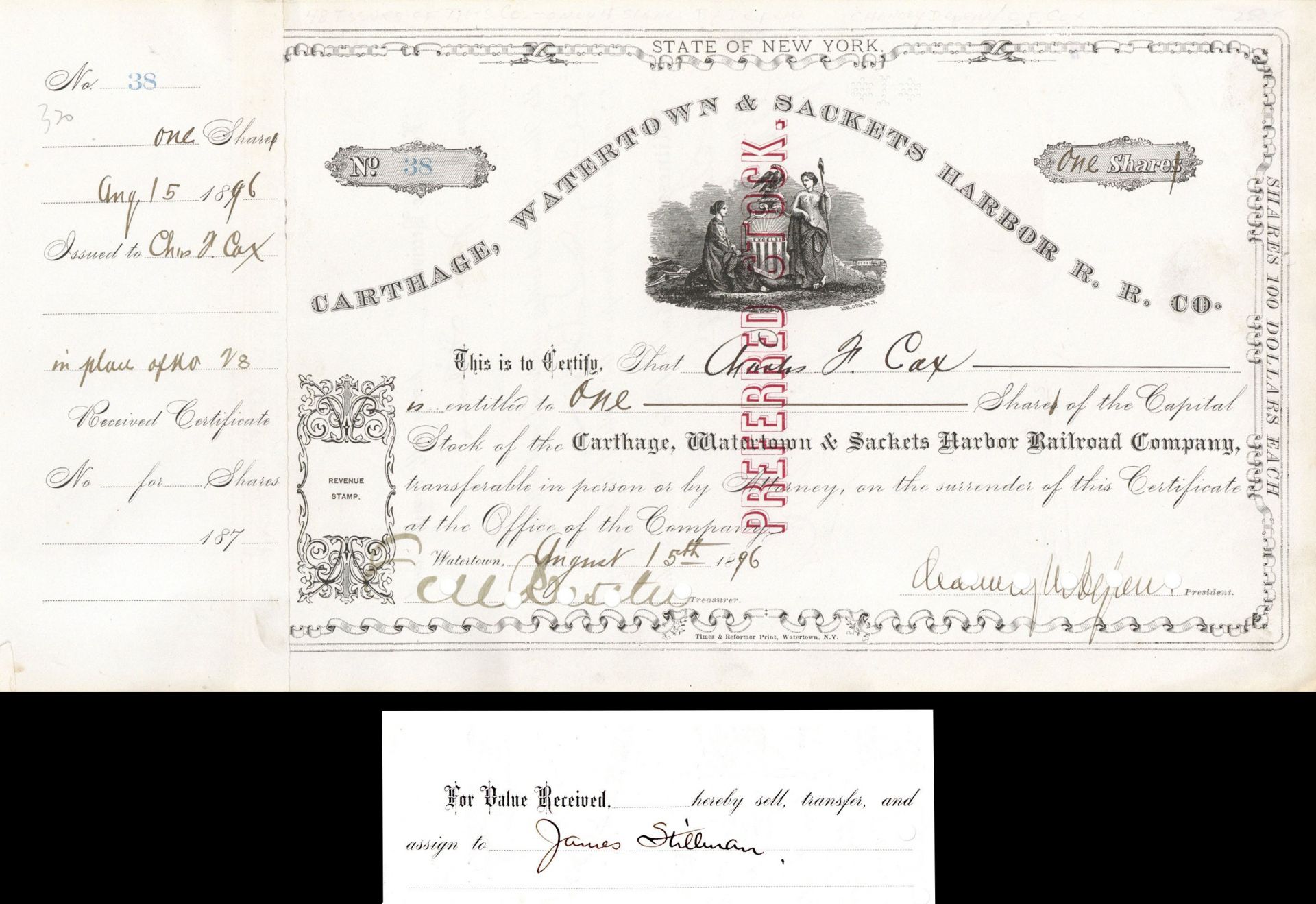
Stock signed by Chauncey M. Depew as president and transferred to James Stillman on the back.

Chauncey Mitchell Depew (April 23, 1834 – April 5, 1928) was a prominent American lawyer, businessman, and Republican politician who lived from 1834 to 1928. A graduate of Yale College, he entered politics early in his career, serving in the New York State Assembly before becoming New York's Secretary of State. However, Depew declined President Andrew Johnson's appointment to serve as the first U.S. Minister to Japan in 1866, opting instead to pursue a career as a railroad lawyer for Cornelius Vanderbilt. His work within the Vanderbilt railroad system led to him serving as president of the New York Central Railroad from 1885 to 1898, after which he became chairman of the company's board of directors until his death.
Alongside his successful business career, Depew was a widely celebrated public speaker and orator known for his wit and engaging after-dinner speeches. He delivered major addresses, including at the unveiling of the Statue of Liberty in 1886 and the cornerstone laying for Grant's Tomb in 1892. Later in life, he returned to politics, serving two terms as a U.S. Senator from New York between 1899 and 1911. During this period, his political career became marred by controversy following accusations that he was serving the interests of railroad and insurance companies, though his prolific public speaking and colorful anecdotes ensured his fame and recognition continued for many years. Upon his death in 1928, a concourse at Grand Central Terminal was draped in mourning in his honor, and his legacy is also preserved in the names of Depew, New York, and Depew, Oklahoma.

James Jewett Stillman (June 9, 1850 – March 15, 1918) was an American businessman who invested in land, banking, and railroads in New York, Texas, and Mexico. He was chairman of the board of directors of the National City Bank. He forged alliances with the Rockefeller family, Standard Oil and Kuhn, Loeb & Co. to lay a foundation that made it, arguably, "the greatest bank in the Western Hemisphere." He engaged in an expansion policy that made National City the largest bank in the United States by 1894, the first to open foreign branches, and a leader in foreign exchange. By 1902, the bank was able to pay any sum of money to any city in the world within 24 hours. He was worth approximately $77 million at the time of his death, making him one of the wealthiest people in the country at the time.
Stillman was born on June 9, 1850 to Charles Stillman (1810–1875) and Elizabeth Pamela Goodrich in Brownsville, Texas, a town founded by his father. Both of his parents were born in Wethersfield, Connecticut. Charles Stillman had significant business interests which James acquired in 1872. He expanded those to control of sixteen Texas banks and a significant land holdings in the Rio Grande Valley, particularly Corpus Christi and Kerrville, Texas. Along with Edward Henry Harriman, Jacob Henry Schiff and William Rockefeller, he controlled the most important Texas railroads (including the Texas and Pacific Railway, the Southern Pacific Railroad, the International-Great Northern Railroad, the Union Pacific Southern Railway, the St. Louis, Brownsville and Mexico Railway, and the Mexican National Railroad). In 1876, Stillman supported Porfirio Díaz's overthrow of the government of Mexico by the Revolution of Tuxtepec. He was chairman of the board of directors of the National City Bank and retired in 1908. He died on March 15, 1918 at his home on 9 East 72nd Street in Manhattan, New York. His funeral was at St. Bartholomew's Episcopal Church, New York.




Ebay ID: labarre_galleries