


Baltimore and Ohio Rail Road Co. signed by Thomas Swann - Stock Certificate
Inv# AG2610 Stock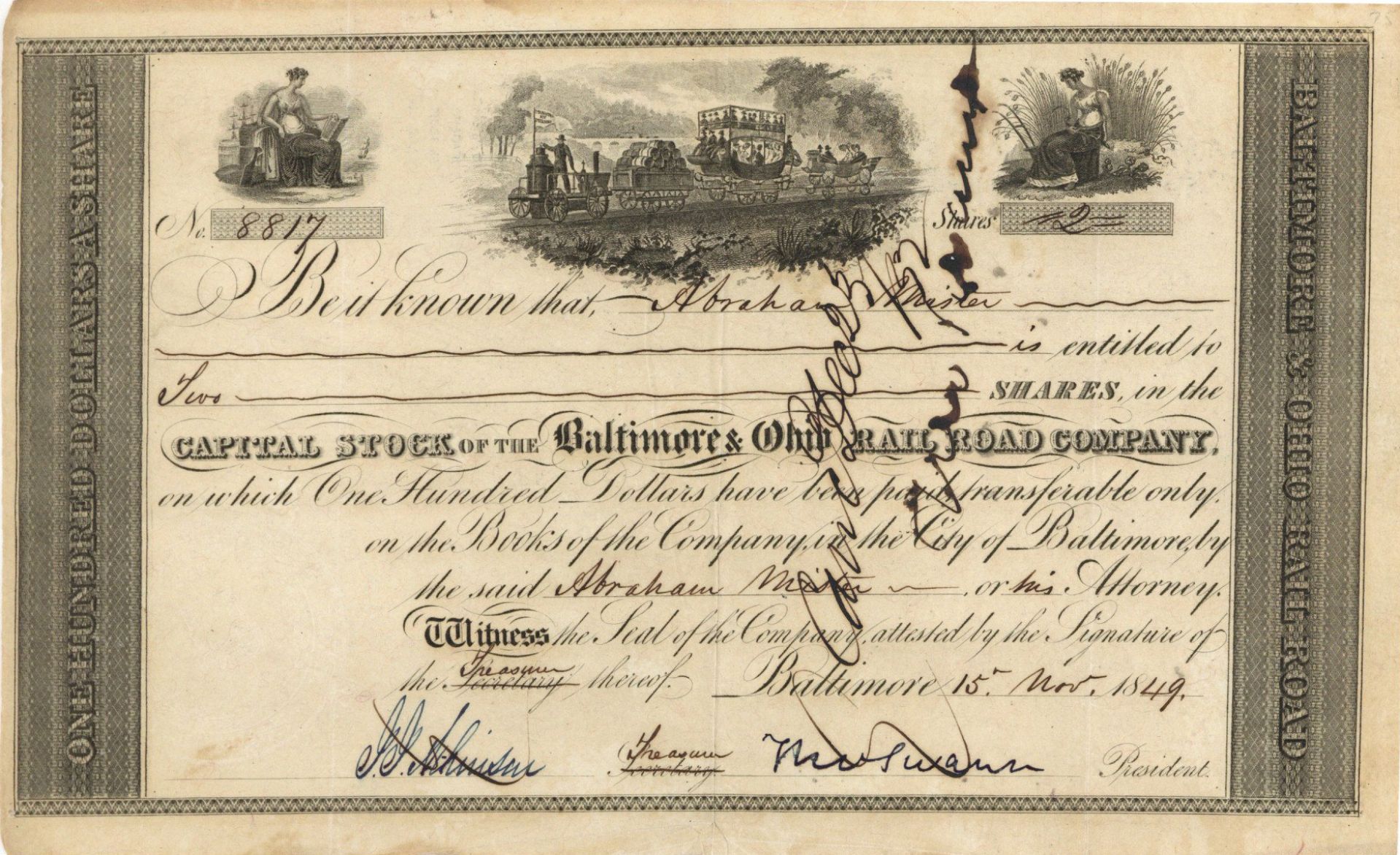
Ohio
Stock signed by Thomas Swann as president.

Thomas Swann, born on February 3, 1809, in Alexandria, Virginia, was an American lawyer and politician. He played a significant role in the Baltimore and Ohio Railroad’s expansion, completing track to Wheeling and gaining access to the Ohio River Valley. Initially a Know-Nothing, Swann later transitioned to becoming a Democrat.
Swann’s political career spanned various positions. He served as the 19th Mayor of Baltimore from 1856 to 1860. Later, he became the 33rd Governor of Maryland from 1866 to 1869. Additionally, he represented Maryland’s 3rd and 4th congressional districts as a U.S. Representative (“Congressman”) from 1869 to 1879, primarily focusing on the Baltimore area.
Swann’s father, also named Thomas Swann, was a lawyer and served in the Virginia House of Delegates. He had political connections to prominent figures like William Wirt and held the position of United States Attorney for the District of Columbia during Swann’s childhood. Tragically, two of Swann’s brothers passed away between 1825 and 1829. However, his elder brother, Wilson Cary Swann (1806-1876), received an education alongside Swann and later became a renowned physician, philanthropist, and social reformer in Philadelphia.
The Swann brothers attended Columbian College (now George Washington University) in Washington, D.C., and later the University of Virginia in Charlottesville. Thomas Jr. studied Ancient and modern languages and mathematics, but faced disciplinary action for disorderly conduct in 1825 and was questioned in a gambling scandal the following year. This may have prompted him to enroll in a class in moral philosophy from the renowned Virginia lawyer George Tucker. Additionally, he studied law under his father’s guidance.
In 1833, as a Democrat, Swann secured an appointment from President Andrew Jackson as secretary of the United States Commission to Naples (Kingdom of the Two Sicilies, later Italy). He was also admitted to the Virginia bar and, following his father’s career path, won election to the Alexandria City Council in 1833.
In 1834, Swann married an heiress and relocated to Baltimore, Maryland, where his father’s lawyer friend, William Wirt, had settled. Swann later became a railroad lawyer in Baltimore. His bride’s British-born father, John Sherlock, left a substantial estate that included interests in French and Neopolitan spoliation claims, 6,000 acres of Pennsylvania land, 150 ounces of silver plate, 300 bottles of madeira, and stock in the Bank of the United States, three Baltimore banks, two turnpikes, a canal in York, Pennsylvania, and the Baltimore and Ohio Railroad (which had been incorporated in 1827 and completed track to Harper’s Ferry by 1834). His wife’s uncle, Robert Gilmor, helped them enter Baltimore society. However, Swann’s father faced financial difficulties after the Panic of 1836. Consequently, young Thomas inherited 600 to 700 acres of land and the Morven Park plantation home from his father. He noted that his father’s nemesis, Nicholas Biddle, had also been forced to sell property to his sons after the panic. In 1840, Swann’s father passed away, and Thomas inherited Morven Park, sixty slaves, and his father’s law library. Over the next few years, he gradually purchased the remaining land that had belonged to his father. Meanwhile, Swann and his family resided on Franklin Street in Baltimore. They used his late father’s Virginia property, Morven Park, as their summer retreat.
Swann returned to Alexandria after his father’s passing in 1840 and continued his career as a railroad lawyer. Between 1837 and 1843, he served as the assistant to Louis McLane, a seasoned politician who held the position of railroad president. In 1844, Swann assumed the role of Alexandria’s tobacco inspector, a crucial responsibility in that port city with significant railroad connections to Richmond and Baltimore, via a separate station.
From 1846 to 1847, Swann acted as the B&O’s lobbyist in Richmond. The railroad’s franchise, secured in 1827, was expiring, and its extension through western Virginia faced opposition from powerful political interests affiliated with the James River and Kanawha Canal Company. Swann successfully secured the extension on March 6, 1847, leading to the commencement of railroad construction to Wheeling. By October 1848, Swann’s substantial stockholdings and services to the B&O propelled him to the position of director. Upon McLane’s retirement, Swann succeeded him as the railroad’s president.
By 1850, Swann had raised funds in Europe to facilitate the B&O’s extension to the Ohio River. He held this position until his resignation in 1853. Subsequently, he was appointed as the president of the Northwestern Virginia Railroad.
A stock certificate is issued by businesses, usually companies. A stock is part of the permanent finance of a business. Normally, they are never repaid, and the investor can recover his/her money only by selling to another investor. Most stocks, or also called shares, earn dividends, at the business's discretion, depending on how well it has traded. A stockholder or shareholder is a part-owner of the business that issued the stock certificates.




Ebay ID: labarre_galleries