


Bank of the United States of America signed by Nicholas Biddle - 1829 dated Autograph Stock Certificate
Inv# AG2509 Autograph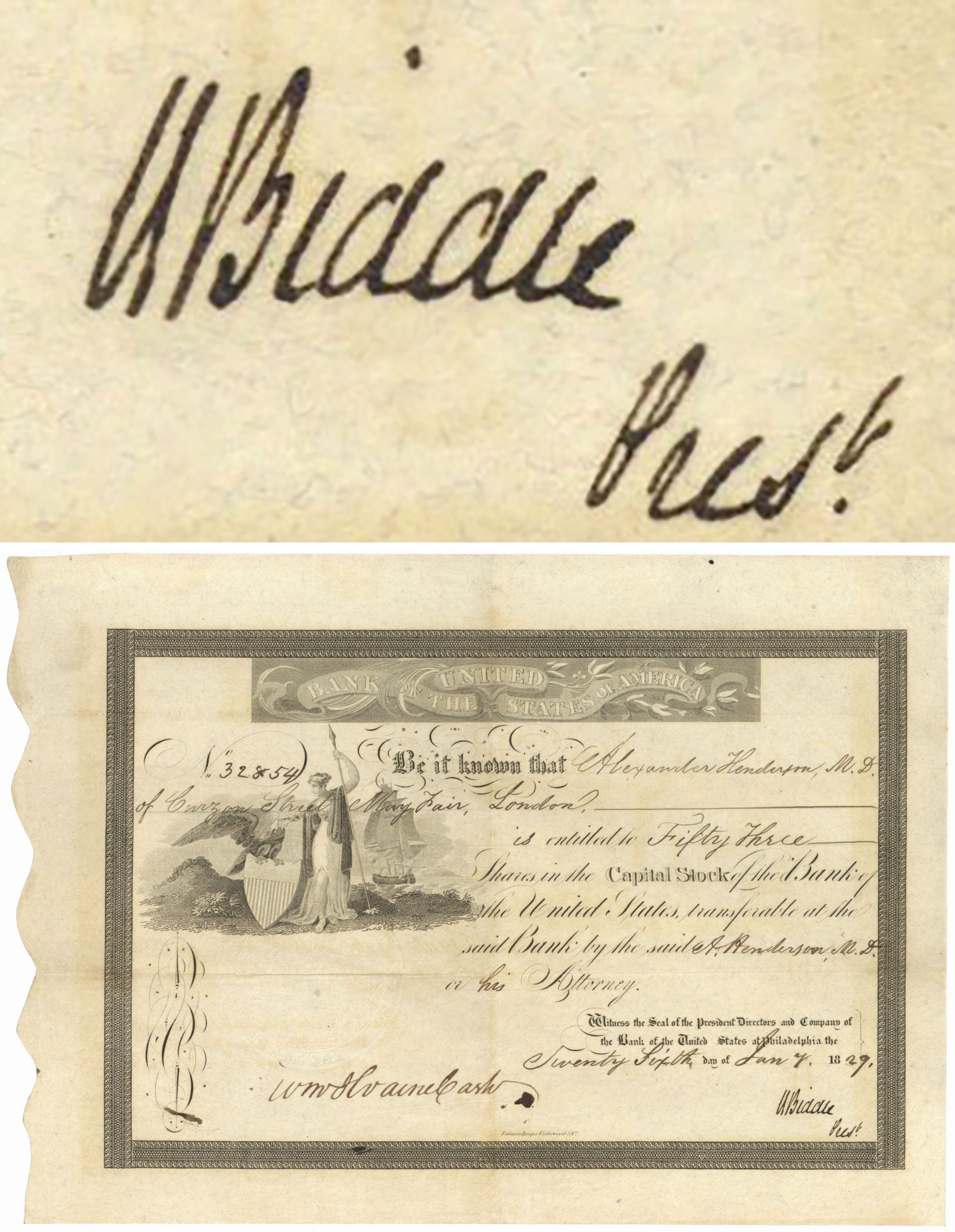
Early stock for the Bank of the United States signed by Nicholas Biddle. Rare! Measures 11.75" wide x 7.5" tall.
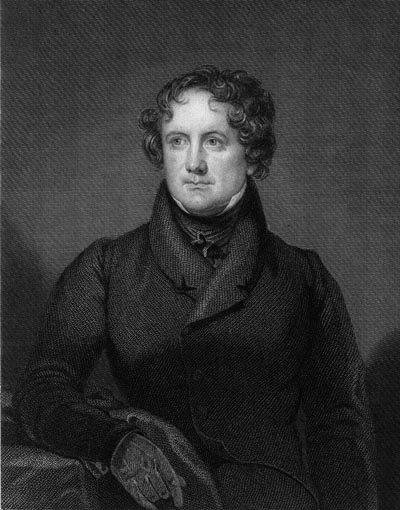
Nicholas Biddle (January 8, 1786 – February 27, 1844), a prominent 19th-century American financier and politician, served as the third and final president of the Second Bank of the United States. A child prodigy who graduated from Princeton at the tender age of 15, Biddle brought an intellectual and sophisticated approach to American finance. Under his leadership, the Bank acted as an early version of a central bank, stabilizing the national currency and regulating the credit issued by smaller state banks. Biddle was a staunch advocate for a strong federal role in the economy, believing that a centralized financial institution was crucial for the young nation’s industrial growth and stability.
However, Biddle is most famously remembered for his high-stakes confrontation with President Andrew Jackson, known as the Bank War. Jackson viewed the Bank as an unconstitutional monopoly that favored the urban elite at the expense of the “common man.” When Biddle, encouraged by political allies like Henry Clay, applied for an early recharter of the Bank in 1832, Jackson responded with a stinging veto. The ensuing political battle was fierce. Biddle restricted credit to trigger a minor economic downturn in an attempt to prove the Bank’s necessity, but the move backfired and alienated the public. Ultimately, the Bank’s charter expired in 1836, leading to Biddle’s retirement from public life and a period of significant volatility in the American banking system.
Chartered in 1816, the Second Bank of the United States was established after the War of 1812 to restore order to a chaotic national currency and manage the federal government’s fiscal responsibilities. Like its predecessor, it was a private corporation with public duties, holding a twenty-year charter. However, its early years were plagued by mismanagement and economic instability, culminating in the Panic of 1819. During this period, the bank was widely blamed for fueling land speculation and then abruptly tightening credit, leading to widespread foreclosures and deep resentment among citizens in the South and West, who perceived it as an elitist “monster.”
The bank’s trajectory took a significant turn in 1823 when Nicholas Biddle became its president. An intellectual and sophisticated financier, Biddle transformed the institution into a powerful tool for national economic stability. Under his leadership, the bank effectively regulated the money supply by forcing state banks to redeem their paper notes for gold or silver, curbing inflation and establishing a uniform national currency. However, Biddle’s aggressive defense of the bank’s autonomy ultimately led to a legendary political showdown with Andrew Jackson. This “Bank War” would ultimately shape the institution’s legacy, as Jackson’s populism clashed with Biddle’s vision of centralized financial control.




Ebay ID: labarre_galleries