


Gouverneur and Oswegatchie Railroad Co. Signed by Chauncey M. Depew - 1892 and 1893 dated Autographed Stock Certificate
Inv# AG2303A Autograph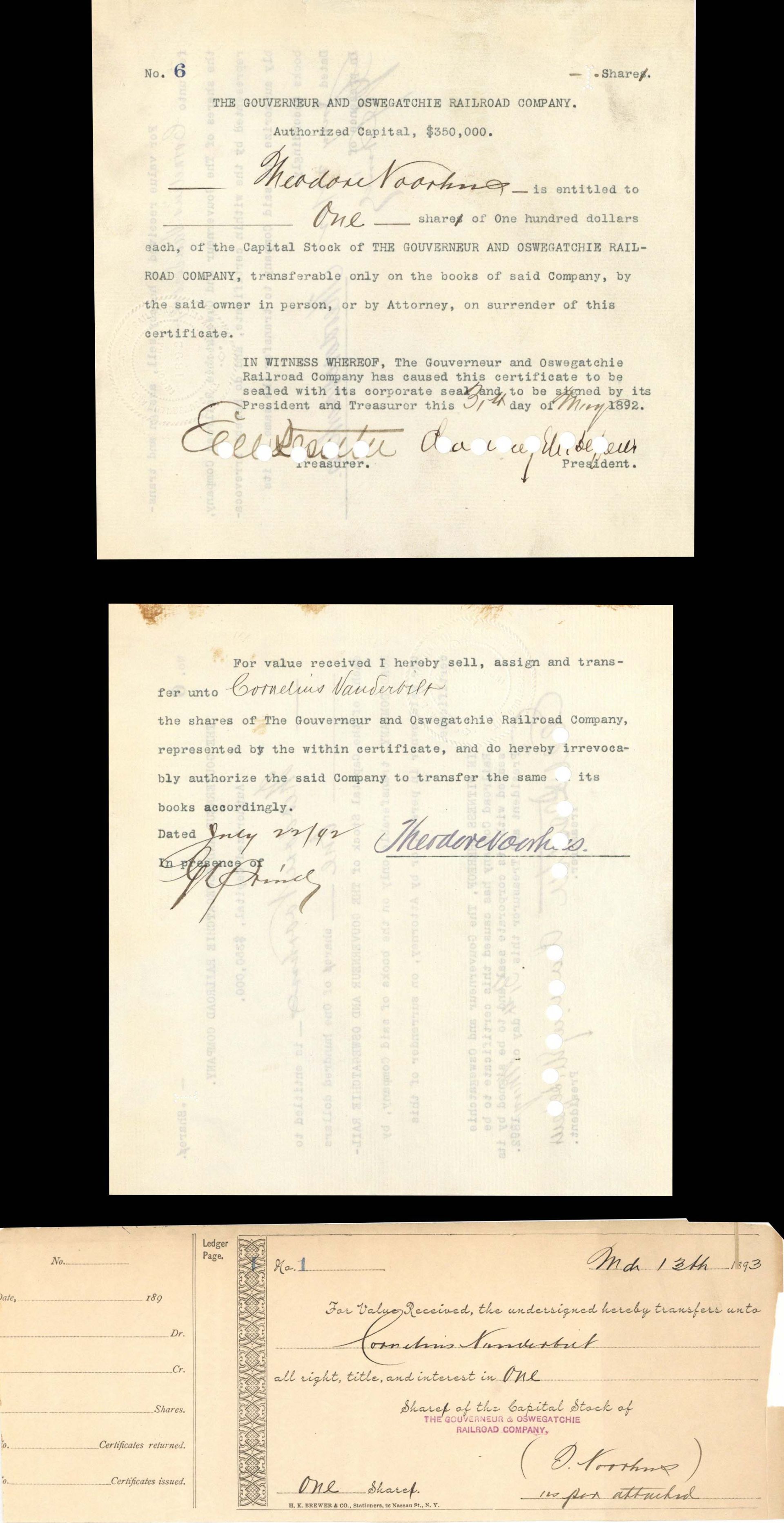
Stock signed by Chauncey M. Depew and E.V.W. Rossiter. Unattached transfer issued to Cornelius Vanderbilt.
Gouverneur, a town nestled in St. Lawrence County, New York, boasts a population of 7,085 as per the 2010 census. The town’s name pays homage to the esteemed statesman and landowner, Gouverneur Morris. The Town of Gouverneur encompasses a charming village named Gouverneur. Situated near the southwestern border of St. Lawrence County, Gouverneur is conveniently located southwest of Canton, the county seat. The region’s history can be traced back to around 1805, when the first settlers arrived. In 1810, the Town of Gouverneur was established from a portion of the Town of Oswegatchie, which was previously known as the “Town of Cambria.” In 1850, the community of Gouverneur decided to break away from the town and incorporated as a village. Throughout its history, the town’s economy has been influenced by various industries. Mining marble, talc, and zinc played a significant role in shaping Gouverneur’s economic landscape. In 1989, the United States Post Office, a historic landmark, was recognized and listed on the National Register of Historic Places, further adding to the town’s charm and significance.
Chauncey Mitchell Depew, born on April 23, 1834, and passing away on April 5, 1928, was an American attorney, businessman, and Republican politician. He is best known for his two terms as a United States Senator from New York and his significant contributions to Cornelius Vanderbilt’s business endeavors.
In 1866, Depew joined the legal team of the New York & Harlem Railroad, owned by Cornelius Vanderbilt. Three years later, he took on the same position for Vanderbilt’s New York Central and Hudson River Railroad. His expertise and dedication earned him recognition, and in 1876, he was appointed as the general counsel and director of the entire “Vanderbilt System.”
Depew’s involvement extended beyond legal matters. In 1882, he joined the executive board of the New York Central & Hudson River Railroad and was later appointed as its second vice president. In 1885, he was elected as the railroad’s president and served in that capacity until 1898 when he was succeeded by Samuel R. Callaway.
After leaving the railroad industry, Depew continued his contributions to business. He became the chairman of the board of directors of the New York Central Railroad Company until his passing in 1928. While primarily active in the Vanderbilt railroads, Depew held concurrent positions with numerous other railroads and companies. He served as the president of the West Shore Railroad and was a member of the boards of directors for the New York and Harlem Railroad, the Chicago and North Western Railway, the Chicago, St. Paul, Minneapolis and Omaha Railway, the Cleveland, Cincinnati, Chicago and St. Louis Railroad, the Delaware and Hudson Railroad, the New Jersey Junction Railroad, the St. Lawrence and Adirondack Railroad, the Wallkill Valley Railroad, and the Canada Southern Railroad, the New Jersey Junction Railroad, the St. Lawrence and Adirondack Railroad, the Wallkill Valley Railroad, and the Canada Southern Railroad.

Edward Van Wyck Rossiter, born in 1844 and passing away in 1910, held various positions in the railroad industry. From 1860 to 1867, Rossiter served as a clerk in the President’s office for the Hudson River Railroad. Subsequently, from 1867 to 1877, Rossiter worked as a cashier for the New York & Harlem Railroad. In 1883, Rossiter became the treasurer of the same company. Later, in November 1900, Rossiter was appointed as the Vice President of the New York Central and Hudson River Railroad, as well as the New York & Harlem Railroad. Additionally, Rossiter held the position of Vice President for almost all the lines affiliated with the New York Central Company, including the Lincoln National Bank and the Lincoln Safe Deposit Company.

Cornelius Vanderbilt II, born in 1843 and passing away in 1899, was a prominent financier and the third generation head of the esteemed House of Vanderbilt. He inherited a substantial fortune from his grandfather, Cornelius Vanderbilt, receiving $5 million, and from his father, William Henry Vanderbilt, inheriting nearly $70 million. In turn, he succeeded them as the head of the New York Central and related railroad lines in 1885.
Despite his reputation as a workaholic, a stroke in 1896 compelled him to reduce his active business involvement. However, he continued to play an advisory role in the numerous properties in which he and his family had invested. Regarded as a capable and conservative railroad manager, he was also an exceptional accountant, having mastered the intricacies of the banking system during his association with the Shoe and Leather Bank of New York.
Between 1885 and his untimely death in 1899, the stock of the leading railroads, which were then synonymous with the Vanderbilt name, experienced a remarkable growth in value, increasing to $173,497,000. Cornelius, who found no pleasure in yachting or the Turf, sought satisfaction in philanthropy, fine music, exquisite paintings, and architectural marvels.
Cornelius Vanderbilt II married Alice Claypoole Gwynne (1852-1934). Their eldest son, William Henry Vanderbilt II (1870-1892), tragically passed away while a junior at Yale University. In memory of his son, Cornelius endowed a substantial dormitory at Yale. However, he disinherited his second son, Cornelius Vanderbilt III (1873-1942), for marrying without his approval. Alfred Gwynne Vanderbilt (1877-1915), their third son, met his demise while the RMS Lusitania sank. Cornelius Vanderbilt II’s remaining son was Reginald Claypoole Vanderbilt. His daughters, Gertrude Vanderbilt Whitney and Countess Gladys Vanderbilt Széchenyi, were also notable figures.
The opulent Fifth Avenue mansions that Cornelius Vanderbilt II, his brothers, and his sons resided in have been demolished. Nevertheless, The Breakers, the Newport, Rhode Island vacation home he constructed, stands as a testament to the lifestyle of Cornelius Vanderbilt II. Upon Cornelius Vanderbilt II’s passing, family leadership was passed down to his brother, William Kissam Vanderbilt. Cornelius Vanderbilt II’s philanthropic efforts were so significant that he chose not to increase the wealth he had bequeathed to his heirs.




Ebay ID: labarre_galleries