

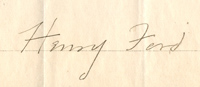
Ford Motor Co. of Canada, Limited signed by Henry Ford - 1908 dated Autograph Stock Certificate
Inv# AG1747 Stock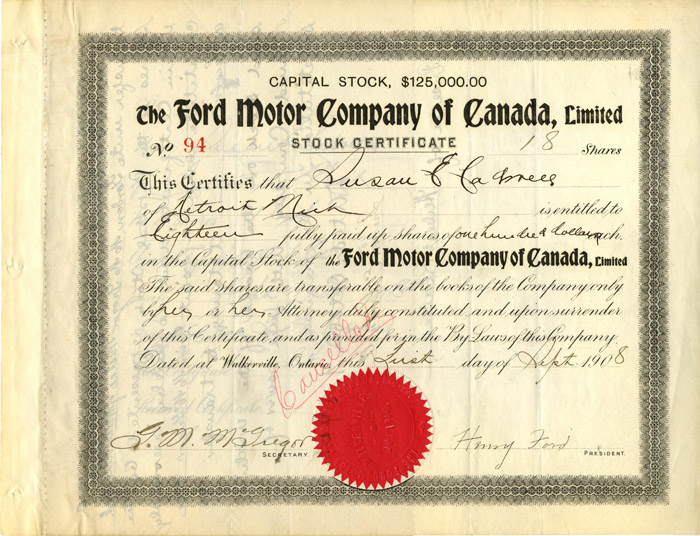
Stock signed by Henry Ford as president. Very Rare!
Henry Ford (July 30, 1863 – April 7, 1947) was an American industrialist, the founder of the Ford Motor Company, and sponsor of the development of the assembly line technique of mass production. Although Ford did not invent the automobile or the assembly line, he developed and manufactured the first automobile that many middle class Americans could afford. In doing so, Ford converted the automobile from an expensive curiosity into a practical conveyance that would profoundly impact the landscape of the twentieth century. His introduction of the Model T automobile revolutionized transportation and American industry. As owner of the Ford Motor Company, he became one of the richest and best-known people in the world. He is credited with "Fordism": mass production of inexpensive goods coupled with high wages for workers. Ford had a global vision, with consumerism as the key to peace. His intense commitment to systematically lowering costs resulted in many technical and business innovations, including a franchise system that put dealerships throughout most of North America and in major cities on six continents. Ford left most of his vast wealth to the Ford Foundation and arranged for his family to control the company permanently.
Ford was also widely known for his pacifism during the first years of World War I, and also for being the publisher of antisemitic texts such as the book The International Jew. Ford was devastated when his mother died in 1876. His father expected him to eventually take over the family farm, but he despised farm work. He later wrote, "I never had any particular love for the farm—it was the mother on the farm I loved." In 1879, Ford left home to work as an apprentice machinist in Detroit, first with James F. Flower & Bros., and later with the Detroit Dry Dock Co. In 1882, he returned to Dearborn to work on the family farm, where he became adept at operating the Westinghouse portable steam engine. He was later hired by Westinghouse to service their steam engines. During this period Ford also studied bookkeeping at Goldsmith, Bryant & Stratton Business College in Detroit. In 1891, Ford became an engineer with the Edison Illuminating Company. After his promotion to Chief Engineer in 1893, he had enough time and money to devote attention to his personal experiments on gasoline engines. These experiments culminated in 1896 with the completion of a self-propelled vehicle which he named the Ford Quadricycle. He test-drove it on June 4.
After various test drives, Ford brainstormed ways to improve the Quadricycle. Also in 1896, Ford attended a meeting of Edison executives, where he was introduced to Thomas Edison. Edison approved of Ford's automobile experimentation. Encouraged by Edison, Ford designed and built a second vehicle, completing it in 1898. Backed by the capital of Detroit lumber baron William H. Murphy, Ford resigned from the Edison Company and founded the Detroit Automobile Company on August 5, 1899. However, the automobiles produced were of a lower quality and higher price than Ford wanted. Ultimately, the company was not successful and was dissolved in January 1901. With the help of C. Harold Wills, Ford designed, built, and successfully raced a 26-horsepower automobile in October 1901. With this success, Murphy and other stockholders in the Detroit Automobile Company formed the Henry Ford Company on November 30, 1901, with Ford as chief engineer. In 1902, Murphy brought in Henry M. Leland as a consultant; Ford, in response, left the company bearing his name. With Ford gone, Murphy renamed the company the Cadillac Automobile Company.

The Ford Motor Company of Canada was established on August 17, 1904, just a year after Henry Ford founded the parent company in Detroit. Seeking to expand into the British Empire while avoiding high import tariffs, Henry Ford partnered with Gordon McGregor, the head of the Walkerville Wagon Works in Windsor, Ontario. This strategic move granted the Canadian branch exclusive rights to manufacture and sell Ford vehicles across the British Commonwealth (excluding the UK). Operations began in a modest converted wagon factory, where a handful of employees assembled the first Canadian-built Fords by ferrying parts across the Detroit River via ferry.
Throughout the mid-20th century, Ford of Canada became an industrial powerhouse and a cornerstone of the Canadian economy. The company played a vital role during World War II, pivoting its production lines to produce hundreds of thousands of military vehicles for Allied forces. In 1965, the signing of the Canada-United States Automotive Products Agreement (Auto Pact) revolutionized the business, allowing for a more integrated North American market and leading to the expansion of major facilities like the Oakville Assembly Plant. Today, while the manufacturing landscape has shifted toward electric vehicle innovation, Ford remains Canada’s longest-standing automotive manufacturer, maintaining a deep-rooted legacy in the nation’s labor and transportation history.
A stock certificate is issued by businesses, usually companies. A stock is part of the permanent finance of a business. Normally, they are never repaid, and the investor can recover his/her money only by selling to another investor. Most stocks, or also called shares, earn dividends, at the business's discretion, depending on how well it has traded. A stockholder or shareholder is a part-owner of the business that issued the stock certificates.




Ebay ID: labarre_galleries