


International Mercantile Marine Issued to Yale University - 1929 dated $1,000 Shipping Bond - Company that Made the Titanic
Inv# AG1778 Bond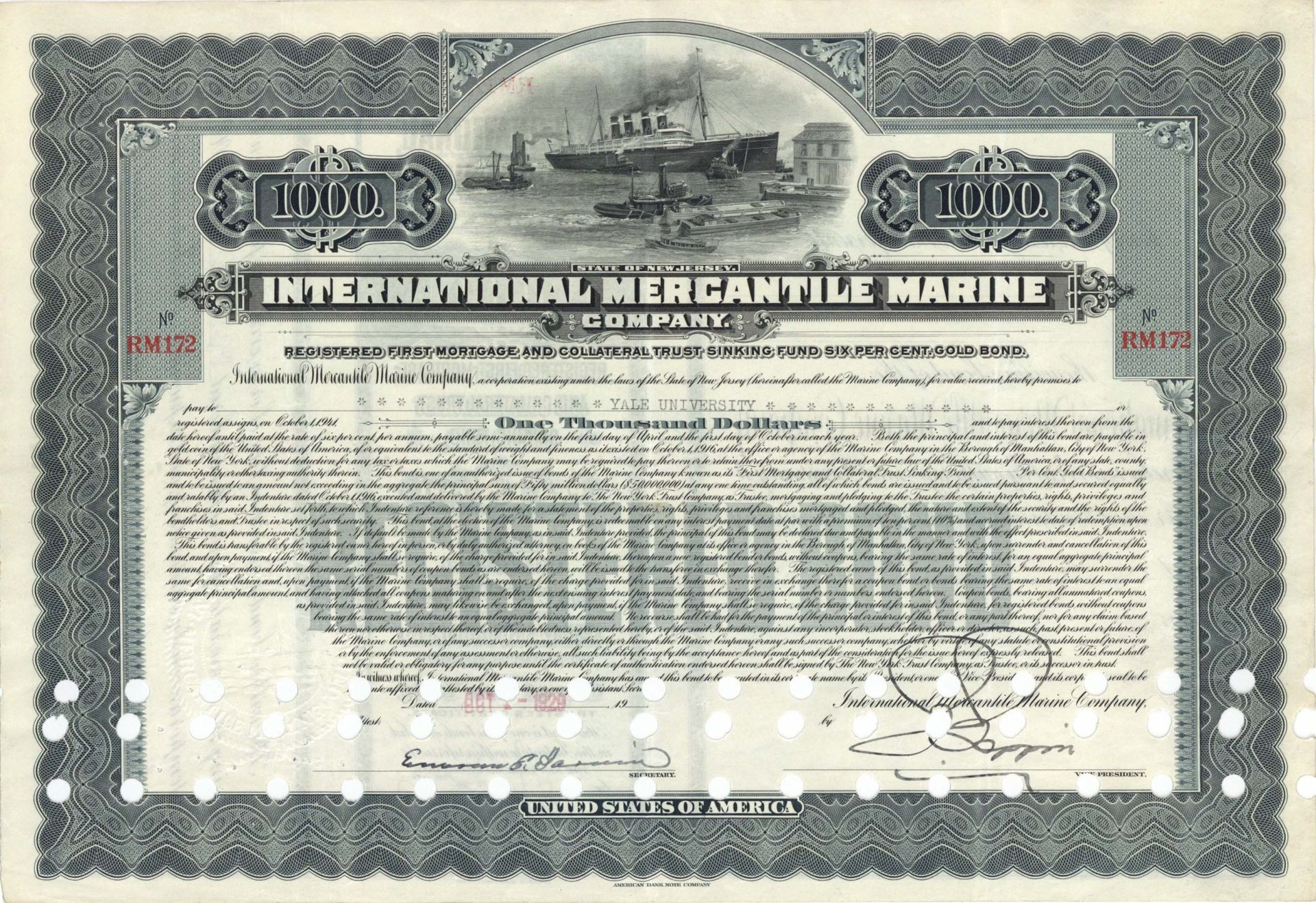
$1,000 6% Gold Bond printed by American Bank Note Company and Issued to Yale University. Dated same month as stock market crash.
Yale University, established in 1701 in New Haven, Connecticut, holds the distinction of being the third-oldest institution of higher education in the United States. As a member of the esteemed Ivy League, Yale has a rich history spanning over three centuries. Initially founded as the Collegiate School, it was established by colonial clergymen to provide students with an education in the tradition of European liberal arts. In 1718, the school underwent a transformative change and was renamed Yale College in honor of Elihu Yale, a prominent Welsh merchant and benefactor who made a substantial donation to the institution.
Over the years, Yale has undergone a remarkable evolution, shifting its initial focus on theology to become a global research university. Today, it is dedicated to expanding and disseminating knowledge across a diverse range of disciplines, including the humanities, sciences, social sciences, and professional fields.
One of Yale’s most distinctive features is its residential college system, established in the 1930s. This system aims to foster stronger student-faculty relationships and create smaller, more intimate communities within the larger university. The collegiate gothic-style buildings, many designed by the renowned architect James Gamble Rogers, contribute to the university’s distinctive aesthetic, characterized by their enclosed courtyards and intricate details.
Yale’s alumni are a veritable who’s who of accomplished individuals who have made significant contributions in various fields. From politics and law to business, the arts, and sciences, Yale alumni have left an indelible mark on society. Notably, five U.S. presidents have graced the halls of Yale, further solidifying its reputation as a prestigious institution.
Today, Yale remains committed to its mission of training future leaders, conducting groundbreaking research, and engaging with its hometown and the wider world. The university continues to inspire and empower individuals, shaping the course of history and advancing knowledge in countless ways.
The International Mercantile Marine Company (IMM), a prominent U.S. shipping conglomerate founded in 1902 by J.P. Morgan, controlled several key transatlantic shipping lines. Morgan’s ambitious goal was to monopolize the North Atlantic shipping trade by acquiring major American and British steamship companies, including the American Line, the Red Star Line, and most notably, the British-based White Star Line. Despite operating the largest American-owned merchant fleet in the world for several decades, IMM’s strategy proved flawed. American antitrust legislation, the complexities of the shipping business, and an agreement with the British government limited Morgan’s attempt at a total monopoly.
The company’s history is intrinsically linked to the tragic fate of one of its most renowned vessels, the RMS Titanic, owned by IMM’s subsidiary, the White Star Line. The sinking of the Titanic in 1912 marked a turning point for the company and the golden age of ocean liners. Combined with severe overleveraging, IMM defaulted on bond payments in 1914 and entered a “friendly” receivership in 1915. Despite reorganization and survival during World War I, the company underwent a series of sales and mergers in the 1920s and 1930s, eventually emerging as United States Lines in 1943. The story of IMM serves as a poignant reminder of the risks and challenges associated with large-scale consolidation in the early 20th-century maritime industry.
A bond is a document of title for a loan. Bonds are issued, not only by businesses, but also by national, state or city governments, or other public bodies, or sometimes by individuals. Bonds are a loan to the company or other body. They are normally repayable within a stated period of time. Bonds earn interest at a fixed rate, which must usually be paid by the undertaking regardless of its financial results. A bondholder is a creditor of the undertaking.




Ebay ID: labarre_galleries