

Philadelphia and West Chester Traction Co. - 1895 dated Railway Stock Certificate - Popular Pennsylvania Railroad
Inv# RS2709 Stock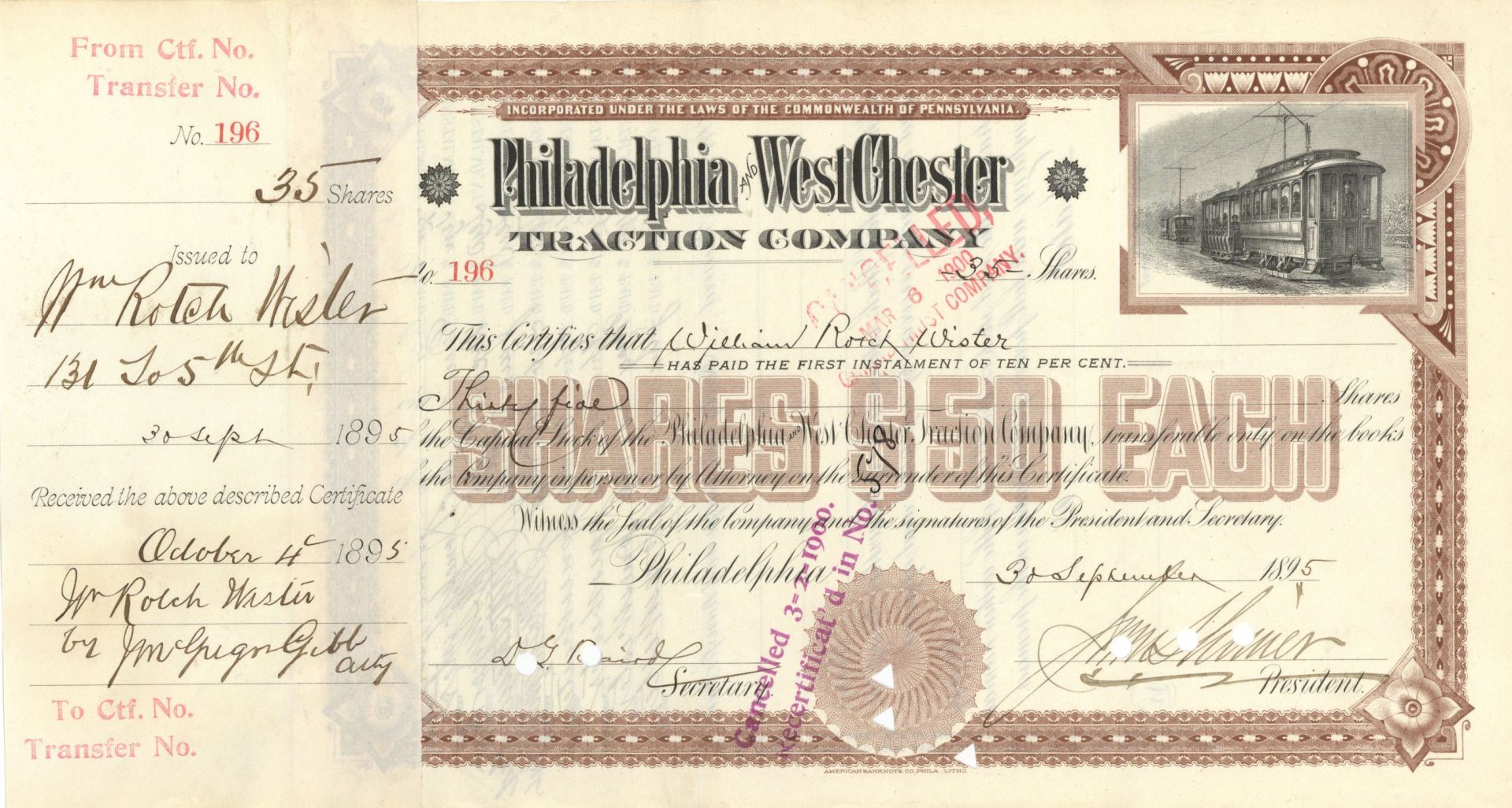
Stock printed by American Bank Note Co., Phila., Litho. Stub at left border. Abraham Merritt Taylor is the patron saint of this site. He was a visionary and if his ambitious plans had been executed, Philadelphia would be a very different place. A. Merritt Taylor was named Philadelphia’s first director of City Transit in 1912. While serving as director he produced a series of plans for rapid transit in Philadelphia that are collectively referred to as the Taylor Plans. In addition to the Market Street Subway and Elevated which had opened in 1907, Taylor advocated the immediate construction of the Frankford Elevated, the Broad Street Subway with spurs to to the Northeast and Germantown, the Darby Elevated, a subway under the Parkway and elevated to Roxborough.
In his 1913 report, Taylor lays out his future plans for Philadelphia’s Rapid Transit. In addition to the rail lines that he had previously urged be built, he added lines on Girard and Allegheny Avenue, an elevated to Southwest Philadelphia, a second elevated to the Northeast and conversion of the Pennsylvania Railroad’s Chestnut Hill line to rapid transit. He also proposed a Chestnut Street tunnel connecting Philadelphia to Camden.Taylor also advocated a single 5¢ fare for all of the rapid transit systems and free transfer to surface trolleys. Taylor was the director of City Transit for four years and under his leadership, work began on the Frankford Elevated and Broad Street Subway. When Thomas B. Smith was elected mayor in 1916, he replaced Taylor with William S. Twinning. Twinning, who was on Taylor’s staff, favored a more conservative approach to rapid transit construction. Twinning recommended only building lines where there was already demand, while Taylor saw transit as a stimulant of growth. Even after Taylor was replaced, he remained an advocate for Philadelphia’s rapid transit plans. Working with the Mayor Smith to further rapid transit in the city and to help resolve issues between the city and Philadelphia Rapid Transit, the privately run monopoly that was to run the new lines.
With World War I on the horizon, Taylor went to Washington D.C. to become the Emergency Fleet Corporation and Shipping Board’s head of passenger transit, ensuring workers could get to-and-from shipyards around the country. After the war ended, Taylor returned to private business as president of the Philadelphia and West Chester Traction Company and Springfield Real Estate Company. The real estate company developed residential development along the trolley company’s railways in Delaware County. Taylor retired in 1932, handing the company to his son, Merritt H. Taylor who grew P&WCTC into the Philadelphia Suburban Transit Company, known for its Red Arrow Lines. If Taylor’s plans were followed through, we would live in a very different Philadelphia today. Philadelphia & West Chester Traction Company?President?1899 to 1902, 1919 to 1932 • Elected president at age 24. • Expanded trolley service from 8 miles of track to 50 miles of track by purchasing the Philadelphia and Garrettford Street Railway and the Ardmore & Llanerch Street Railway companies. • Purchased new equipment for company. • Implemented modern operation methods. • Formed Eureka Light, Heat & Power Company in 1901 to sell surplus electricity to homeowners. After years in public service, returned to P&WC in 1919. • Added bus service to trolley lines via Aronimink Transportation Company in 1923. Read more at https://en.wikipedia.org/wiki/List_of_Pennsylvania_railroads
A stock certificate is issued by businesses, usually companies. A stock is part of the permanent finance of a business. Normally, they are never repaid, and the investor can recover his/her money only by selling to another investor. Most stocks, or also called shares, earn dividends, at the business's discretion, depending on how well it has traded. A stockholder or shareholder is a part-owner of the business that issued the stock certificates.




Ebay ID: labarre_galleries