

Northern New York Railroad Co. issued to and signed by George Foster Peabody - 1897 dated Autograph Railway Stock Certificate
Inv# AG3027 Autograph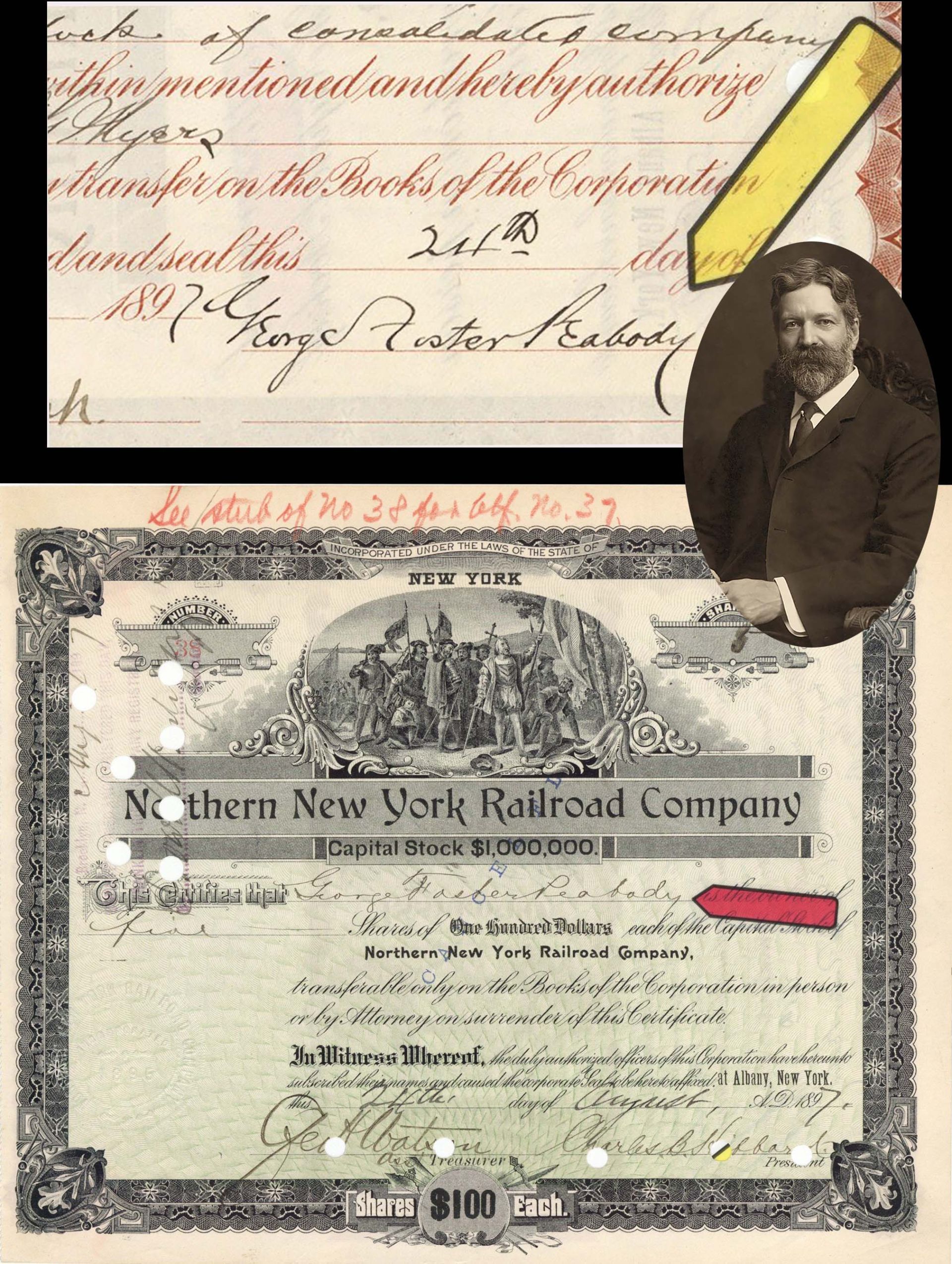
Railroad Stock issued to and signed on back by George Foster Peabody. Only 1 found.

George Foster Peabody (July 27, 1852 – March 4, 1938) was an American banker and philanthropist. In the evenings Peabody read extensively at the library of the Brooklyn YMCA, which he later called his "alma mater". He also took part in the activities of the Reformed Church in Brooklyn Heights, where he met and became good friends with young investment banker Spencer Trask. On May 2, 1881, Peabody became a partner in the new firm of Spencer Trask & Company. During the 1880s and 1890s this investment house took a leading part in financing electric lighting corporations, beet sugar and other industrial enterprises, and railroad construction in the western United States and Mexico. Peabody himself handled most of the firm's railroad investments, working in close association with William J. Palmer. He also became a director in numerous corporations. Peabody, his brother Charles Jones Peabody and Spencer Trask amassed a great portion of their wealth from the Edison Electric Company. Trask served as president of Edison Electric Illuminating, and when J. P. Morgan—protégé of New England businessman/philanthropist George Peabody—financier of Edison Electric, merged all into the General Electric Company in 1892, George Foster Peabody became a member of the GE board of directors. Peabody had investments in Mexico, particularly in railways, along with many other U.S. financiers in the late nineteenth century. He was director of the Mexican National Railroad; and had holdings in Yucatán, where he was involved in commercial henequen exports, a natural twine used for binding wheat; was a director of the Intercontinental Rubber Company, founded by Bernard Baruch; and provided capital for mining enterprises. Peabody retired from business in 1906 to pursue a life of public service. Long interested in social causes, he supported such progressive ideas as the single tax as advocated by Henry George in his book Progress and Poverty, free trade, women's suffrage and government ownership of railroads. He was active in the anti-war movement and also interested in education, particularly in the South and particularly for African-Americans. He was a co-founder, director and treasurer of the General Education Board, the Southern Education Board, and the Anna T. Jeanes Foundation. He also served on the board of trustees for the American Church Institute for Negroes, Hampton University in Virginia, Tuskegee University in Alabama, the University of Georgia, and the Brooklyn Polytechnic Institute. He was secretary of the Southern Education Board. From early in his life Peabody was interested in Democratic Party politics. In the early 1880s, he helped his close friend Edward M. Shepard organize the Young Men's Democratic Club of Brooklyn, took a part in the 1892 presidential campaign on behalf of Grover Cleveland, supported the Gold Democrats against William Jennings Bryan in 1896, then switched to more moderate monetary reform as a member of the executive committee of the Indianapolis Monetary Convention in 1897. In 1904–1906, he served as treasurer of the Democratic National Committee.[5][6] Although he declined to run for political office, and declined President Wilson's offer of a place on the Federal Trade Commission, Peabody was an unofficial counselor to many government officials. From 1914 to 1921 he served on the board of directors of the Federal Reserve Bank in New York. In June 1932, Franklin Delano Roosevelt, then Governor of New York, visited Peabody for advice and support in deciding to run for President of the United States.
This railroad operated from 1862 to 1904 and then became part of the Illinois Central Railroad. The Illinois Central Railroad (reporting mark IC), sometimes called the Main Line of Mid-America, was a railroad in the Central United States, with its primary routes connecting Chicago, Illinois, with New Orleans, Louisiana, and Mobile, Alabama, and thus, the Great Lakes to the Gulf of Mexico. A line also connected Chicago west to Sioux City, Iowa (1870). There was a significant branch to Omaha, Nebraska (1899), west of Fort Dodge, Iowa, and another branch reaching Sioux Falls, South Dakota (1877), starting from Cherokee, Iowa. The IC also serviced Miami, Florida, on trackage owned by other railroads.




Ebay ID: labarre_galleries