


San Francisco and San Joaquin Valley Railway Co. issued to and signed by Claus Spreckels - 1896 dated Autographed Stock Certificate
Inv# AG1874D Autograph
Stock issued to Claus Spreckels and signed by A.B. Spreckels on back for him. Portrait and biography included.
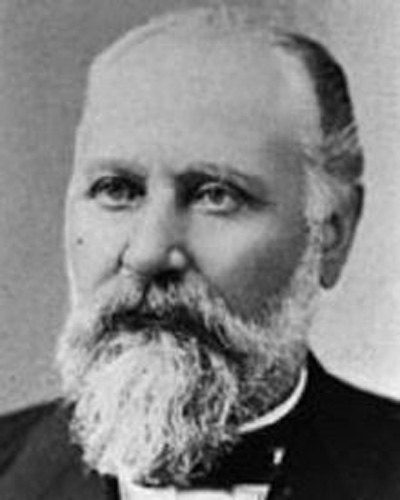
Claus Spreckels, formally Adolph Claus J. Spreckels (July 9, 1828 – December 26, 1908) was a major industrialist in Hawai' during the kingdom, republican and territorial periods of the islands' history.
Spreckels was born in Lamstedt, Hanover, now a city of Germany. In 1846, he left his homeland to start a new life in the United States. In 1852 he married his childhood sweetheart, Anna Christina Mangels, who had immigrated to New York City with her brother 3 years earlier. They had t13 children, five of whom lived to maturity. The family first settled in South Carolina, where Spreckels opened a grocery store business. Within a short time they moved to New York City, then in 1856 relocated to San Francisco, where Spreckels began a brewery. Spreckels entered the sugar business in the mid-1860s and came to dominate the Hawaiian sugar trade on the West Coast. His first refinery, built in 1867, was at Eighth and Brannan Streets in San Francisco, but by the late 1870s the Brannan Street facilities were running at capacity, so Spreckels chose a site in Potrero Point to open a larger sugar refinery with water access. He called his concerns the California Sugar Refinery.
Spreckels used some of his wealth in 1874 to purchase a large tract of ranch and timber land in Aptos, California. He built a large resort hotel and, not far away, an extensive ranch complex. Spreckels was one of the original investors in the Santa Cruz Railroad, which began operation in 1875 and passed through his land on its run between Santa Cruz and Watsonville. The narrow-gauge line was later acquired and standard-gauged by the Southern Pacific Railroad, now part of the Union Pacific Railroad. It was on the Aptos ranch that Spreckels began to experiment with growing sugar beets. In 1888, Spreckels established the Western Beet Sugar Company in Watsonville, which was at that time the largest beet sugar factory in the U.S. By 1890, Spreckels main growing operations had shifted to the Salinas Valley, so he built the 42-mile narrow gauge Pajaro Valley Consolidated Railroad to ship his sugar beets from the fields near Salinas to Watsonville. In 1899, Spreckels opened an even larger factory closer to the main sugar beet fields. He named the new factory Spreckels Sugar Company. A company town grew up around the plant, and still exists as Spreckels, California. The town and the sugar factory were important in the early life of novelist John Steinbeck, and several scenes from his novels take place there. In the 1890s, Spreckels helped found the national sugar trust and renamed his San Francisco property the Western Sugar Refinery and continued to increase his control over the Hawaiian sugar trade. This control over the industry was irksome to Hawaiian planters not directly affiliated with Spreckels and his associates. At the end of the 1890s, they attempted to break free. In 1905, the planters established a cooperative refinery in Crockett, California, the California and Hawaiian Sugar Company (C&H). The Spreckels dominance in sugar was broken, but the Western Sugar Refinery continued operation in San Francisco until 1951. While in Hawaii, he purchased the Pacific Commercial Advertiser in 1880 and became a publisher. This paper later became known as the Honolulu Advertiser and, prior to its demise in 2010, was one of the largest newspapers in circulation in the United States. Spreckels' conservative, pro-monarchy slant caused him to fall from favor in the business community, and he eventually sold the newspaper. Claus Spreckels also lent his assistance to William Matson when he first founded Matson Navigation Company. Spreckels financed many of Matson's new ships including Matson’s first ship called Emma Claudina named for Spreckels’ daughter. Spreckels was the President of the San Francisco and San Joaquin Valley Railway from 1895 until it was sold to the Santa Fe Railway in 1901. The railroad built a line that competed with the Southern Pacific through the San Joaquin Valley between Richmond and Bakersfield. The railroad was welcome competition for shippers who were strangled by Southern Pacific's monopoly on shipping rates in the valley. Today this route is BNSF's main route to Northern California. On July 9, 1893 Spreckels found a death threat graffitied on his house. He went into self-exile from Hawaii July 19 on the Australia vowing to “return to see grass growing in the streets of Honolulu.” Despite his vow he returned to Hawaii for one last time in 1905.
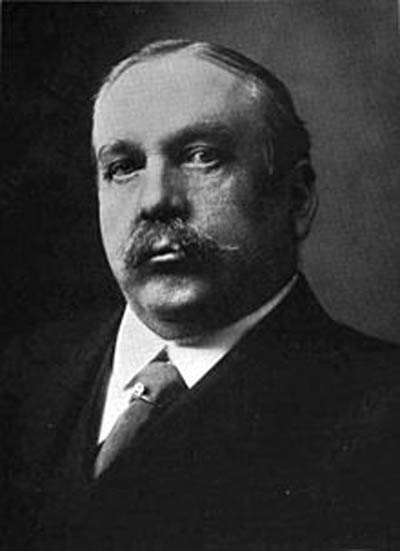
Adolph Bernard Spreckels (January 5, 1857 – June 28, 1924) was a California businessman who ran Spreckels Sugar Company and who donated the California Palace of the Legion of Honor art museum to the city of San Francisco in 1924. His wife Alma was called the "great grandmother of San Francisco". His 55-room mansion, built in 1913 in Pacific Heights is the current home of novelist Danielle Steel. Spreckels was born in San Francisco, California. His parents were Anna Christina Mangels and Claus Spreckels, founder of the Spreckels Sugar Company. At the age of 12, Adolph studied abroad in Hanover, Germany for two years, returning to San Francisco to finish his studies. When the company was founded in 1881, he was named a vice-president. Spreckels succeeded his father as company president upon the latter's death in 1908. He was intensely loyal to both his father and his brother John. In 1884, he shot Michael H. de Young, co-founder of the San Francisco Chronicle, supposedly because of an article in that newspaper suggesting his sugar company defrauded its shareholders. Spreckels pleaded temporary insanity to the charge of attempted murder and was acquitted. The California Palace of the Legion of Honor was championed by his wife Alma and paid for from the Spreckels fortune. It was merged with the M. H. de Young Memorial Museum in 1972 to become the Fine Arts Museums of San Francisco. Besides the sugar company, Spreckels was president of the San Francisco and San Mateo Electric Railway, vice-president of both the Western Sugar Company and the Oceanic Steamship Company, as well as a director of the Sunset Monarch Company. In addition to his business enterprises, Spreckels served as a San Francisco Park Commissioner and was heavily involved in the development of Golden Gate Park. Spreckels Lake, in the park, is named after him. Spreckels Organ Pavilion in San Diego's Balboa Park, housing the largest outdoor pipe organ in the world, was also built by Spreckels and his brother John. Furthermore, his brother John commissioned Spreckels Organ in honor of Adolph, who died before it was completed.




Ebay ID: labarre_galleries