

Cincinnati, Wabash and Michigan Railway Co. signed by Jeptha Homer Wade - 1880 dated Autograph Railroad Stock Certificate
Inv# AG2647 Stock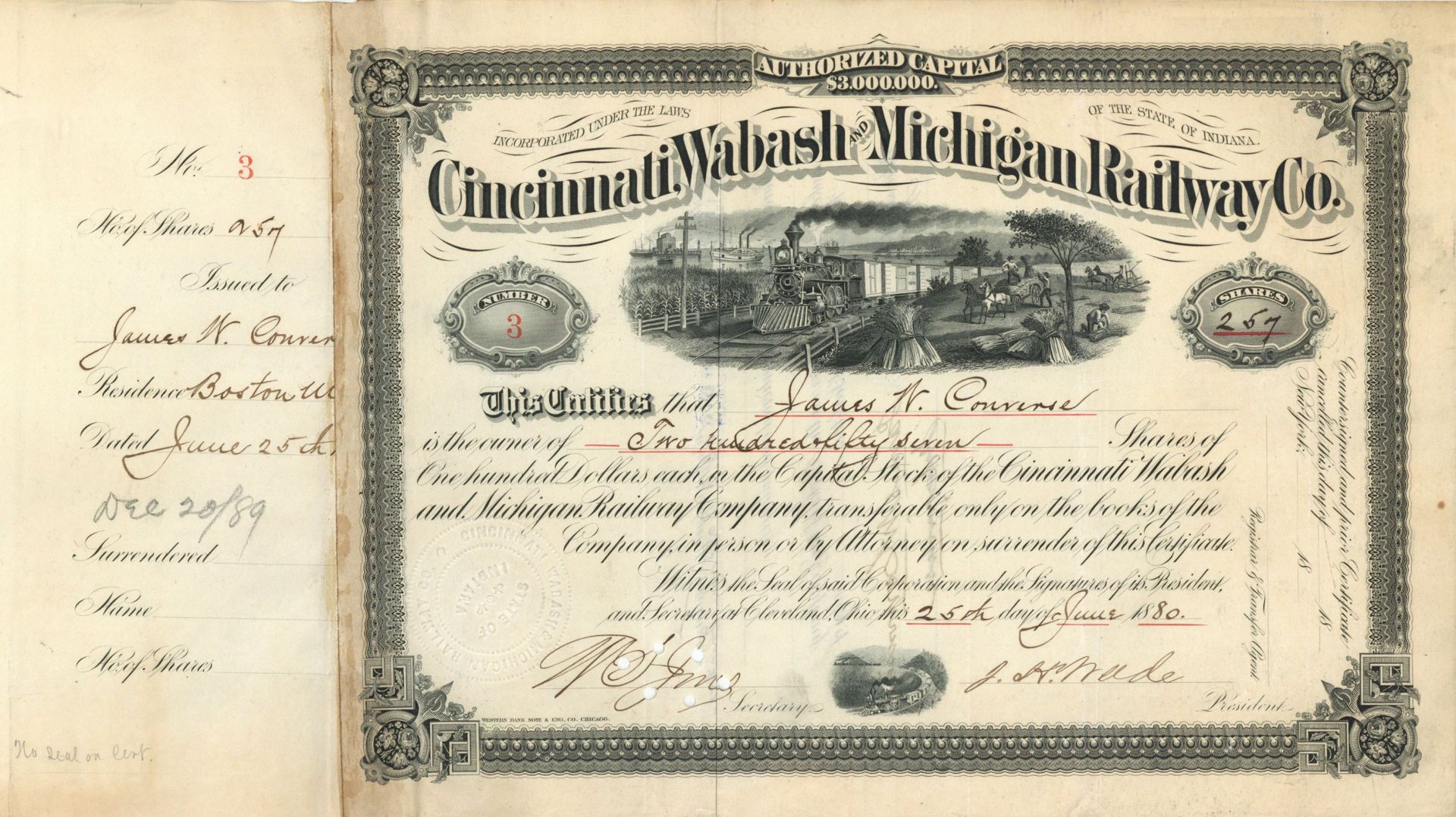
Stock printed by Western Bank Note & Eng. Co., Chicago signed by Jeptha Homer Wade.
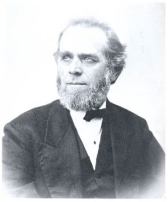
Jeptha Homer Wade (1811–1890) was a prominent American industrialist and a key figure in the global telecommunications industry. Born in Romulus, New York, Wade initially pursued diverse trades, including carpentry, tanning, and portrait painting. However, his fascination with the telegraph’s emergence led him to embark on a career in telecommunications. In 1847, he set out to construct telegraph lines across the Midwest, eventually inventing the “Wade insulator” to enhance transmission reliability. His strategic vision resulted in the consolidation of several telegraph companies in 1856, forming the Western Union Telegraph Company. Wade held the positions of first general manager and later president from 1866 to 1867. Notably, he played a crucial role in completing the first transcontinental telegraph line in 1861 through the Pacific Telegraph Company, effectively connecting the eastern and western United States.
Beyond his industrial accomplishments, Wade left a lasting philanthropic legacy in Cleveland, Ohio, where he relocated in 1856. Utilizing his substantial wealth, he actively contributed to the city’s cultural and educational development. One of his most significant contributions was the donation of 75 acres of land in 1882 to establish Wade Park. Today, Wade Park serves as the centerpiece of the Cleveland Museum of Art and the Cleveland Museum of Natural History. Additionally, Wade was a co-founder of the Case School of Applied Science (now part of Case Western Reserve University) and held the inaugural position as the president of the Lake View Cemetery Association. Wade’s diverse interests extended beyond telecommunications, encompassing banking and railroads. He served as the president of the National Bank of Commerce and oversaw eight railroad companies. Tragically, Wade passed away in 1890, leaving behind a legacy of public service and a transformed American communication landscape.
The Cincinnati, Wabash & Michigan Railway Co., formed on June 30, 1871, through the merger of the Grand Rapids, Wabash & Cincinnati Railroad and the Warsaw, Goshen and White Pigeon Railroad, played a pivotal role in connecting communities in Indiana and Michigan during the late 19th century. By the end of 1882, the company had built a line that stretched from Anderson, Indiana, to Benton Harbor, Michigan. Known colloquially as the “Elkhart Line,” the railway provided a vital transportation link for both passengers and freight, contributing to the economic growth of towns like Wabash and Goshen.
However, the railway’s independent operation was short-lived. In July 1890, control was acquired by the Lake Shore & Michigan Southern Railway, and by June 30, 1892, it was controlled by the Cleveland, Cincinnati, Chicago and St. Louis Railway (CCC&St.L), commonly known as the “Big Four.” The line was formally merged into the Big Four system on June 16, 1915, and its infrastructure was later incorporated into the larger New York Central Railroad system in 1906. Over the decades, portions of the original Cincinnati, Wabash & Michigan line were abandoned, with some segments eventually becoming part of the government-sponsored Conrail in 1976 and later incorporated into today’s Norfolk Southern Railway network.
A stock certificate is issued by businesses, usually companies. A stock is part of the permanent finance of a business. Normally, they are never repaid, and the investor can recover his/her money only by selling to another investor. Most stocks, or also called shares, earn dividends, at the business's discretion, depending on how well it has traded. A stockholder or shareholder is a part-owner of the business that issued the stock certificates.




Ebay ID: labarre_galleries