


Detroit and Charlevoix Railroad Co. - Estate of David Ward - 1902-12 dated Railway Stock Certificate - Very Important
Inv# RS5250 Stock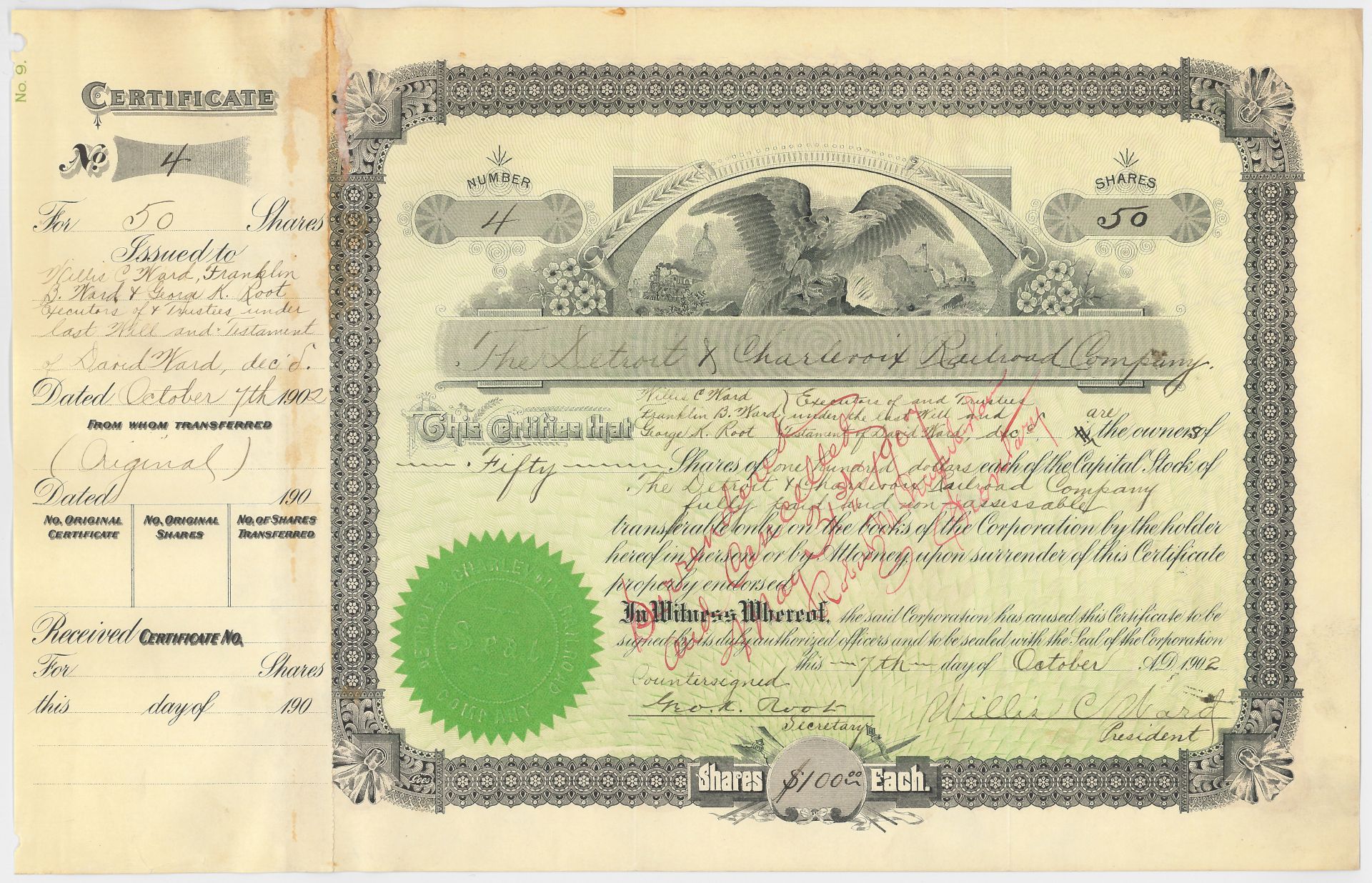
Stock printed by Goes. Rare! The Detroit and Charlevoix Railroad was a defunct railway situated in Northern Lower Michigan. Its purpose was to transport finished lumber from timberlands to the market. The railroad was subsequently acquired by the Michigan Central Railroad. David Ward (who passed away on May 29, 1900) was a landowner with 70,000 acres of timberland in the Northern Michigan counties of Otsego, Crawford, Antrim, Charlevoix, and Kalkaska. He required an economical means to access his timber holdings and ship the harvested timber to sawmills in Bay City, Michigan. In 1893, Ward initiated the construction of the Frederic & Charlevoix RR Co., a logging railroad that connected at Frederic, Michigan, with the Michigan Central Railroad Mackinac Division, extending 42.66 miles to East Jordan, Michigan, which was previously known as South Arm on the shores of Lake Charlevoix, formerly referred to as Pine Lake.
In 1897, the final three miles leading into East Jordan were removed for reasons that remain unknown. On May 29, 1900, David Ward passed away, leaving his timberlands to his six children. He stipulated that for 12 years following his death, his son Willis C. Ward, his grandson Franklin B. Ward, and his son-in-law George K. Root would have full authority to manage, harvest, and control the timberland, with profits distributed equally among his surviving six children. After the 12-year period, the entire estate was to be divided equally among the surviving six children. This arrangement created a significant incentive for the Ward executors to engage in extensive clearcutting of the timberlands to capitalize on the timber holdings, as equitably dividing the 70,000 acres among the six children would prove challenging.
The estate executors concluded that transporting 70,000 acres of harvested timber to Bay City was not a viable option. The optimal approach would involve constructing a modern sawmill in proximity to the timber and enhancing the logging railroad to support Class I railroad rolling stock, thereby facilitating the shipment of finished lumber to major markets such as Chicago. On January 1, 1901, the estate executors—Willis C. Ward, Franklin B. Ward, and George K. Root—established a corporation under the general railroad laws of the State of Michigan, named the Detroit & Charlevoix Railroad Company. This company was authorized with a capital stock of $525,000, to which all equipment and right-of-way property from David Ward’s Frederic & Charlevoix RR Co. were transferred. At that time, the railroad operated three steam locomotives equipped with air brakes, 25 Russel Logging Cars, and 29 platform cars rated for 60,000 lbs, also equipped with air brakes, along with two snow plows and two passenger cars.
The executors intended to enhance the line to accommodate interstate railcars, reconstruct the line into East Jordan, Michigan, and extend it to Charlevoix, Michigan, located 13 miles to the northwest. In the winter of 1901, the executors initiated the construction of a 600-horsepower, steam-driven, double-band sawmill plant at a site known as Deward, situated near the headwaters of the Manistee River, 11 miles from Frederic, along the logging railroad, and approximately 30 miles from East Jordan. This sawmill was designed to have an annual capacity of 20 million board feet. Alongside the sawmill, a railroad switch yard, mill pond, tramways, boarding houses, machine shops, barns, offices, a school, a general store, a railroad station, and residential houses were built. The structures were made from milled lumber and tarpaper. By 1912, all 70,000 acres of the Ward estate had been clearcut, leaving no timber available for the sawmill. Consequently, the sawmill was dismantled and sold, leading to the town of Deward's gradual return to nature.
On May 1, 1907, the Michigan Central Railroad acquired all the capital stock of the Detroit & Charlevoix Railroad. On September 27, 1912, the Detroit & Charlevoix Railroad was integrated into the Michigan Central. The acquisition was valued at $518,735.86, and an operating loss of $5,428.91 was reported for the year 1916. The name of the Detroit & Charlevoix Railroad was eliminated, and the line became known as the East Jordan Branch. By 1930, the Michigan Central Railroad ceased operations on the East Jordan Branch, and in 1933, the line was officially abandoned.
A stock certificate is issued by businesses, usually companies. A stock is part of the permanent finance of a business. Normally, they are never repaid, and the investor can recover his/her money only by selling to another investor. Most stocks, or also called shares, earn dividends, at the business's discretion, depending on how well it has traded. A stockholder or shareholder is a part-owner of the business that issued the stock certificates.




Ebay ID: labarre_galleries